Settlement Proposed for Oil Spill Discharges in the San Francisco Bay Estuary
Submitted by ryan.v.smith on
 An official website of the United States government. Here's how you know we're official.
A .gov website belongs to an official government organization in the United States.
A small lock or https:// means you’ve safely connected to a .gov website. Share sensitive information only on official, secure websites.
Submitted by ryan.v.smith on
Submitted by ryan.v.smith on
Submitted by ryan.v.smith on
Submitted by ryan.v.smith on
Submitted by ryan.v.smith on
Submitted by ryan.v.smith on
The latest ERMA dashboard update introduces several new features designed to improve user experience and data accessibility. A photo carousel now offers a visually engaging way to browse images, while tab cards provide an organized, at-a-glance view of key data points. Button placements within ERMA have been updated for a more intuitive layout, and users now have added abilities to display percentage values alongside raw data and apply new sort options to streamline data analysis.
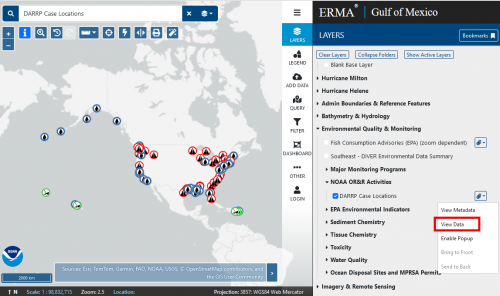
Users can also now export data directly from the View Data table, making data sharing and analysis more accessible than ever before. To find the View Data option, find a layer, hover over, and right click on the layer. Users can also find this option by clicking on the vertical ellipsis.
From the View Data table, users can apply additional filters before data export. In the upper right-hand corner is a menu where the Export Layer Data option lives. Accessing this option prompts terms of use that must be agreed upon before proceeding, as well as the different formats data can be exported in.


Submitted by ryan.v.smith on
The latest versions, CAMEO Data Manager 4.4.0 and Tier2 Submit 2024, were released on November 4, 2024. These versions have many enhancements, including:
Both programs are part of the CAMEO® software suite, a set of tools to help emergency planners and responders with hazardous chemical releases. Annually, the suite has over eight million page views online and more than 500,000 downloads of the desktop and mobile app programs.
The CAMEO software suite has been jointly developed by the NOAA Office of Response and Restoration and the EPA Office of Emergency Management for more than 35 years. Programs within the suite are vital components of many emergency responder and planner toolkits. All of the programs in the suite are available to users at no cost. For more details and to subscribe to future updates, see the official CAMEO Data Manager and Tier2 Submit release announcement.


Submitted by ryan.v.smith on
Submitted by ryan.v.smith on
OCT. 18, 2024 — On August 21, the Greek-flagged oil product tanker Sounion caught fire and was abandoned after being attacked by the Houthis in the southwest Red Sea. The tanker was reported to be carrying 140,000 metric tons (roughly 42 million gallons) of crude oil.
On August 23, the U.S. Coast Guard, which oversees marine pollution response, contacted NOAA’s Office of Response and Restoration (OR&R) to request expertise and scientific support for a potential oil spill response to the Sounion. OR&R worked quickly to identify environmental resources at risk in the event of a release of oil and provided a hypothetical oil spill fate and effects analysis based on seasonal weather and oceanographic trends. Additionally, NOAA’s National Environmental Satellite, Data, and Information Service (NESDIS) provided satellite imagery and analysis. Information provided by OR&R was used by the National Response Team to brief federal officials working on the incident.
After several weeks of negotiations and planning, the Sounion was successfully towed to a safer location for repairs. The fires onboard the vessel continued to burn during the towing operation. There was international concern that the large volume of crude oil on board (up to four times the amount spilled from the Exxon Valdez) could lead to a severe ecological disaster. At time of publishing, the fires aboard the Sounion were extinguished, with a potential disaster from this vessel averted.
The environmental concern associated with the Sounion was similar to the threat posed by the decaying floating storage and offloading facility Safer off Yemen’s coast in 2020, the response to which NOAA scientists supported. With about one million barrels aboard, Safer threatened an environmental and humanitarian catastrophe by risking pristine reefs, coastal mangroves, and other sea life across the Red Sea; exposing millions of people to pollution; and cutting off food, fuel, and other life-saving supplies.
Earlier in 2024, NOAA scientists from OR&R and National Centers for Coastal Ocean Science also supported the response to the 563-foot bulk carrier M/V Rubymar, which sustained damage from a Houthi missile strike in the Red Sea. NOAA determined the potential effects from an uncontrolled release of the 21,000 metric tons of ammonium phosphate sulfate fertilizer aboard the Rubymar.


Submitted by ryan.v.smith on
Submitted by ryan.v.smith on
Submitted by ryan.v.smith on
Submitted by ryan.v.smith on
Submitted by ryan.v.smith on
Submitted by ryan.v.smith on
Submitted by ryan.v.smith on
Submitted by ryan.v.smith on
