Back to top

$44 Million Natural Resource Damage Settlement to Restore San Francisco Bay After Cosco Busan Oil Spill

Short title: 
Restoring San Francisco Bay After Cosco Busan Oil Spill

SEPTEMBER 21, 2011 -- The infamous fog of San Francisco was thick and gray the morning the Cosco Busan cargo ship crashed into the San Francisco-Oakland Bay Bridge. It was November 7, 2007, and within seconds of the crash, 53,000 gallons of fuel oil were released into the surrounding waters. One of the largest oil spills in the history of San Francisco Bay, it set into motion a series of events that ultimately led to the recent historic $44.4 million settlement [PDF] with the companies responsible for the spill (Regal Stone Limited and Fleet Management Limited).

To the public, this $44.4 million means there will be money for bird, fish, and habitat restoration in the bay. It will enhance shoreline parks and outdoor recreation throughout the Bay Area, helping compensate the public for the lost visits to the beach when oil washed up on the shores. This settlement will resolve all outstanding legal claims for natural resource damages, paying for the damage assessment, remaining cleanup costs, and for restoration of natural resources from the spill. That first morning, we didn't really know how much oil had been spilled—initial reports indicated it was only a small amount. But as the fog lifted, it quickly became apparent that oil was spreading over a large expanse of the bay. For the next several weeks NOAA scientists worked long hours to quickly organize and conduct the field work to evaluate natural resource damages from the Cosco Busan oil spill.

As the thick bunker oil spread on the waters surrounding San Francisco, it turned into tarry patches and balls that eventually stranded along hundreds of miles of shoreline. Much of our understanding about the toxic effects from oil spills comes from studies of crude oil, conducted after the 1989 Exxon Valdez spill. But as we studied the effects of bunker oil on fish and wildlife after the Cosco Busan spill, we discovered bunker oil not only behaves differently than crude oil in the environment, but it appears to have different toxicological effects.

Two to three months after the spill, when the huge annual schools of Pacific herring entered San Francisco Bay to find their shallow spawning grounds, most of the evidence of lingering bunker oil was already gone, either cleaned up or weathered away. But when we collected herring eggs from areas both affected and unaffected by the spill, we made a remarkable discovery: Almost all of the eggs collected from spill locations were dead or deformed. The eggs collected outside of the spill zone were largely normal. This was especially surprising given the lack of significant remaining evidence of bunker oil. We conducted additional studies over two more seasons of herring spawning in the bay and eventually concluded that the toxic characteristics of the bunker oil from the Cosco Busan spill affected as much as a quarter of the herring spawning in 2008. We also concluded that the effects didn't carry over past that first spawning season after the spill.

Our studies, directed by scientists from NOAA's Northwest Fisheries Science Center and the Bodega Marine Laboratory in California, forged new scientific understandings on the effects of oil spills on aquatic resources and will guide further progress on our assessment of present and future spills. Find out more about the natural resource damage settlement by listening to this National Ocean Service podcast and reading the natural resource trustees' press release.
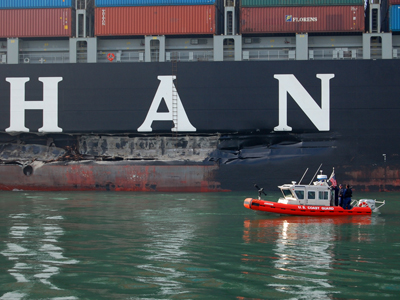
Cosco Busan ship with Coast Guard vessel.
A U.S. Coast Guard boat approaches the gash in the side of the M/V Cosco Busan, which released 53,000 gallons of bunker oil into San Francisco Bay. (U.S. Coast Guard)
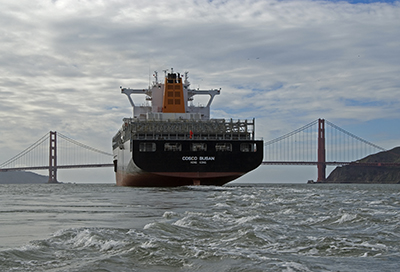
Cosco Busan leaving Bay Area.
The Cosco Busan leaves San Francisco Bay on Dec. 20, 2007, after hitting the Bay Bridge on Nov. 7. (Jonathan R. Cilley, U.S. Coast Guard)
Node Weight: 
3

CAMEO Software Suite

Short title: 
Plan Chemical Spill Response

The programs of the CAMEO software suite are designed to help prepare for and respond to chemical emergencies.

Node Weight: 
1
Site Themes: 

More Information about CAMEO

Two emergency responders in protective clothing walk past a fenced area.
Responders at the scene of a chemical incident. Image credit: U.S. Coast Guard
  • CAMEO Fact Sheet [PDF, 505 KB]: Learn more about basic features of the four core CAMEO suite programs in this CAMEO fact sheet.
  • CAMEO and its Uses: Discover who is using the CAMEO software suite and how they are adapting its programs for applications beyond chemical emergency response and planning.
  • CAMEO News Service: This mailing list provides a way for the CAMEO team (at EPA and NOAA) to communicate important information to the CAMEO community. It is used primarily to send updates when new releases are available for ALOHA, CAMEO Chemicals, CAMEO Data Manager, MARPLOT, and/or Tier2 Submit. The service is hosted by NOAA. Follow this link to subscribe.
  • CAMEO Training: Find CAMEO training opportunities for first responders ad emergency planners.
     

Questions: Contact us with questions, comments, or suggestions about CAMEO.

The CAMEO® (Computer-Aided Management of Emergency Operations) software products have been valuable hazardous materials response and planning tools since the first products were introduced in 1986.

CAMEO Software Suite: Core Programs

The CAMEO software suite consists of four core programs, which can be used together or separately. When they are used together, the programs interact seamlessly and information can be linked easily between them.

  • CAMEO Data Manager: A tool for managing data about chemicals stored or transported in your community, especially data required under the Emergency Planning and Community Right-to-Know Act (EPCRA).
  • CAMEO Chemicals: A program with response recommendations and physical properties for thousands of hazardous chemicals, and it also includes a tool for predicting possible hazards that could occur if chemicals mix. The program is available in several formats, including a CAMEO Chemicals app for iOS and Android.
  • ALOHA®: A hazard model that estimates how a chemical cloud travels in the air after a spill and identifies areas where a threat to people may exist. It also models some types of fires and explosions.
  • MARPLOT®: A mapping tool used for assessing geospatial information for emergency incidents and creating custom maps.

CAMEO Software Suite: Related Software

Additionally, there are several other programs that can be used with the CAMEO software suite.

  • Tier2 Submit™: A program that generates an electronic chemical inventory Tier II facility report, which can be used to automatically update the facility information in CAMEO Data Manager.
  • RMP*Comp™: A tool to help facilities complete the offsite consequence analysis that is required as part of the Risk Management Plan.

Natural Resource Damage Assessment

Short title: 
Identifying Harm to Natural Resources

Learn how scientists work together to identify injuries to natural resources resulting from oil spills and other hazardous releases.

Node Weight: 
2
Photo: Scientist holding oiled turtle.
A NOAA veterinarian prepares to clean an oiled Kemp's Ridley turtle. As part of the NRDA process, NOAA assesses injuries to marine life.

Damage Assessment and Restoration of Public Natural Resources

After an oil spill or hazardous substance release, response agencies such as the U.S. Environmental Protection Agency or the U.S. Coast Guard lead efforts to control and clean up the substance in order to eliminate or reduce risks to human health and the environment.

However, these efforts may not fully restore injured natural resources or address their lost uses by the public. This is the point when a Natural Resource Damage Assessment may become necessary.

Several federal laws charge NOAA and certain other federal agencies, states, and Indian tribes—collectively known as trustees—with evaluating the impacts of oil spills, releases of hazardous substances, and ship groundings on public natural resources. NOAA is a federal trustee for coastal and marine natural resources, including marine and migratory fish, endangered species, marine mammals, and their habitats.

Natural Resource Damage Assessment (NRDA) is the process that NOAA and other trustees use to study the effects of these incidents on fish, wildlife, surrounding habitats, and public use of those resources. Scientists work together to identify the extent of natural resource damage and specify the type and amount of restoration required.

NOAA created the Damage Assessment, Remediation and Restoration Program (DARRP) to carry out the three steps involved in an NRDA:

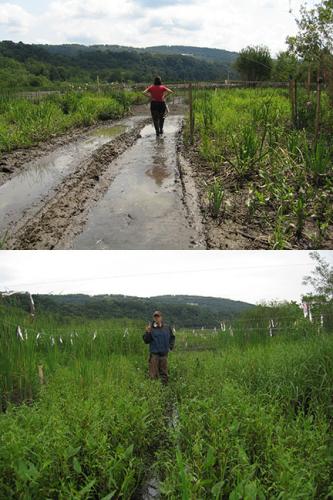
Photo: A before and after picture of a wetland restoration project.
As a result of environmental injuries caused by hazardous release from a battery manufacturing facility, East Foundry Cove Marsh (N.Y.) required replanting. The upper photo from Aug 2, 2010, shows areas before the planting while the lower photo was taken one year after planting emergent plants.

Although the concept of assessing and restoring environmental injuries may sound simple, understanding complex ecosystems, the services these ecosystems provide, and the damage caused by oil and hazardous substances takes time—often years.

The season and location the resource was injured, the type of oil or hazardous substance, and the amount and duration of the release are among the factors that affect environmental assessment and restoration.

Rigorous scientific studies may be necessary to prove injury to resources and natural resource services in a court of law. The responsible party, when working cooperatively with the trustees, may be a key participant in assessing injuries and implementing restoration. The responsible party pays the costs of assessment and restoration.

The NRDA process ensures an objective and cost-effective evaluation of injuries to American natural resources—and that the public's resources are fully restored.

Restoration actions fall into one or more categories, including:

Primary restoration returns the impacted resources to the condition that would have existed if the incident had not occurred.

Compensatory restoration addresses losses from the date of injury until recovery is completed. While the resource is impaired, it is unable to provide services on which other parts of the ecosystem and the public rely (such as fish nursery habitat or recreational use). Restoration projects address the period from injury until recovery.

Emergency restoration includes actions taken prior to the completion of the damage assessment and restoration planning process to prevent or reduce continuing natural resource impacts and prevent potential irreversible loss of natural resources.

Early restoration is a form of compensatory restoration. If the responsible party agrees, it can be implemented prior to the completion of the NRDA process to achieve restoration more quickly.

Environmental Sensitivity Index (ESI) Maps and Data

Short title: 
Map Environmental Sensitivity

Environmental Sensitivity Index (ESI) maps provide a concise summary of coastal resources at risk if an oil spill occurs nearby.

Node Weight: 
1
Site Themes: 

More Information about ESI Maps

Sample ESI map, showing part of the Point Reyes National Seashore.
Shorelines on ESI maps are color-coded by sensitivity to oil. Symbols mark localized areas for biological and human-use resources.

Basics: Learn about the basic elements of ESI maps, including the types of information that are mapped.

Toolkit: Browse a collection of resources for ESI users.

Availability: See the regions that have been mapped and available formats.

Sample ESI Atlas [PDF, 2.2 MB]: Review this sample ESI atlas, which includes an ESI map with seasonality data; background information about shoreline habitat ranking and sensitive biological and human-use resources; a list of species included in the atlas; a description of shoreline habitat types; a map legend; and guidelines for interpreting ESI maps.  
 

Questions: Contact us with questions, comments, or suggestions about ESI maps.

Environmental Sensitivity Index (ESI) maps provide a concise summary of coastal resources that are at risk if an oil or chemical spill occurs nearby. Examples of at-risk resources include biological resources (such as birds and shellfish beds), sensitive shorelines (such as marshes and tidal flats), and human-use resources (such as public beaches and parks).

When a spill occurs, ESI maps can help responders meet one of the main response objectives: reducing the environmental consequences of the spill and the cleanup efforts. Additionally, ESI maps can be used by planners—before a spill happens—to identify vulnerable locations, establish protection priorities, and identify cleanup strategies.

ESI maps and data are created by NOAA OR&R researchers, working with colleagues in state government agencies, federal government agencies, and industry. These maps and data would not be possible without the support of these regional resource experts.

Access the ESI Products

Key Features of ESI Maps and Data

  • Use GIS techniques to integrate maps of a region with geographically-referenced biological resources, human-use resources, and ESI-classified shorelines that are ranked based on their sensitivity to oiling.
  • Contain a variety of associated attributes (such as seasonality and contact information) summarized in an attached map report for the paper and PDF maps, and in associated data tables that enable queries to the GIS data.
  • Serve as a quick reference for spill responders and coastal zone managers.
  • Are available as a single map, or a regional collection of maps called an ESI atlas.
  • Are available in electronic formats (including several GIS formats) for most coastal regions of the U.S., as well as a few international locations.

New Research Identifies Impacts to Developing Zebrafish Exposed to Contaminants

Short title: 
New Research Identifies Impacts to Developing Zebrafish Exposed to Contaminants

MARCH 12, 2026 — In 2026, the University of California, Riverside; University of North Texas, NOAA’s Office of Response and Restoration Assessment and Restoration Division, and partners, published a follow-up to a 2025 study examining how developing zebrafish are impacted by exposure to Aroclor 1254, a mixture of industrial chemicals, known as polychlorinated biphenyls (PCBs), which can harm living organisms in multiple ways. The initial 2025 research linked exposure to Aroclor 1254 to impaired neurological and heart rate in early life stage zebrafish. The newer publication, titled "Aroclor 1254 impairs visual and neurosensory signaling pathways independent of the aryl hydrocarbon receptor in larval zebrafish," reports results that lead to a better understanding of how PCBs interact with biological processes.

Zebrafish are commonly used in laboratory studies because they help scientists understand how contaminants affect fish and, in some cases, human health. Chemicals like PCBs are known as “legacy contaminants” because they persist in the environment for decades. They build up in the food chain, moving from small organisms to fish and wildlife, and to consumers of contaminated food. These pollutants can interfere with growth, development, reproduction, and survival, and cause cancer.

Using a technique called RNA sequencing, the team examined which genes were turned on or off in exposed early life stage zebrafish to understand how Aroclor 1254 causes harm. Bioassays were also conducted to assess the toxicity of Aroclor 1254 to larvae exposed as embryos. Findings of this study include:

Eye tremor behavior of seven days post fertilization larval zebrafish. Video credit: University of North Texas.
  • Information about how this chemical mixture impairs pathways involved in vision and nervous system development.
  • Eye diameter decreased and eye tremor and tremor response behavior increased.
  • The resulting visual impairment in PCB-exposed fish may reduce the ability of young fish to survive in the wild.

These research findings underscore the importance of understanding how legacy contaminants like PCBs continue to affect aquatic life at critical stages of fish development as scientists work to protect and restore ecosystems impacted by hazardous waste and oil spills.

The full research dataset is forthcoming and will be published for public access on the National Centers for Environmental Information website. Meanwhile, the sequencing data is available now at The National Center for Biotechnology, and the bioassay data will follow soon.

A magnified photograph of four zebrafish embryos, upright in a row against a purple gray background.
Zebrafish are a freshwater fish commonly used to study diseases and contaminant effects in humans and other organisms. Image credit: University of North Texas.
Node Weight: 
1

2026 Spill Response Training Schedule Announced

Short title: 
2026 Spill Response Training Schedule Announced

JAN. 12, 2026 — NOAA’s Office of Response and Restoration (OR&R) is now accepting applications for its 2026 training classes for spill response professionals.

Spill responders and planners are encouraged to apply for the following courses.

Oil Spill Response Training

The Science of Oil Spills (SOS) class addresses the scientific considerations necessary for informed decision-making during oil spill responses.

Location Training Dates Application Period
Baton Rouge, LA March 23–26, 2026

December 16, 2025 – January 23, 2026

Charleston, SC April 20–24, 2026

January 5 – February 13, 2026

Seattle, WA June 1–5, 2026

March 2 – April 3, 2026

Applicants may review course details on the SOS Classes page and submit applications via the SOS Application Form.

Chemical Spill Response Training

The Science of Chemical Releases (SOCR) class equips responders with a science-based framework for analyzing chemical and hazardous materials spills and making risk-based decisions to protect public health and the environment.

Location Training Dates Application Period
Mobile, AL March 3–5, 2026

December 16, 2025 – January 16, 2026

Note: A second SOCR class is being planned. Updates will be posted to the SOCR training page.

Applicants may review course details on the SOCR Classes page and submit applications via the SOCR Application Form.

Incident Command System-300 Training – Internal to NOAA only

OR&R will also offer one or two Incident Command System-300 (ICS-300) classes for candidates internal to NOAA. Information is available on the ICS-300 Classes page or through the OR&R Training Team.

General Information about OR&R Training Offerings

There is no tuition cost to attend OR&R classes, but participants must cover their own travel expenses for in-person training. OR&R’s classes experience high demand and are not filled on a first-come, first-served basis.

Responders and planners unable to attend an in-person training may access self-study resources, such as job aids and on-demand training, through the OR&R website. For further information, contact orr.training@noaa.gov or view the OR&R Training Calendar.

A group of approximately 15 individuals stands in a circle on a sandy beach under a cloudy sky during an outdoor field briefing.
Students learning about Shoreline Cleanup Assessment Technique (SCAT) during a Science of Oil Spills course in Seattle. Image credit: NOAA.
Node Weight: 
1

New Environmental Sensitivity Index Data for Lake Michigan

Short title: 
New Environmental Sensitivity Index Data for Lake Michigan

NOV. 25, 2025 — A new dataset and updated Environmental Sensitivity Index (ESI) maps are now available for Lake Michigan, providing a critical tool for oil spill preparedness and response in the Great Lakes region. This new Lake Michigan ESI data, which replaces the previous 1993-1994 data, can be downloaded and viewed in Great Lakes ERMA®.

The NOAA Office of Response and Restoration (OR&R)’s ESI program maps sensitive biological and human-use resources, classifies shorelines, and assigns vulnerability rankings based on a shoreline’s sensitivity to oil and chemical spills. These products, in addition to other efforts OR&R is advancing, improve planning and decision-making for environmental response agencies, helping to protect sensitive and rare habitats and inform restoration investments in the Great Lakes.

Expanded ESI Updates for the Great Lakes

In addition to the recently published data for Lake Michigan, OR&R has begun updating the ESI datasets for Lakes Superior and Huron, which were last updated in 1994. The updates will also include the Straits of Mackinac and the St. Clair-Detroit River system, last updated in 2019. These areas are high-traffic shipping routes and are home to infrastructure like the 645-mile-long Enbridge Line 5 oil pipeline, which crosses both the Straits of Mackinac and the St. Clair River. Refineries are also located along the St. Clair-Detroit River corridor.

Since 2019, OR&R has released updated ESI data for Lake Erie, the St. Marys River, the St. Lawrence River, the Straits of Mackinac, the St. Clair-Detroit River System, and Lake Ontario. Once all updates are complete, the Great Lakes ESI data will cover over 2,000 miles of shoreline and produce more than 200 maps, improving coastal resilience in the Great Lakes, where busy shipping routes and pipelines support a massive economy. This vital commerce generates $50 billion in annual economic activity, supports between 35 and 40 million tons of cargo, and provides more than 356,000 jobs in the U.S. and Canada.

The modernization of outdated ESI datasets across the Great Lakes has been a collaborative effort supported by significant federal funding. The 2025 update to Lake Michigan data is supported by funding from the Great Lakes Restoration Initiative, in partnership with the Coastal Response Research Center at the University of New Hampshire. Lake Ontario (2023) and the St. Clair/Detroit River System/Straits of Mackinac (2019) updates were funded by the Great Lakes Restoration Initiative, sponsored by the Environmental Protection Agency. The U.S. Coast Guard separately provided funding for the updates to Lake Erie (2022) and the St. Marys and St. Lawrence Rivers (2021).

Giant rock boulders sit on the coast of Lake Michigan on the shore of Sheboygan, Wisconsin.
Giant rock boulders sit on the coast of Lake Michigan on the shore of Sheboygan, Wisconsin. Image credit: Adobe Stock.
Map graphic illustrating the last publication year for NOAA's Environmental Sensitivity Index (ESI) data for the Great Lakes. Areas published in 1994 (Lake Superior, most of Lake Huron) are highlighted in red and orange, indicating the oldest datasets currently being updated. Newer data (2021-2025) covers Lakes Michigan, Erie, and Ontario.
Publication dates of NOAA Great Lakes ESI datasets, ranging from 1994 through 2025. Work is underway to update the ESI dataset for Lakes Superior and Huron (last updated in 1994), which will include data for the Straits of Mackinac and the St. Clair-Detroit river system (last updated in 2019). Image credit: NOAA.
Node Weight: 
1

Pages

Subscribe to response.restoration.noaa.gov RSS