Back to top

Is Marine Debris Impacting Your Beach Day, and Your Wallet?

Short title: 
Is Marine Debris Impacting Your Beach Day, and Your Wallet?

Debris on beaches is not only ugly, it can be hazardous to people on the sand or out in the water, and it could also be costing you money!

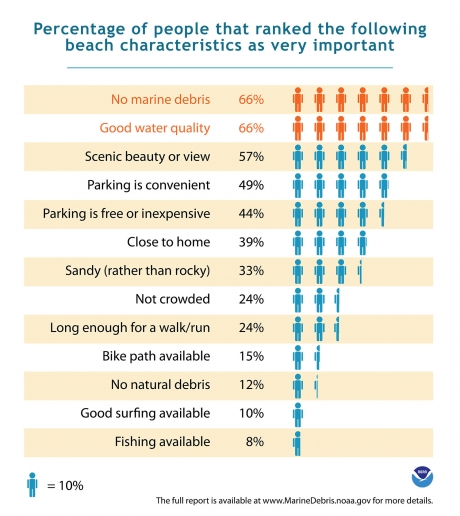
An infographic depicting the beach characteristics that are important to people. In a study funded by the NOAA Marine Debris Program, it was found that the presence of debris on beaches influences our decisions to go to a beach littered with debris, or spend money seeking out a cleaner spot. Focusing on southern California, the study surveyed residents in Orange County to understand what features are most important when they consider visiting a beach. These included a scenic view, convenient parking, the distance from their home, and even whether or not the beach is suitable for recreational activities like surfing or fishing. However, most important to residents is that no marine debris is on the beach, and that it features good water quality.

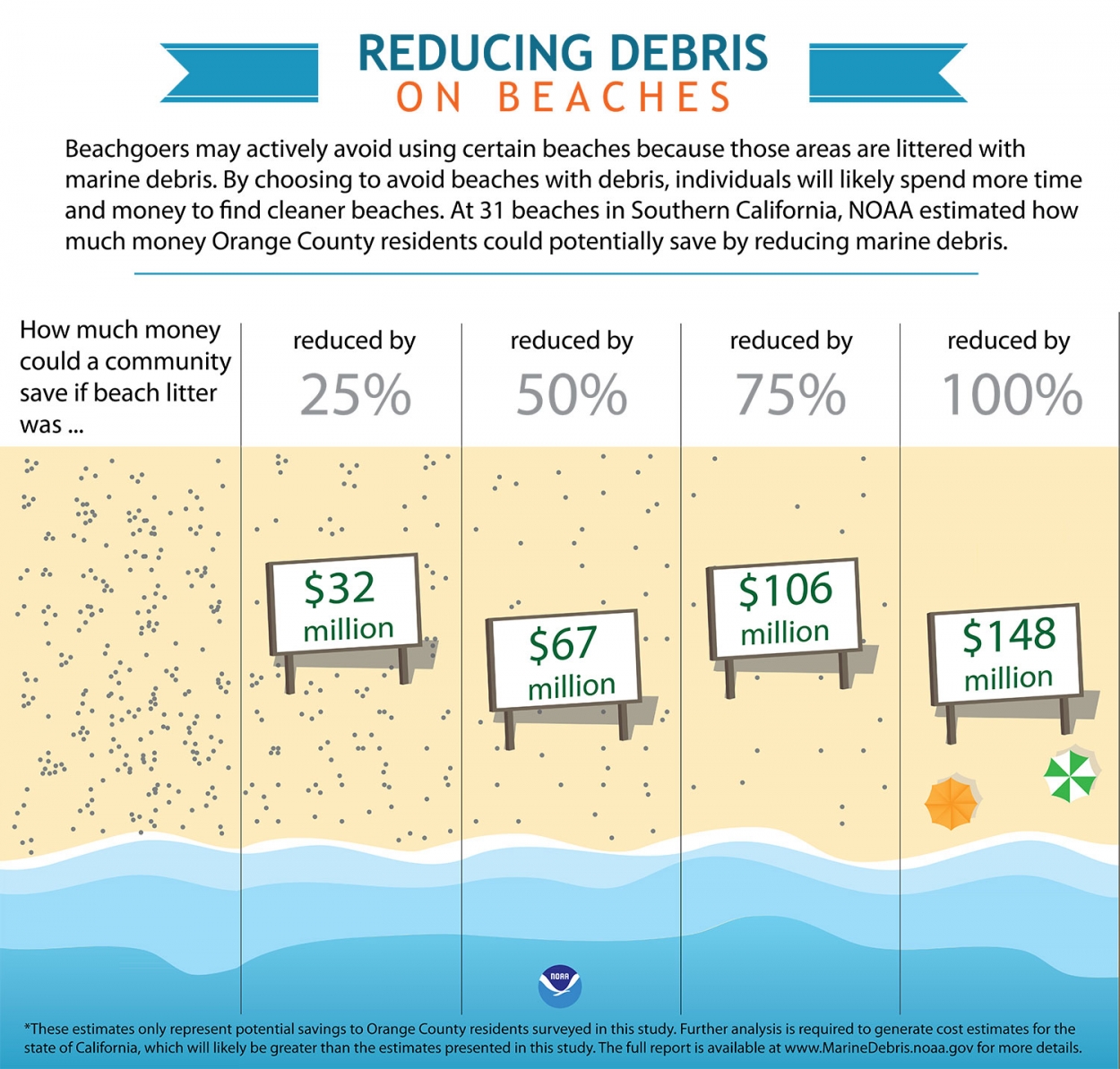
In order to find a beach that fits the bill, residents of southern California find themselves travelling farther from their local beaches, and spending more money as a result. Overall, this results in losses of millions of dollars every year. By reducing marine debris on beaches by just 25 percent, Orange County residents could save roughly $32 million during summer months by decreasing travel distances to enjoy the beach.

The study only focused on one county in the United States, where tourism generated over $1.5 trillion in economic output in 2016, according to the Department of Commerce SelectUSA Program. In a country where one out of every 18 Americans is employed in a travel or tourism-related industry, the potential effects marine debris has on this sector of the economy is substantial.

An infographic depicting how much money communities can save by reducing marine debris on beaches. In order to better understand the financial impacts of marine debris around the country, the NOAA Marine Debris Program is partnering with Abt Associates to conduct a Regional Pilot Study in a first attempt to link beach trip choices with estimates of marine debris at beaches. The regions of interest for this work include the Great Lakes (OH), Mid-Atlantic (DE), Gulf of Mexico (AL), and West Coast (CA). Using this information and data from the previous Orange County study, we can evaluate changes in tourism spending based on increases or decreases in marine debris, improve our understanding of the economic impact of marine debris, and prioritize areas of the United States where future prevention and removal efforts might be needed.
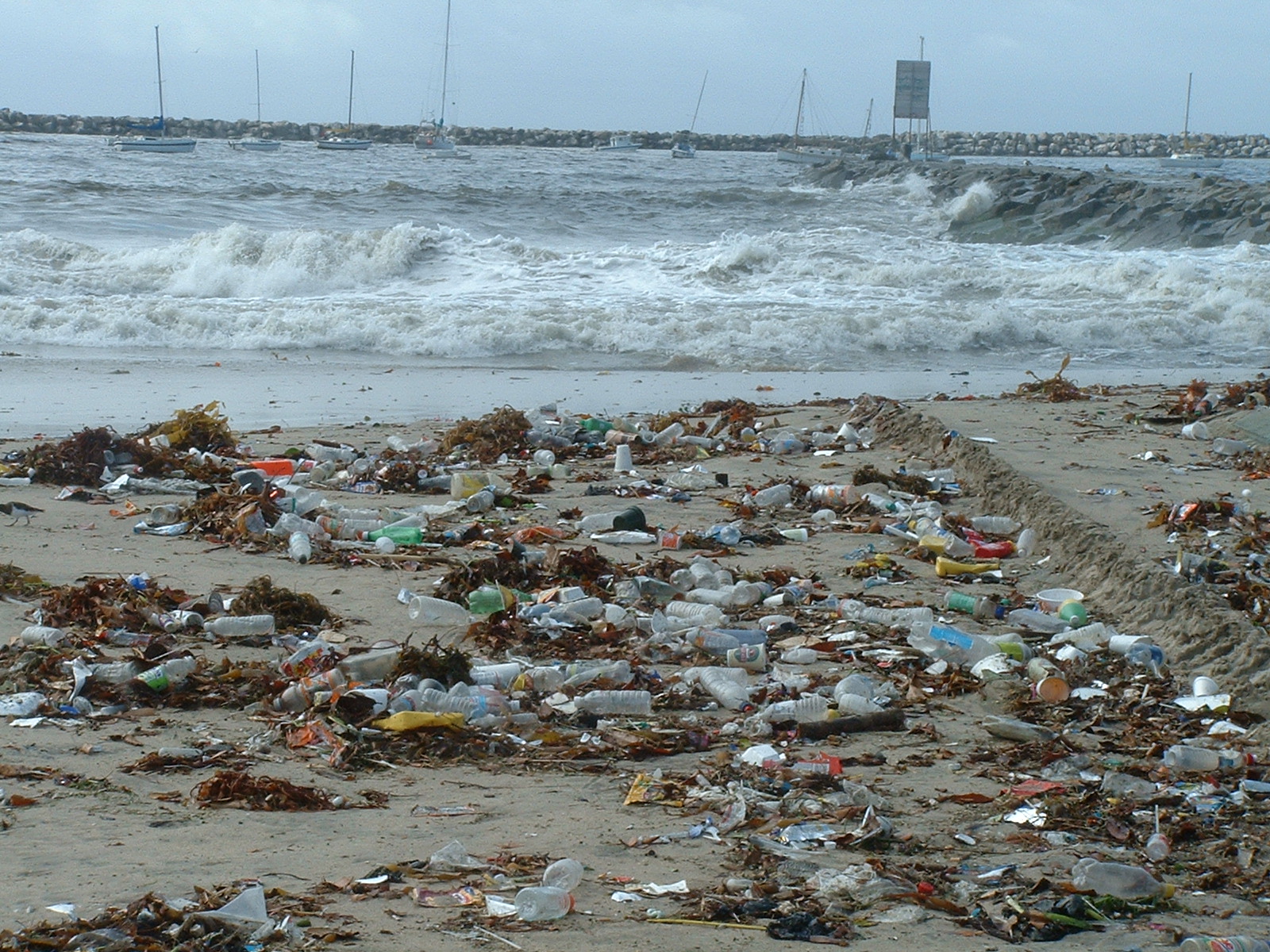
So, where does the debris on beaches come from? Well, it comes from us! People are the sole cause of marine debris, but that means we can also be the solution. You can help reduce marine debris on beaches by practicing these simple tips and tricks:

  • Reduce your waste footprint. Reduce the amount of waste you bring to the beach by choosing reusable bottles, food containers, and coolers.
  • Dispose of trash properly, no matter where you are. Whether you are inland, or on the beach, trash can travel. Wind, rain, and storms can push trash and litter into storm drains and streams, where it can travel to our ocean and Great Lakes.
  • Keep track of your beach toys. Make sure to keep an eye on your beach toys, like balls, sand shovels and nets. What may seem like a good place to leave your stuff while you go explore, may soon be covered in water as the tide rises. These plastic items can quickly wash out to sea and become marine debris.
  • Pack it out. No trash cans, or only overflowing bins at your beach? No problem! Pack up all of the trash you bring to the beach and dispose of it properly once you get home.
  • Clean up debris. Spend a couple of minutes picking up the debris around you when you leave the beach, and dispose of it properly. Want to do more? Join a local cleanup, or start your own using the Marine Debris Tracker app!

Debris littering a beach.

Marine debris litters a beach in Southern California. Image credit: Heal the Bay.
A toy on the beach.
Hold onto your beach toys! This toy was found on a shoreline in the remote Northwestern Hawaiian islands, far from urban centers or tourist beaches. Image credit: NOAA.
Node Weight: 
3

NOAA Provides Trajectory for Diesel Fuel Release from Grounded Vessel Near Santa Cruz

Short title: 
NOAA Provides Trajectory for Diesel Fuel Release from Grounded Vessel Near Santa Cruz

The Monterey Bay National Marine Sanctuary notified NOAA that a fishing vessel had grounded at the base of a bluff near the sanctuary earlier that day. Attempts to pull the vessel off the bluff were unsuccessful. It was determined that salvage operations would be unsafe.

The 56-foot commercial fishing vessel had a maximum potential capacity of 1,200 gallons of diesel aboard at the time of the spill. The Pacific Quest began discharging diesel fuel after the vessel started to break apart on the rocks — rupturing a fuel line.

The fuel vents were secured during low tide to prevent further discharge. No oil sheen has been observed at this point. As of Monday, Aug. 13 the vessel remained aground and responders were working to remove fuel from tanks on the beach during low tide.

"The Coast Guard and other federal, state and local agencies have established a unified command to ensure a safe and rapid response to the Pacific Quest grounding," said Coast Guard Ensign Kelly Hodges in a press release, the federal on-scene coordinator representative for the unified command. "We are working diligently with our partners to minimize impacts to the public and the environment."

For more information, see the Coast Guard’s most recent update. You can also check out a video of the grounded vessel here.


A broken up vessel on a beach.
The 56-foot commercial fishing vessel, Pacific Quest, is shown broken and beached near Seymour Marine Discovery Center in Santa Cruz, Calif., Aug. 13, 2018. Responders are working to remove fuel from tanks on the beach during low tide. (U.S. Coast Guard courtesy photo/released)
Node Weight: 
1

The True Cost of an Oil Spill: Q&A with a NOAA Economist

Short title: 
The True Cost of an Oil Spill: Q&A with a NOAA Economist

This new law resulted in NOAA’s Deepwater Ports Project Office — an early predecessor to NOAA’s Office of Response and Restoration and the start of OR&R Senior Economist Norman Meade’s 43 year career with NOAA.

“There was an increase in public awareness that came from assessing costs and impacts from potential oil spills,” Norman said, adding that in the mid- to late 1970s NOAA had been very innovative in preparing for the potential negative environmental impacts that the rise in big tankers could lead to. Though, he said, it wasn’t until the Amoco Cadiz oil spill of 1978 that NOAA had the opportunity for a large-scale damage assessment.

On March 16, 1978, the super tanker Amoco Cadizran aground on Portsall Rocks three miles off the northwestern coast of France due to failure of the steering mechanism and stormy weather. The entire cargo — a total of 1,619,048 barrels of oil — spilled into the sea and polluted approximately 200 miles of the Brittany coastline, a very ecologically and recreationally important region of France.

“That was really the first oil spill that was studied in depth by lots of different disciplines under the rubric of the natural resource impacts,” Norman said. “I was involved with conducting a study of the economic consequences, which NOAA headed up in collaboration with French colleagues. For many of us, that was the first time we were involved in an empirical study of the economic impact of an oil spill.

Since then, the tools and methodologies available have evolved to offer a more in-depth precise estimate of the economic and social impacts of oil spills. Find out more below in the Q&A with NOAA economist Norman Meade:

Q: How have the economic assessment methodologies changed over time?

A: Since the late ‘70s when I got started studying the economic effects of oil spills, a number of state and federal laws and regulations have been created to codify how natural resource trustees, such as NOAA, are to go about assessing the ecological and economic impacts of oil spills and hazardous waste site releases. The biggest change over time is probably in the depth and accuracy of the results. They aren’t dramatically different, but they’re more refined and more sophisticated. There’s more data that can be relied on. Advances in the natural sciences have influenced the development of the social sciences — and vice versa — such that we can progressively get better insights into what the ecological and economic consequences are.

Q: When assessing the damages to natural resources, how do you arrive at a monetary number for what they’re worth?

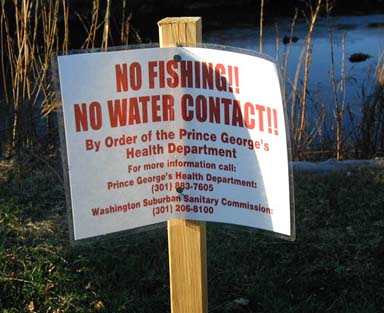
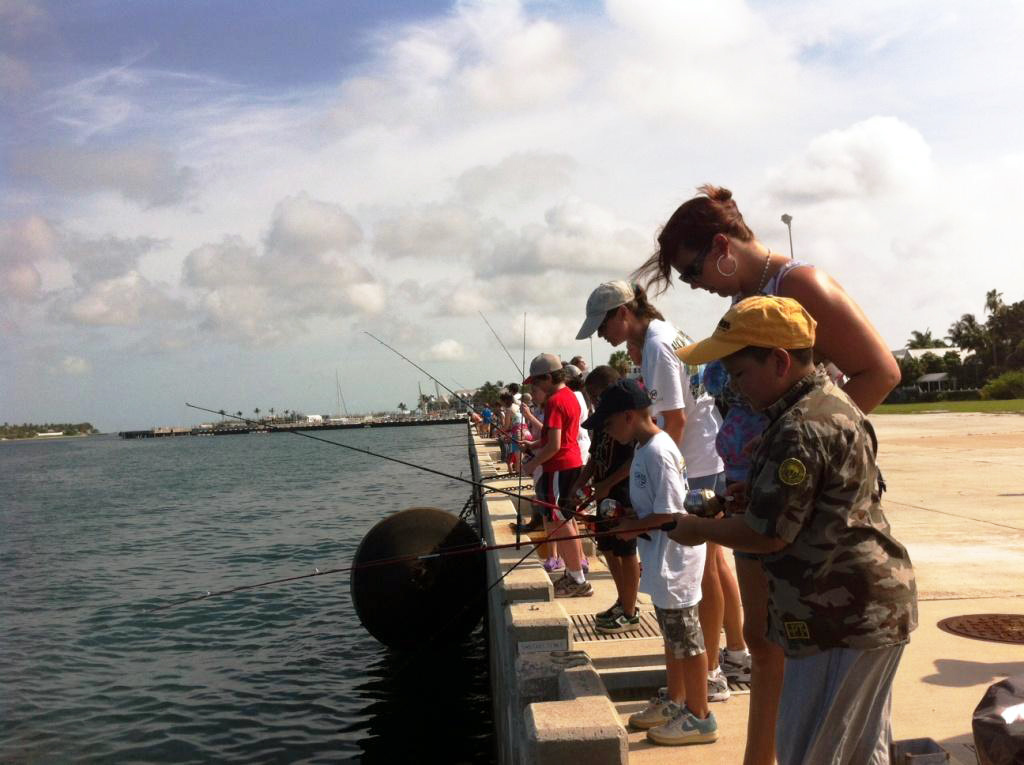
A fishing advisory. A: Looking at how we estimate the cost of spills, we are using what’s called non-market valuation — things that are not traded in ordinary markets. You don’t go to the store to purchase a trip to a clean beach, you may have other accrued costs — such as for transportation, entry fees, and the like — but you can’t buy that experience in the market.
For example, if you’re trying to preserve an endangered species, say an endangered chinook salmon in the Columbia River, what’s the value of that fish? Is it just the value of the price it could be sold for in a fish market? … Hardly. Some people also want to preserve the fish just for its existence — because people care about them swimming in the wild, maybe it symbolizes their view on what should exist in nature, and obviously Native Americans have their own cultural uses and values for salmon as well. Losses of the mere existence of species (natural resources) that members of the public care about would not otherwise be compensated for were it not for natural resource damage assessment laws and regulations. NOAA and other natural resource trustees act on behalf of the public to quantify losses of resources and/or their services and compensate the public for them. Without a trustee doing that, the public would be at a loss to recover them on their own because of the way our system of laws works regarding publicly owned natural resources. The principle that the natural resource damage assessment process is built on is that the trustees work on behalf of the public to make the public whole and to compensate them through restoration projects that try to provide equivalent projects and services to what they lost. It’s still not a perfect process, but we’re constantly learning and improving on the science, data, and techniques.

Q: How you decide what method to use for valuation?

A: Habitat equivalency analysis is one of the methodologies in our toolbox for analysis to equate the amount of loss, in ecological terms, with the amount of gain, in ecological terms. We avoid putting economic values on the resources until the very end when we estimate the cost for the restoration projects to just equal the level of ecological services lost. That’s an ecological based approach typically used for cooperative resource damage assessment settlements.

People fishing off a pier. Revealed preference methods (RPM) and stated preference methods (SPM), they’re both survey based, i.e. where you have to collect survey data in order to estimate the value lost in, say, recreational activity. The travel cost method (aRPM),takes the cost people incur to travel to and from a site for a recreational activity and derives an estimate of the value of the recreational experience or trip. This allows us to estimate losses from oil spills that close beaches or result in fish consumption advisories. Even when people are just aware that there are contaminated fish in the water, how does that affect their recreational experience? … There’s also another type of human use loss, which I referred to earlier, known as passive use values, where you don’t exactly have to reveal your use of the resources. “Nonuse values” is a little misleading so we prefer to say “passive use values,” are for resources that people care about or just want to know they exist, say for future generations (a bequest value, if you will). That’s where the stated preference method comes in, we typically ask people their willingness to pay to prevent the loss or willingness to receive payment to accept a loss.

Most recently with the Deepwater Horizon natural resource damage assessment, we employed both stated and revealed preference methods to estimate recreational and total value losses. Recreational loss is a subset to the total value loss. Just because some people don’t ever go to the Gulf of Mexico, doesn’t mean that they don’t care about natural resources adversely impacted there by an oil spill. It [passive use value losses] could potentially pertain to anyone in the U.S. population, whereas the recreational losses would be limited to the people who actually recreated, or wanted to recreate, there. It took awhile for the concern over the oiling and the impact on people’s decisions and values to go back to baseline following the spill. Collecting recreational data for two plus years after the spill, there were telephone and mail surveys as well as on-shore surveys and aerial counts of users on the beaches of the Gulf of Mexico. We asked people retrospectively what their reaction was to the injuries caused by the spill. We described in detail the key injuries as we understood them from the natural scientists and we asked them what they would be willing to pay to prevent another Deepwater Horizon spill.

Q: From these surveys, have you discovered some resources that the public values more than others?

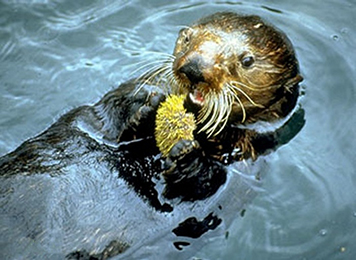
A sea otter eating an urchin. A: Different people care about different things. What you learn from these surveys is that there are big difference is what people care about. Such as the more charismatic critters like sea otters, whales, dolphins … not surprisingly more people resonate to those animals with higher expressions of value and importance than they do for small benthic organisms that live down in the sediments. But even for a generally acknowledged charismatic critter, like the sea otter, there are people who value them very little versus those who value them highly. ... Someone in Chicago, who has a greater passive use value for them, may value otters more highly than a fisherman living along the Pacific Coast.
Q: If you could emphasize to the public any one point, what would it be?

A: That human values and the natural world are very complex and we should not assume we understand either based on instinct, rather than sound scientific evidence. Scientists who get degrees in these subject areas will have a lot more knowledge, but that doesn’t mean that people without that knowledge don’t hold legitimate values for elements of the natural world. One of the things that has been a real benefit to society from the natural resource damage assessment process (in addition to compensatory restoration), is the knowledge and insights gained into the natural world and how people value the goods and services they provide.. The damage assessment process is in part a public process. When we get to the stage of having a successful claim and the damage assessment and restoration plan comes out with information on the value of the injuries and the preferred restoration projects, the public gets to comment on that, and in some cases, change the thinking of the trustees about what and how to restore. Outreach, communicating what the trustees are doing to restore those injured resources is key. We try to keep the public informed so they understand what they’re getting back for what they lost.


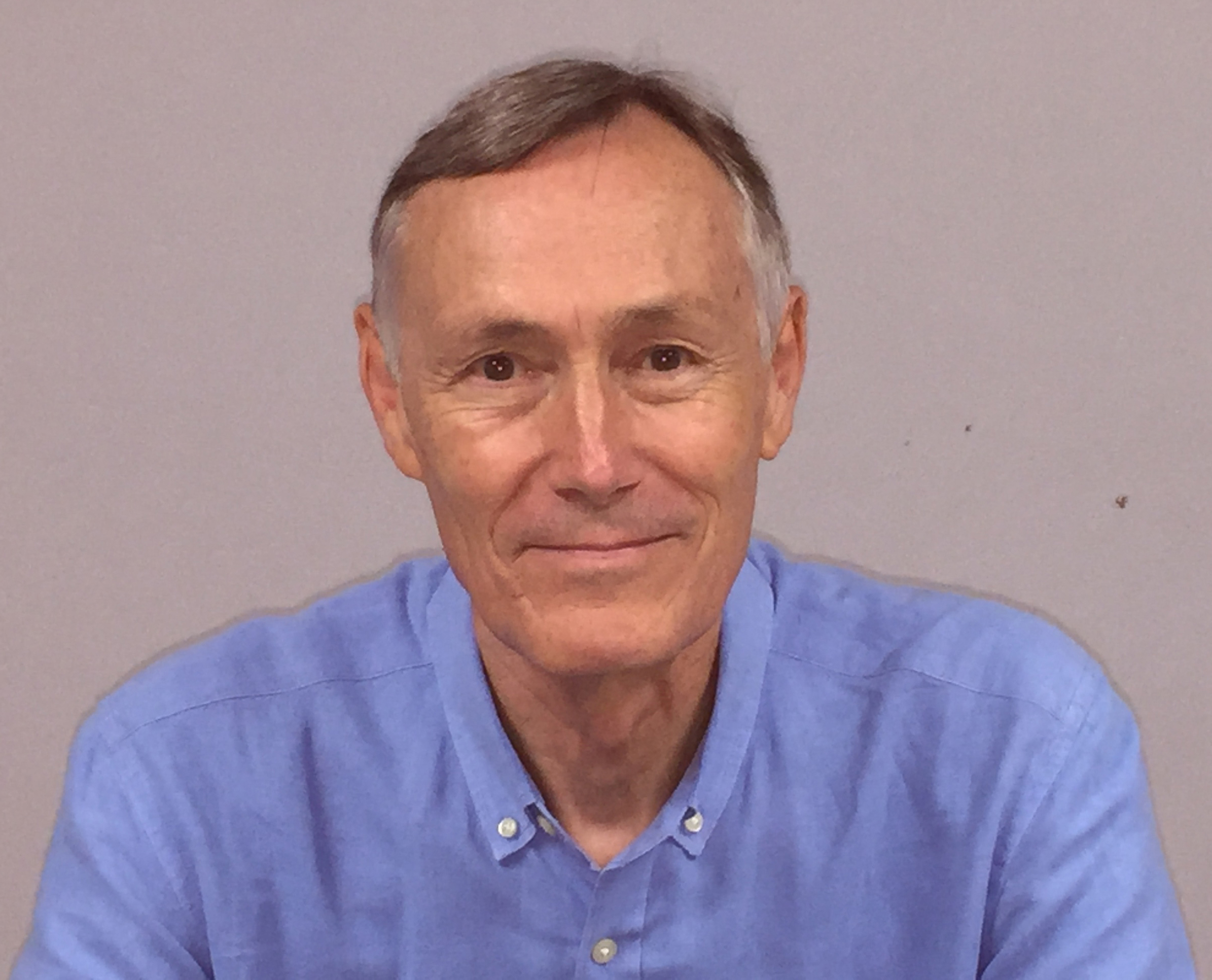
A profile photo of a man. Norman Meade is the senior economist for NOAA's Office of Response and Restoration. He joined NOAA's Deepwater Ports Project Office in 1975 after working as a staff economist for the Environmental Protection Agency. He stepped into the role of senior economist for OR&R in 1990 and after 43 years at NOAA, Norman will be retiring this year. To learn more about Norman's work, read his recent paper titled "Estimating the value of lost recreation days from the Deepwater Horizon oil spill."

Tarballs on a beach.
Extensive tarballs are visible in the foreground and surf zone in this image from the Gulf Islands National Seashore, Florida, shot on July 1, 2010. Image credit: NOAA.
A sinking vessel.
The VLCC tanker Amoco Cadiz oil spill. After the ship broke apart, its total cargo of 68.7 million gallons of oil spilled into the sea on the coast of Brittany, France. Image credit: NOAA.
Node Weight: 
2

The True Cost of an Oil Spill: Q&A with a NOAA Economist

Short title: 
The True Cost of an Oil Spill: Q&A with a NOAA Economist

This new law resulted in NOAA’s Deepwater Ports Project Office — an early predecessor to NOAA’s Office of Response and Restoration and the start of OR&R Senior Economist Norman Meade’s 43 year career with NOAA.

“There was an increase in public awareness that came from assessing costs and impacts from potential oil spills,” Norman said, adding that in the mid- to late 1970s NOAA had been very innovative in preparing for the potential negative environmental impacts that the rise in big tankers could lead to. Though, he said, it wasn’t until the Amoco Cadiz oil spill of 1978 that NOAA had the opportunity for a large-scale damage assessment.

On March 16, 1978, the super tanker Amoco Cadizran aground on Portsall Rocks three miles off the northwestern coast of France due to failure of the steering mechanism and stormy weather. The entire cargo — a total of 1,619,048 barrels of oil — spilled into the sea and polluted approximately 200 miles of the Brittany coastline, a very ecologically and recreationally important region of France.

“That was really the first oil spill that was studied in depth by lots of different disciplines under the rubric of the natural resource impacts,” Norman said. “I was involved with conducting a study of the economic consequences, which NOAA headed up in collaboration with French colleagues. For many of us, that was the first time we were involved in an empirical study of the economic impact of an oil spill.

Since then, the tools and methodologies available have evolved to offer a more in-depth precise estimate of the economic and social impacts of oil spills. Find out more below in the Q&A with NOAA economist Norman Meade:

Q: How have the economic assessment methodologies changed over time?

A: Since the late ‘70s when I got started studying the economic effects of oil spills, a number of state and federal laws and regulations have been created to codify how natural resource trustees, such as NOAA, are to go about assessing the ecological and economic impacts of oil spills and hazardous waste site releases. The biggest change over time is probably in the depth and accuracy of the results. They aren’t dramatically different, but they’re more refined and more sophisticated. There’s more data that can be relied on. Advances in the natural sciences have influenced the development of the social sciences — and vice versa — such that we can progressively get better insights into what the ecological and economic consequences are.

Q: When assessing the damages to natural resources, how do you arrive at a monetary number for what they’re worth?

A: Looking at how we estimate the cost of spills, we are using what’s called non-market valuation — things that are not traded in ordinary markets. You don’t go to the store to purchase a trip to a clean beach, you may have other accrued costs — such as for transportation, entry fees, and the like — but you can’t buy that experience in the market.

For example, if you’re trying to preserve an endangered species, say an endangered chinook salmon in the Columbia River, what’s the value of that fish? Is it just the value of the price it could be sold for in a fish market? … Hardly. Some people also want to preserve the fish just for its existence — because people care about them swimming in the wild, maybe it symbolizes their view on what should exist in nature, and obviously Native Americans have their own cultural uses and values for salmon as well. Losses of the mere existence of species (natural resources) that members of the public care about would not otherwise be compensated for were it not for natural resource damage assessment laws and regulations. NOAA and other natural resource trustees act on behalf of the public to quantify losses of resources and/or their services and compensate the public for them. Without a trustee doing that, the public would be at a loss to recover them on their own because of the way our system of laws works regarding publicly owned natural resources. The principle that the natural resource damage assessment process is built on is that the trustees work on behalf of the public to make the public whole and to compensate them through restoration projects that try to provide equivalent projects and services to what they lost. It’s still not a perfect process, but we’re constantly learning and improving on the science, data, and techniques.

Q: How you decide what method to use for valuation?

A: Habitat equivalency analysis is one of the methodologies in our toolbox for analysis to equate the amount of loss, in ecological terms, with the amount of gain, in ecological terms. We avoid putting economic values on the resources until the very end when we estimate the cost for the restoration projects to just equal the level of ecological services lost. That’s an ecological based approach typically used for cooperative resource damage assessment settlements.

Revealed preference methods (RPM) and stated preference methods (SPM), they’re both survey based, i.e. where you have to collect survey data in order to estimate the value lost in, say, recreational activity. The travel cost method (aRPM),takes the cost people incur to travel to and from a site for a recreational activity and derives an estimate of the value of the recreational experience or trip. This allows us to estimate losses from oil spills that close beaches or result in fish consumption advisories. Even when people are just aware that there are contaminated fish in the water, how does that affect their recreational experience? … There’s also another type of human use loss, which I referred to earlier, known as passive use values, where you don’t exactly have to reveal your use of the resources. “Nonuse values” is a little misleading so we prefer to say “passive use values,” are for resources that people care about or just want to know they exist, say for future generations (a bequest value, if you will). That’s where the stated preference method comes in, we typically ask people their willingness to pay to prevent the loss or willingness to receive payment to accept a loss.

Most recently with the Deepwater Horizon natural resource damage assessment, we employed both stated and revealed preference methods to estimate recreational and total value losses. Recreational loss is a subset to the total value loss. Just because some people don’t ever go to the Gulf of Mexico, doesn’t mean that they don’t care about natural resources adversely impacted there by an oil spill. It [passive use value losses] could potentially pertain to anyone in the U.S. population, whereas the recreational losses would be limited to the people who actually recreated, or wanted to recreate, there. It took awhile for the concern over the oiling and the impact on people’s decisions and values to go back to baseline following the spill. Collecting recreational data for two plus years after the spill, there were telephone and mail surveys as well as on-shore surveys and aerial counts of users on the beaches of the Gulf of Mexico. We asked people retrospectively what their reaction was to the injuries caused by the spill. We described in detail the key injuries as we understood them from the natural scientists and we asked them what they would be willing to pay to prevent another Deepwater Horizon spill.

Q: From these surveys, have you discovered some resources that the public values more than others?

A: Different people care about different things. What you learn from these surveys is that there are big difference is what people care about. Such as the more charismatic critters like sea otters, whales, dolphins … not surprisingly more people resonate to those animals with higher expressions of value and importance than they do for small benthic organisms that live down in the sediments. But even for a generally acknowledged charismatic critter, like the sea otter, there are people who value them very little versus those who value them highly. ... Someone in Chicago, who has a greater passive use value for them, may value otters more highly than a fisherman living along the Pacific Coast.

Q: If you could emphasize to the public any one point, what would it be?

A: That human values and the natural world are very complex and we should not assume we understand either based on instinct, rather than sound scientific evidence. Scientists who get degrees in these subject areas will have a lot more knowledge, but that doesn’t mean that people without that knowledge don’t hold legitimate values for elements of the natural world. One of the things that has been a real benefit to society from the natural resource damage assessment process (in addition to compensatory restoration), is the knowledge and insights gained into the natural world and how people value the goods and services they provide.. The damage assessment process is in part a public process. When we get to the stage of having a successful claim and the damage assessment and restoration plan comes out with information on the value of the injuries and the preferred restoration projects, the public gets to comment on that, and in some cases, change the thinking of the trustees about what and how to restore. Outreach, communicating what the trustees are doing to restore those injured resources is key. We try to keep the public informed so they understand what they’re getting back for what they lost.

Norman Meade is the senior economist for NOAA's Office of Response and Restoration. He joined NOAA's Deepwater Ports Project Office in 1975 after working as a staff economist for the Environmental Protection Agency. He stepped into the role of senior economist for OR&R in 1990 and after 43 years at NOAA, Norman will be retiring this year. To learn more about Norman's work, read his recent paper titled "Estimating the value of lost recreation days from the Deepwater Horizon oil spill."

Node Weight: 
2

Looking Deeper at the Social Science Behind Marine Pollution

Short title: 
Looking Deeper at the Social Science Behind Marine Pollution

Behind each of these images is a deeper level to the complexity of the issue of marine pollution — a social one. The effects of marine pollution go beyond environmental issues. They encompass a wide range of impacts, including economic, mental and physical health, cultural, social, and governmental.

The human dimensions of oil spills are widespread.

The most obvious impacts come in the form of acute and chronic health problems and physical injuries. But marine pollution can even affect entire communities — changing their social behavior, altering the local economy, and threatening their natural and cultural resources. 

On an economic level, the impacts can be anything from a fisherman’s temporary loss of income to a complete loss of livelihood. It could even be an industry-wide disruption of normal economic activities.

For the Native American tribes who have cultural ties to their natural resources that go beyond that of simply recreational activities, marine pollution can pose a threat in the form of a degradation of natural heritage, interruption of customary activities, loss of identity, violation, damage, destruction of cultural sites, and a change in values.

An altered experience and use of the natural environment is also an important social aspect to marine pollution. An oil spill or another pollution incident can affect public access to natural environment and infrastructure — including a negative experience or even a loss of recreation opportunity. It can also impact the quality and availability of housing, as well as the quality of community infrastructure.

On a governmental level, many marine pollution incidents result in crime enforcement, hearings, and new legislation or regulation. They can also affect the participation, preparedness, and capacity of response and planning.

Together with federal, state, tribal, industry, and academic partners, NOAA’s Office of Response and Restoration looks to social science research to inform our capacity to respond to incidents, assess the damages, and restore resources wherever possible and compensate the public through other restoration projects when it isn’t.

This month, OR&R will be taking a closer look at the relationship between humans, the environment, and the various forms of marine pollution that impact them both. Coming up next, find out about how historic industrial pollution in the Great Lakes has affected a way of life for native communities. Keep an eye out for more upcoming blogs on our website here

Marine debris littering a beach.

Oil covering a rocky beach.
Oil on the beach at Refugio State Park in Santa Barbara, California, on May 19, 2015. Image credit: U.S. Coast Guard.
Node Weight: 
1

NOAA and Trustees seeking comment on Lower Duwamish Natural Resources Injury Assessment Plan

Short title: 
NOAA and Trustees seeking comment on Lower Duwamish Natural Resources Injury Assessment Plan

At this time, the Elliott Bay Trustees are identifying ways to assess ecological injuries to habitat in the area, and loss of recreational use and and tribal services using a variety of approaches outlined in the Injury Assessment Plan.

Approaches include potential studies that will assist the Trustees in identifying and implementing restoration projects to compensate for those injuries. The studies will focus on species like shellfish and other invertebrates, forage fish, bottom-dwelling fish, and salmon.

The Injury Assessment Plan is a part of the Trustees’ evaluation and restoration of natural resource injuries incurred over time in areas contaminated with hazardous substances such as PCBs, PAHs, metals and other substances.  

The Injury Assessment Plan provides an update on the status of the natural resource damage assessment, information regarding the trustees’ emphasis on specific natural resources and hazardous substances, methods and metrics for quantifying contaminant-related injuries, and the specific studies the trustees have identified to support the damage assessment. The trustees will consider the public comments received, and will release a final injury assessment plan by late 2018 or 2019.

The Duwamish River was once a wide, meandering river with large areas of mudflats and marshes. By the 1940s, channelization and filling had transformed the 9-mile estuary into a 5-mile industrial waterway. This process destroyed 97 percent of the original habitat.

The Lower Duwamish River is still highly developed, with many industrial and commercial facilities lining its banks. Hazardous substances have been released since the early 1900s, resulting in injuries to fish, birds, wildlife, and their habitats, and loss of recreational uses, like fishing.

Comments on the Injury Assessment Plan should be emailed to Rebecca.Hoff@noaa.gov with the subject line: “Comments on Lower Duwamish River Natural Resource Damage Assessment: Injury Assessment Plan.” Comments may also be mailed to: Rebecca Hoff of NOAA Western Region Center, 7600 Sand Point Way Building 1, Seattle, WA 98118.

For more information on the Lower Duwamish River hazardous waste site, visit the Damage Assessment, Remediation, and Restoration Program site

A boat navigating down a river with an industrial shoreline in the background.
A boat navigates the Lower Duwamish River with industrial development on both sides of the river's banks.
Node Weight: 
3

Minds Behind OR&R: Meet Scientific Support Coordinator Michael Doig

Short title: 
Minds Behind OR&R: Meet Scientific Support Coordinator Michael Doig

By Donna L. Roberts, Office of Response and Restoration

July 25, 2018 — Lieutenant Michael Doig is currently serving as the NOAA scientific support coordinator (SSC) for the Great Lakes, based in Cleveland, Ohio. Like other NOAA SSCs, Doig provides scientific support to the federal on-scene coordinator during responses to oil and hazardous substance releases in the coastal zone.

Being an SSC is both challenging and rewarding, Michael says, adding that what he enjoys most about his job is the opportunity it allows him to work with a close-knit team and to have a positive impact on the environment. He finds it particularly rewarding to interact with community members and utilize his background in education to inform the public on marine pollution.

Michael received his bachelor’s degree in zoology from the University of Hawaii at Mānoa (UH), his master’s in education from Pace University in New York, and a Master of Public Administration degree from the University of North Carolina at Chapel Hill.

While attending UH, Michael was an after-hours resident in the Waikiki Aquarium, ensuring the safety of the aquarium equipment and sea life. Another of the residents was a NOAA employee who piqued his interest about working for NOAA. For his senior project, he assisted a graduate student on a population study of juvenile hammerhead sharks in Kaneohe Bay, catching, tagging, and releasing the sharks from a small boat. He also hosted a weekly radio show on the university’s radio station KTUH.

After graduating from UH, Michael was accepted into the New York City Teaching Fellows program. He taught earth and marine science to high school students in Brooklyn, New York, and attended graduate school at night. A dedicated educator, he produced a collection of videos for his website ScienceBoom: Episode 1: Density DemonstrationEpisode 2: Water Circulation and ConvectionEpisode 3: Balloon in a CarEpisode 4: Chemical Weathering; and Episode 5: Barometric Pressure and Temperature.

As a teacher, his online searches for lesson plan ideas frequently brought him to NOAA websites, where he discovered the NOAA Corps. Armed with knowledge of the Corps, he applied, interviewed and was selected for Basic Officer Training Class (BOTC) 117 that graduated in 2010. Naturally, Michael contributed his videography skills to BOTC 117’s graduation video.

After BOTC, Michael was assigned to the fleet and sailed aboard NOAA ships Pisces, Nancy Foster, and Gordon Gunter. He has sailed extensively throughout the Gulf of Mexico, Caribbean, and along the Eastern Seaboard supporting fisheries and marine mammal research.  

Michael’s wide array of jobs and travel hasn’t stopped with his current job. Since coming on board with OR&R, he has travelled the Great Lakes region extensively including: Port HuronSturgeon BayTraverse CityBuffaloMackinaw City, Chicago, and Detroit. Michael enjoys the unpredictability of his job, recalling what someone once told him, that “You never go to the same response twice.”

A diver in the water.“There is no typical day in the life of an SSC. This job requires a lot of travel, meetings, learning, training, and working with a diverse group of stakeholders. With roughly 12 SSCs for the entire U.S., each one is responsible for a large area,” Michael said. “You can have plans to travel to Duluth, Minnesota and suddenly you’re on a flight to St. Thomas [U.S. Virgin Islands]. Being an SSC is a challenge, but it’s highly rewarding!”

Last year, Michael was part of the Hurricane Maria response in the Caribbean. He spent two months in the U.S. Virgin Islands, supporting the U.S. Coast Guard and advising on the removal of grounded and sunken vessels to minimize environmental impacts. He helped develop best management practices, provided training, and briefed field teams on ways to minimize harm to coral, mangrove, seagrass, and turtle-nesting beaches.

As a NOAA diver, Michael was able to put his skills to use relocating corals in the Virgin Islands. When vessels were identified on sensitive coral reefs, salvage crews needed a pathway to remove the vessels from the reef. He worked with NOAA Coral Reef Restoration Ecologist Sean Griffin to relocate and reattach the corals with cement once the operations were completed.

Michael has had a lot of memorable experiences throughout his NOAA career — from trawling in the Gulf of Mexico oil patch and spending Hurricane Sandy at the dock in Newport, Rhode Island, to recording the Bryde’s whale call for the first time and helping coral scientists collect data in the Florida Keys. He also has more fond memories of watching beautiful sunrises and sunsets than he could ever recount.

A sunrise as seen from a vessel in water.

“Being a part of NOAA provides an incredible array of opportunities, adventures, and once in a lifetime memories,” Michael said.

A man in uniform standing in front of a statue of a hand.Michael says that in the future, he sees his role as a scientific support coordinator becoming more important as the industry continues to grow and change.

“New products, sensitive habitats, and an increasingly aware public make protecting the environment a high priority for the American people. Finding ways to balance industries’ needs while at the same time making sure we are prepared and able to respond in the event of a spill is an important part of being an SSC,” Doig said. “As a NOAA Corps officer, I am in this assignment for roughly three years before I go back out for my third sea assignment aboard one of the ships in NOAA’s fleet. I hope to someday be in command of one of those ships.”

A man in a hard hat and an orange vest with large equipment and a shoreline in the background.
Great Lakes Scientific Support Coordinator LT Michael Doig aboard the USCGC Hollyhock. Image credit: NOAA.
Node Weight: 
4

From Research to Response, the Evolving Role of Science in Oil Spills

Short title: 
The Evolving Role of Science in Oil Spills

The Spilled Oil Research Team

Earlier that year, NOAA had established the Spilled Oil Research (SOR) Team to study the effects of oil and gas exploration in Alaska. This team was a network of coastal geologists, marine biologists, chemists, and oceanographers that could go on-scene at "spills of opportunity" with the goal of investigating oil spill impacts.

The Argo Merchant spill was the first major deployment of the SOR Team. The U.S Coast Guard, charged with directing the spill response and cleanup effort, was inundated with competing and often conflicting scientific recommendations. To sort this out, the Coast Guard asked the SOR Team to act as its scientific adviser and be an informal liaison with the scientific community concerned with the spill.

This informal relationship quickly became invaluable. The Coast Guard began to rely on the SOR Team to coordinate the complex scientific issues that arose at spills after the Argo Merchant, including: the Metula, a crude ship grounding off of Tierra del Fuego, Chile; the Amoco Cadiz, a 1.6 million barrel oil spill off the Breton coast of France; and the IXTOC I well blowout in the Gulf of Mexico in June 1979.

Evolution of the Emergency Response Division

The Spilled Oil Research Team — now the Office of Response and Restoration’s Emergency Response Division — has grown from a handful of oceanographers, mathematicians, and computer modelers into a highly diverse team of chemists, biologists, geologists, information management specialists, and technical and administrative support staff. The informal role of scientific support coordinators is now formally recognized in the National Oil and Hazardous Substances Pollution Contingency Plan.

It’s been a busy 35 years (on top of events like the Deepwater Horizon/BP spill), and some of that old history has been forgotten. A couple years ago when I was cleaning out an equipment store room, I discovered this artifact of the earlier days on some old coveralls:

 NOAA-Coast Guard, Spilled Oil Research (SOR) Team.
A badge from the original NOAA Spilled Oil Research Team. Credit: Doug Helton, NOAA.


You can find out more about the evolving history of NOAA’s involvement in oil spill response and OR&R’s Emergency Response Division.

A large ship sinking in the ocean.
The tanker Argo Merchant run aground Nantucket Shoals, southeast of Nantucket Island, Mass., in December 1976. Credit: NOAA.
The bow of a sinking ship above the waves of the ocean.
On December 21, 1976, the Argo Merchant broke apart and spilled its entire cargo of 7.7 million gallons of No. 6 fuel oil. Credit: NOAA.
Site Themes: 
Node Weight: 
1

Restoring Natural Resources after Disasters: NOAA’s FAST Program Keeps Scientists Ready to Respond

Short title: 
Restoring Natural Resources after Disasters: NOAA’s FAST Program Keeps Scientists Ready to Respond

By Sarah Allan, Assessment and Restoration Division

Cleaning up after oil spills and chemical releases is one important aspect to disaster response. Within NOAA’s Office of Response and Restoration, the Assessment and Restoration Division (ARD) is a group that tackles a different challenge in recovering from disasters. ARD conducts natural resource damage assessment (NRDA), which begins soon after disasters strike to determine what was harmed or “injured” by oil, chemical releases, and other marine pollutants, and what needs to be done to bring back or “restore” the environment to its pre-disaster conditions. While the NRDA can last for years after an oil or chemical spill, it begins as soon as a spill threatens fish, wildlife, habitats, and the ecological and human use services the resources provide.

Time-critical information, also known as ephemeral data, about the environmental conditions and natural resources is important for understanding spill impacts. If early evidence of dead or injured biota and transitory presence of toxic compounds isn’t collected right away, we may never know the true magnitude of harm. This means that ARD scientists need to be prepared for rapid response to disasters, such as oil spills, ship groundings, and hurricanes. NRDA field teams train to be ready to mobilize and collect information and data shortly after disasters are reported. The concentration of oil in the water or the abundance of fish eggs on submerged vegetation in the path of a spill are two examples of ephemeral data that a field assessment for NRDA could document.

To support preparedness ARD has a six person Field Assessment and Support Techniques (FAST) team whose mission is to maintain staff readiness for NRDA field efforts. The FAST program provides guidance, templates, training, and tools to facilitate rapid and consistent execution of critical components of field assessments. For example, guidelines on collecting samples and other field data, and chain of custody forms are available for a range of resources and habitats. Additionally, FAST team members have identified staffing and field gear needs for disaster response, developed and distributed materials to support NRDA spill drills, and organized in-field assessment methods trainings. NOAA often pursues funding for damage assessment and restoration from polluters, so evidence gathered for damages must be sufficient to withstand potential scrutiny in court.

In the event of a disaster that leads to an oil or chemical spill, ARD staff can access resources to guide and facilitate field assessment efforts through different FAST products. For example, the FAST library archives study plans, guidelines, data sheets, agreement templates, and other documentation that can be adapted to the incident-specific needs for field assessment. The FAST team also works to make these documents available to our partners, since NRDA is a collaborative process that may involve federal, state, and tribal trustees, as well as representative of the party responsible for the spill.

OR&R’s assessment and restoration work has a timeframe that extends well beyond the emergency response, but it begins as soon as a spill or threat of a spill occurs. The FAST program is an important way ARD identifies and addresses its disaster response needs. By gathering crucial but fleeting field observations and samples during and after a spill, NOAA and its partners position themselves to obtain appropriate restoration for injured natural resources and assure that the public is compensated for the lost uses and enjoyment of the resources.


More on Disaster Preparedness: 

A group of people in tall grass looking at a plot of ground.
Marsh field assessment training in the Northeast region. (Image credit: NOAA).
A woman leaning on the ground writing in a notebook.
Using sampling guidelines and field data sheets for sandy beach field assessment. (Image credit: NOAA).
A group of people standing on a shoreline plotting out a section of the ground.
Marsh field assessment training in the Northwest region. (Image credit: NOAA).
Node Weight: 
5

Preparing to Reduce Marine Debris During Hurricanes

Short title: 
Preparing to Reduce Marine Debris During Hurricanes

By Krista Stegemann, OR&R's Marine Debris Program

Another hurricane season is upon us and with that, it’s time to think about how best to prepare for potential storms. Hurricanes and other severe storms can have devastating impacts on coastal communities, and the safety of you and your family should be the ultimate priority. Take some time to come up with a plan of action in the case of a hurricane in your area. There are lots of great resources on the National Weather Service’s website.

Unfortunately, the wind, rains, and storm surge that can come with hurricanes can also result in a substantial influx of marine debris. Keep this point in mind when prepping your home for an upcoming storm. As long as it is safe and there is time to do so, move any loose items — from lawn ornaments to deck furniture — indoors. These items have the potential to blow away and become marine debris. For larger items that can’t be moved inside, make sure they’re secured carefully and tightly. If you own a boat, do your best to have it moved from the water and into storage. If that’s not possible, then secure everything you can, including lines and hatches.

Sadly, some marine debris resulting from severe storms is unavoidable. Natural disasters such as hurricanes can easily result in debris such as abandoned and derelict vessels, construction debris, and household waste. To most effectively address this storm debris and to mitigate its impacts as much as possible, the NOAA Marine Debris Program is facilitating response planning efforts in coastal states. Through a highly collaborative process with local, state, and federal agencies, response guidance documents are being developed, aimed at improving preparedness and facilitating a coordinated, well-managed, and immediate response to acute waterway debris incidents. These efforts work to outline existing response structures at the local, state, and federal levels, capturing all relevant responsibilities and existing procedures into one guidance document for easy reference in order to facilitate the most effective and smooth debris response operation.


More on Disaster Preparedness: 

Damaged vessels and other debris.
Derelict vessels in South Carolina. (Image credit: Peter Kingsley-Smith, SCDNR)
A damaged roller coaster surrounded by water.
A roller coaster, swallowed by rising water during Hurricane Sandy. (Image credit: Shawn Perez)
Site Themes: 
Node Weight: 
4

Natural Disasters are Part of Nature, Planning for Disasters Should be Just as Natural

Short title: 
Natural Disasters are Part of Nature, Planning for Disasters Should be Just as Natural

Share your #DisasterPreparedness strategy by commenting on our blog, or replying to our Twitter and Facebook.

By Charlie Henry, OR&R’s Disaster Response Center

For most of my life and all my NOAA career, I have lived and worked in the Gulf of Mexico. When Hurricane Katrina made landfall in 2005, I was working for NOAA in their New Orleans office. Katrina was far from the first or last disaster that I had lived through in my long career. Severe weather events are just part of nature, and for me, they’re part of my job as an emergency responder.

As a young teenager, I remember a tornado that ripped a line of destruction very close to our house — only just missing us. It was frightening, and a few neighboring houses weren’t quite so lucky. In 1969, I traveled with my grandfather to see the devastation of Hurricane Camille, which hit along the Mississippi coast. At a very early age, I had developed a healthy respect for the damage that storms could do to people’s lives and property.

My family and I are lucky to have never been an actual victim of a disaster, but that doesn’t mean we haven’t had to deal with property damage and secondary impacts. Luck may be part of our survivability, but planning ahead for what nature threatens is, by nature, just a part of our lives. It’s strange to say, but there have been some special times as well — times when disasters have made me appreciate what I have.

A man in military uniform handing a box labeled "Ready Meal" to a person in a car.I remember a time in 2008, after Hurricane Gustov, when our roof was severely damaged and we were without power for nearly six weeks. About a week after the storm passed, my wife and daughter went through the National Guard assistance line to get a big, blue FEMA tarp to help keep the rain out. All we needed was the tarp, but those young women and men gave us two tarps, a case of Meals Ready to Eat (MREs), a case of water, and a bag of ice. The ice was a real treat.

Unless you’ve been in such a situation, you might not appreciate a bag of ice or having a family dinner illuminated only by candle light. It was hot and humid, there was no power, and we were eating a combination of our hurricane survival supplies and MREs, but on that night we had something cold to drink. Most importantly, we were sharing a family meal together, we were OK, and we were in good spirits. I still remember that meal as a special family time during what was, for many, a very real disaster.

As an emergency responder, I’m expected to be prepared. First and foremost, I want to know that my family and my dog are safe — even if that means that they’ve had to evacuate so that I don’t have to worry about their safety. Though that hasn’t always been easy, as my wife works in a hospital emergency room. Having a plan is essential. It should focus on family safety, key records, important medicine and prescriptions — including a spare pair of glasses for my wife, who can’t drive without them —  and keeping the cars fueled. My house and property are of far less importance, though they are well stocked with supplies such as food, water, and other essentials at the start of hurricane season. Property can be replaced, but our lives and the lives of those we care about cannot.

No matter where you live, a natural disaster could be a part of your life. Natural disasters just happen — whether we want them to or not. They are not controlled by our calendars, and they don’t care about our wants or our needs. You might not know it, but natural hazard events are relatively common. A quick look at the NOAA National Weather Service’s daily briefing will generally indicate multiple events across the U.S. Of course, not all of these are devastating enough to be considered a disaster.

An aerial view of a damaged shoreline.Most of us have never faced a true major disaster such as the 1700 Cascadia Earthquake and Tsunami that changed the Pacific Northwest and even impacted the island of Japan, the New Madrid earthquakes in the Mississippi Valley during the 19th Century (the largest series of earthquakes documented in the U.S. affecting an area of nearly 2 million square miles), the Tri-State Tornado in 1925 that killed 695 people in Missouri, Illinois, and Indiana, or the more recent Hurricane Maria in 2017 where a recent study estimated that storm-related deaths reached 4,300. For each of these major disasters, there are hundreds of lesser disasters with impacts spread across the U.S.

There are those who think such events are not worth planning for — and if it does happen, they’ll just deal with it. As an emergency responder and preparedness planner, I would naturally believe such reasoning to be a failed contingency plan that would put an individual, their family, their pets, and their property at greater risk. Preparedness means planning for those real threats and hoping that they never happen. If they do, you have a greater chance of surviving physically and mentally if you are prepared in advance. Mentally planning for a disaster is very important to survival and maintaining a positive attitude rather than an overwhelming feeling that you are suddenly a victim. We prepare to be survivors just as the generations that lived before us.

Most of us work, live, and play without too much worry about disasters — and for the most part, we’re safe from these threats. If we weren’t, we probably would live somewhere else. But where? The other day I was reading an article on the top 10 cities identified by an insurance company study as the safest cities in the U.S. The study was limited to hurricane and tornado threats.  Unsurprisingly, many West Coast cities made the list, while none of the Gulf of Mexico cities did.

While these cities may be safe from hurricanes and tornadoes, I couldn’t help but think, “but what about forest fires, flash floods, mudslides, earthquakes, tsunamis, volcanoes, massive ice storms, snow storms, and severe heat waves?” Being an emergency responder, I could have taken this entire blog to list possible natural hazards and past disasters. In truth, no place offers 100 percent safety guaranteed. Each city and region comes with its own unique threats.

Do you have a personal or family emergency plan that includes a place to evacuate to and adequate food, water, medicine, and cash? During Hurricane Katrina, 1,833 people officially lost their life. More than a million people in the northern Gulf of Mexico had their lives significantly changed as a result of a storm that left $108 billion dollars in property damage.

An infographic depicting emergency plan supplies: non-perishable food and a can opener, bottled water, first aid kit, prescription medication,  spare batteries, cash, extra clothing, flashlight, and more.

Failure to recognize a threat, failure to have effective community, personal, and family emergency plans and supplies, and a failure to act often contribute to the very real human impact of a disaster. I personally didn’t know anyone who died during Katrina, but I knew people who lost everything and were rescued when they failed to evacuate. Be part of the solution and not part of the problem — make being ready for an emergency as natural as such disasters.

This is a post by OR&R's Charlie Henry, director of NOAA's Gulf of Mexico Disaster Response Center.

Related Links:


More on Disaster Preparedness: 

A stormy shoreline.
The outer band of Hurricane Irma approaches San Juan, Puerto Rico, on September 6, 2017. At this point, Irma was a category 5 hurricane. Image credit: U.S. Air Force photo by Staff Sgt. Douglas Ellis.
Node Weight: 
3

Preparing for the 2018 Hurricane Season at FEMA

Short title: 
Preparing for the 2018 Hurricane Season at FEMA

The Disaster Preparedness Program (DPP) in the Office of Response and Restoration works to prepare the National Ocean Service and its partners to respond to and recover from pollution events and natural disasters. One of the ways we achieve this objective is to provide training to complement that provided by our partners such as the National Weather Service and the Federal Emergency Management Agency. The DPP has developed training on the science of coastal natural hazards and an Incident Command System 300 course for NOAA responders. In addition, the DPP provides support for exercises and drills to help NOAA and our partners familiarize themselves with these scenarios and identify areas for improvement to improve preparedness for a real event. The DPP participated in the last National Level Exercise on the NOS team and is currently working on an after-action report which will summarize the exercise and recommendations.

By Chris Landsea, National Hurricane Center

The 2017 hurricane season will long be remembered for the extreme devastation it caused in Texas, the U.S. Virgin Islands, Puerto Rico, and Florida as well as our neighbors in the Caribbean. While long-term recovery efforts continue, plans have to be readied for the soon-to-arrive hurricane season of 2018. No one knows how the United States will be affected by hurricanes this year, so plans must be prepared with the possibility that your community will be impacted.

The Federal Emergency Management Agency (FEMA), in conjunction with partners in other federal agencies such as the National Weather Service/National Hurricane Center and the U.S. Army Corps of Engineers as well as emergency managers at the state, county, and city levels, have been working diligently to prepare for the hurricane season. This is done through training and outreach events coordinated by FEMA’s National Hurricane Program. The National Hurricane Program’s mission is to provide technical assistance to emergency managers at local, state, tribal, territorial and federal government partners on: 

  • Hurricane Preparedness Training;
  • Response and Evacuation Planning; and
  • Operational Decision Support.

A group of people in a conference.During this past winter and spring, the National Hurricane Program provided critical training for emergency managers that will help them to make well-informed decisions for the next hurricane. These life and death decisions include ordering evacuations of residents away from the coast, closing schools, and preparing their communities from the hurricane winds, storm surge, fresh water flooding, and tornadoes. This “off-season,” emergency managers have had the opportunity to get new or refresher training about hurricane forecast and hazards, new Hurricane Evacuation Studies (led by the U.S. Army Corps of Engineers ), and how to commence the decision making process when a hurricane threatens by applying the HURREVAC Decision Support Tool.

Training sessions this past winter and spring were held in many locations, including the National Hurricane Center in Miami, the FEMA Region III office in Philadelphia, and in several states including Massachusetts, New York, New Jersey, Delaware, Maryland, Virginia, Florida, and Texas. These trainings have resulted in hundreds of emergency managers receiving these crucial updates, and additional courses are scheduled for the summer. Such training is an annual necessity due to the availability of new forecast products by the National Weather Service /National Hurricane Center, revised Hurricane Evacuations Studies due to increasing populations along the coast, changes and updates to decision support tools and capability, and job turnover in the emergency management community. Trainings also promote the availability of operational decision support and technical assistance through FEMA’s Hurricane Liaison Team (HLT). The HLT is embedded at the National Hurricane Center and facilitates the rapid exchange of critical information between the NHC and the emergency management community.

In addition to the annual process of training, FEMA in 2018 led up a National Level Exercise for a simulated hurricane – “Cora” – that would hit the Virginia coast as a Category 4 hurricane on the Saffir-Simpson Hurricane Wind Scale and also make a direct strike on Washington, D.C. FEMA’s National Exercise Division led the planning and execution of this large-scale exercise which was held from April 30 to May 11, 2018. (While the 2017 hurricane season was quite active, FEMA and Emergency Managers in Virginia, Maryland, and the District of Columbia were – fortunately – not directly affected. This National Level Exercise allowed emergency managers in those locations to test and execute their hurricane planning, response, and recovery actions.)

A hurricane map.Simulated Cone graphical forecast for Hurricane Cora, used for the 2018 National Level Exercise. (This is NOT an actual hurricane, but is used for testing our nation’s preparedness for hurricane impacts.)


The purpose of this National Level Exercise 2018 was to examine the ability of all levels of government, private industry, and nongovernmental organizations to protect against, respond to, and recover from a major Mid-Atlantic hurricane with the following four themes:

  • Pre-hurricane landfall protective actions;
  • Sustained response in parallel with recovery planning;
  • Continuity of government in a natural disaster; and
  • Power outages and critical interdependencies.

It is through these detailed, realistic exercises that existing hurricane plans can be examined before the next storm threatens the United States. If gaps or problems are uncovered, they can be remedied so that FEMA and partners at the local, county, and state level can help people be safer and better prepared for when (not if) an actual hurricane comes to shore. It is also an opportunity to revisit lessons learned from the previous hurricane season and implement them during the exercise.

Moreover, the general public can and should become engaged with both hurricane preparedness training for your family and business. Here are some online options for learning more about hurricane hazards and how to be prepared down to the neighborhood level:

  • Ready.gov (Plan ahead for disasters. Talk with your family.)
  • Red Cross (The American Red Cross prevents and alleviates human suffering in the face of emergencies by mobilizing the power of volunteers and the generosity of donors.​)
  • The FEMA App (Receive alerts from the National Weather Service for up to five locations. Get safety reminders, read tips to survive natural disasters, and customize your emergency checklist. Locate open shelters and where to talk to FEMA in person [or on the phone]. Upload and share your disaster photos to help first responders.)
  • COMET (The COMET® Program is a world-wide leader in support of education and training for the environmental sciences, delivering scientifically relevant and instructionally progressive products and services.)

These efforts by FEMA’s National Hurricane Program and FEMA’s National Exercise Division are two of the ways that the nation will be more resilient the next time a hurricane threatens.


A man standing next to a NOAA logo.Chris Landsea with the National Hurricane Center wrote this blog. Chris had the unique opportunity through NOAA’s Leadership Competency Development Program to work at FEMAHeadquarters in Washington, D.C. for three months this winter. While at FEMA, he contributed to both the training conducted by the National Hurricane Program as well as developing the “ground truth” for Hurricane Cora’s simulated landfall into Virginia. Chris met and worked with the dedicated men and women in FEMA that work toward a shared mission of “Helping people before, during, and after disasters.”

“They truly embody this mission with their efforts to prepare the Emergency Management community with the tools and expertise to best deal with these catastrophic systems we call hurricanes,” Chris said. “The next time that the United States is hit by a landfalling hurricane whether in 2018 or the next season, the general public will be much better protected and prepared because of their efforts.”


More on Disaster Preparedness: 

An infrared satellite image of a hurricane.
Infrared satellite image of Hurricane Maria near the time of peak intensity on Sept. 19, 2017, approaching the U.S. Virgin Islands and Puerto Rico. (Image from VIIRS satellite, courtesy of the University of Wisconsin-Cooperative Institute for Meteorological Satellite Studies.)
Node Weight: 
2

Disaster Preparedness: It’s Not a One Time Effort

Short title: 
Disaster Preparedness: It’s Not a One Time Effort

Being ready for natural disasters is all about learning from the past, looking ahead to the future, and preparing in the now. Preparedness is not a one time effort. Disasters happen every year, and it’s important to make sure you’re ready — not just once, but throughout the year.

Natural disasters can take you off guard, if you let them. In all reality, natural disasters are not a complete surprise. They happen every year, and for some, we even have a general timeframe for when we might expect them — such as hurricane season. That knowledge affords us the incredible opportunity to be ready and prepared when the time comes.

Preparedness saves lives, it saves property, and it even saves the environment. Here at NOAA’s Office of Response and Restoration, we have preparedness plans for all manner of possible incidents — ranging from natural to human-made disasters. This week, we’ll be sharing with you what we do to stay prepared, and we’ll even have some tips for how you can be prepared, too.

Glance Back

We all know that hindsight is 20/20, so why not use the past as a resource in planning for the future? By examining incidents and disasters that have happened before, we can learn from our experiences as well as the experiences of others.

Glancing back at last year, the 2017 hurricane season had only a fifth the lost of life of past seasons. This is an excellent example of learning from the past, as this number has been largely attributed to improved forecasts and warnings.

A beached vessel with the text "Virgin Islands" on the back.Though the loss of life was far less, the physical damage was twice that of previous years.

NOAA contributed more than 2,000 hours of collective on-scene support during last season’s hurricane response. OR&R, as part of the Hurricane Maria emergency Support Function #10 (ESF-10) team, helped with the vessel removal operations, primarily in Puerto Rico and the U.S. Virgin Islands.

In the U.S. Virgin Island, ESF-10 mitigated the pollution risks from a total of 480 displaced vessels, 3,668 hazardous chemical containers, and 309 batteries. A total of 12,449 gallons of fuel and oil waste was recovered. A total of 400 coral colonies were relocated.

In Puerto Rico, 377 sunken or beached vessels were reported. ESF-10 oversaw the removal of 260 vessels, contacted vessel owners, mitigated 37 pollution incidents, and removed 17,800 gallons of oily water.

During a crisis, human life is of course the priority of any response. When creating a preparedness plan, it’s important to also consider the environmental concerns associated with a disaster — including ways to mitigate potential pollution incidents in your home and on your property.

Look Ahead

When planning ahead for any given year, it’s important to pay close attention to the forecasts and other resources that are available.

According to NOAA’s forecasters, a near- or above-normal 2018 Atlantic hurricane season is expected. The Atlantic hurricane season, which extends from June 1 to November 30, is expected to have a 70 percent likelihood of 10 to 16 named storms (those with winds of 39 mph or higher). Of those, five to nine could become hurricanes — storms with winds of 74 mph or higher — including between one and four major hurricanes of a category 3, 4, or 5 and with winds of 111 mph or higher.

To put this in context, an average hurricane season produces 12 named storms, of which six become hurricanes — including three major hurricanes — which is how forecasters arrive at the prediction of “near-normal” or “above-normal.”

An infographic depicting the 2018 Atlantic hurricane season forecast: 10-16 named storms, 5-9 hurricanes, 1-4 major hurricanes.

NOAA has also issued seasonal hurricane outlooks for the eastern and central Pacific basins. An 80 percent chance of a near- or above-normal season is predicted for both the eastern and central Pacific regions. The eastern Pacific outlook calls for a 70-percent probability of 14 to 20 named storms, of which seven to 12 are expected to become hurricanes, including three to seven major hurricanes. The central Pacific outlook calls for a 70-percent probability of three to six tropical cyclones, which includes tropical depressions, tropical storms and hurricanes.

An updated 2018 Atlantic seasonal outlook will be published in early August, just prior to the peak of the season. For more information on seasonal outlooks, stay tuned for tomorrow’s guest blog from the National Hurricane Center.

Prepare Now

A satellite image of a hurricane.OR&R prepares for disasters year-round through trainings and updating plans and response resources.

NOAA’s Gulf of Mexico Disaster Response Center (DRC) was established to expand the federal capacity to plan for and respond to hazards of all types — bringing together NOAA-wide resources to improve preparedness, planning, and response capacity for natural and human-caused disasters along the Gulf coast. Dedicated in 2012, the DRC has since become the bedrock for NOAA’s new Disaster Preparedness Program — a program to build on the DRC’s existing operational capabilities and knowledge to ensure that commerce, communities, and natural resources can recover from disasters as quickly as possible.

“Our county continues to face challenging and large scale natural and technological events such as last year's hurricanes and the Deepwater Horizon oil spill. The National Ocean Service is committed to a Disaster Preparedness Program, which builds upon NOAA's current operational capabilities and knowledge to ensure that our nation's communities and commerce will be better prepared in the event of a disaster,” said Dave Westerholm, director of NOAA’s Office of Response and Restoration. “Through enhanced training, exercises, scientific tools and collaboration with federal, state and regional governments as well as our industry, academic and non-profit partners we can prepare for, respond to and recover from events more quickly and help protect life, property and our nation's valuable natural resources.”

OR&R’s scientific support coordinators provide training for responders throughout the year, and participate in local area committees, regional response teams, and geographic response teams. Part of training and planning to protect life, property, and the environment, is knowing what there is to protect.

A scuba diver reattaching coral underwater.By creating area contingency plans, responders can identify areas with sensitive habitats and provide protection strategies to assist with future responses. In Puerto Rico and the U.S. Virgin Islands last year, more than 15,000 corals at over 50 sites were reattached. That’s why it’s important to have job aids and plans in place for how to deal with sensitive habitats, such as mangroves, marshes, and coral. Part of the training that is provided includes how to respond to a pollution-disaster based on the type of habitat that was impacted, resources at risk (including sensitive habitats and listed species), and the type of product that is causing the threat to natural resources.

OR&R also provides reference materials, such as the Environmental Sensitivity Index (ESI), which provides summaries of coastal resources that are at risk if a pollution threat occurs. ESI maps identify the types of shoreline that are in an area, establish protection priorities based on the sensitivity of a habitat, and help to identify cleanup strategies. Updated ESI maps can provide responders with very current and relevant information to develop protection strategies before a product comes ashore or develop cleanup strategies that are appropriate for that particular area.

Part of preparing for the next hurricane season is repairing the damage from the previous season. Mangroves and marshes provide shoreline stabilization and can act as the first line of defense against hurricanes and other natural disasters. Restoring shorelines damaged by hurricanes is one way NOAA helps to prepare for future disasters — similar to how you should repair and fortify your house if it was damaged in a hurricane.

Are you ready for the 2018 hurricane season? Stay tuned this week for more information on OR&R’s preparedness efforts, as well as preparedness tips and resources you can use to get prepared for this year’s hurricane season.


More on Disaster Preparedness: 

A man on a boat writing on a clipboard.
Matt Bissell, Regional Response Officer, with the National Oceanic and Atmospheric Administration and the ESF-10 Hurricane Maria Response, conducts environmental assessments for impacted vessels in La Parguera, Puerto Rico, Feb. 12, 2018. Environmental assessments are done in advance of boat removal operations in order to minimize damage to natural resources, plants, and wildlife. (Image credit: U.S. Coast Guard).
Node Weight: 
5

Minds Behind OR&R: Say Aloha to Mark Manuel

Short title: 
Minds Behind OR&R: Say Aloha to Mark Manuel

As the regional coordinator for the Marine Debris Program’s Pacific Island Region, Mark Manuel currently leads efforts to address marine debris in Hawai‘i and the territories of American Samoa, Guam, and the Commonwealth of Northern Mariana Islands.

The Hawaiian archipelago is prone to accumulating marine debris because of its central location in the North Pacific Gyre. Regional efforts center around working with local partners to address marine debris through removals and prevention by way of education and outreach.

Born and raised on the island of Hawai‘i, Mark has spent his life surrounded by the ocean cultivating his cultural, scientific, and recreational connections with it. Mark was inspired by a fellow Hawaiian marine science teacher who first introduced him to the field of marine science. He followed his love for the ocean in his educational pursuits earning a bachelor’s degree in marine science and a master’s degree in tropical conservation biology and environment science from the University of Hawai‘i at Hilo.

Prior to joining the Marine Debris Program in 2015, Mark held positions as a marine debris field technician, research specialist, and operations manager in the Pacific Islands Fisheries Science Center’s Coral Reef Ecosystem Division. Through participation in a number of coral research expeditions throughout the Pacific including marine debris survey and removal efforts in the remote Northwestern Hawaiian Islands, Mark’s specialized background and experiences uniquely informs his current position within the Marine Debris Program.

“Because of the firsthand experience I had removing thousands of pounds of marine debris on our shorelines, I thought it was important to support the mission of the Marine Debris Program and ultimately join the team,” Mark said.

When asked about the challenges presented by his job, Mark notes the magnitude and complexity of the marine debris issue.

“We are experiencing ever increasing amounts of marine debris on our beloved shorelines and waters every year. Though it is a global issue, I am hopeful for our future as we know that solutions start locally and we are very lucky to have a Pacific community that is especially connected and caring of our oceans,” shared Mark.

Reflecting on the most rewarding aspects of his work, Mark notes the hopeful future he holds for his two young sons and the ocean.

“A Hawaiian proverb I hold dear is: he ali‘i ka ‘āina, he kauwā ke kanaka – the land is chief, man its servant. Practicing this concept through my work and guiding my sons, I am confident in the work we do and excited for the future stewards of the ocean that we are raising.”

A group of people surrounded by a large pile of trash.

A scuba diver underwater.
Image credit: NOAA.
A man and two children.
Mark and his two sons. Image courtesy of Mark Manuel.
A man holding a reusable bag that reads "I Choose to Reuse."
Image credit: NOAA.
Node Weight: 
6

NOAA Announces Partnership to Restore Habitats Damaged by Oil and Hazardous Waste

Short title: 
NOAA Announces Partnership to Restore Habitats Damaged by Oil and Hazardous Waste

An initial cooperative agreement between the two organizations includes a recommendation of $1.5 million for restoration with potential for additional funding to support similar projects in other regions over the five-year time period.

The multi-year partnership will help NOAA make major progress toward restoring areas impacted from the S.S. Jacob Luckenbach and M/T Command oil spills, and the Montrose hazardous waste site. Priority activities include restoring 37 acres of kelp forest and planning for restoration of a rocky reef at the Montrose site, essential habitats supporting a diversity of fish and marine life that are important components of commercial and recreational fisheries, and other recreational industries.

For the full story and additional resources, read the Damage, Assessment, Remediation, and Restoration Program article here

A fish in a rocky reef.
A crevice kelpfish exploring a rocky reef in Channel Islands National Marine Sanctuary, an example of rocky reef habitat. Image credit: NOAA sanctuaries.
Node Weight: 
1

Wisconsin’s Sheboygan River Community Gains 324 Protected Acres and Improved Public Recreation Access after Settlements

Short title: 
Wisconsin’s Sheboygan River Community Gains 324 Protected Acres and Improved Public Recreation Access after Settlements

The U.S. Department of Justice issued a press release on Dec. 12, 2017 announcing the settlements. These settlements resolve claims brought by NOAA and its co-trustees regarding liability for historic industrial discharges of chemicals that caused injury to public natural resources.

The settlements include two projects that protect 324 acres of unique habitat and improve public recreational access to natural resources. Funding from the settlements will also provide for future restoration projects at these and other sites. NOAA and the co-trustees will jointly manage the settlement funds to implement projects described in the restoration plan

The Sheboygan River site encompasses the lower 14 river miles of the Sheboygan River, from Sheboygan Falls downstream to and including the Sheboygan Harbor on Lake Michigan, as well as adjoining floodplain areas.

To find out more about current and future restoration projects at the Sheboygan River and Harbor Superfund site, read the full story on the Damage Assessment, Remediation, and Restoration Program site.

A tree-lined beach.

The settlements include projects that protect 324 acres of unique habitat and improve public recreational access to natural resources. (Image credit: NOAA.)

A beach with a treeline in the background.
The Amsterdam Dune area will be acquired as part of the Sheboygan River and Harbor Superfund site settlements. Image credit: NOAA.
Node Weight: 
1

Minds Behind OR&R: Meet Marine Debris Program Chief Scientist Amy Uhrin

Short title: 
Minds Behind OR&R: Meet Marine Debris Program Chief Scientist Amy Uhrin

Not many follow the path their childhood selves first imagined. When asked “What do you want to be when you grow up?” children often respond with “astronaut,” “firefighter,” or “superhero” — and few may actually grow up to become those things. But for Marine Debris Program Chief Scientist Amy Uhrin, the decision to go into marine biology had been made in grade school.

Amy was born and raised in Greenville, Pennsylvania, a small steel town 80 miles north of Pittsburgh. Her father was an avid hunter, trapper, and fisher, and the family lived on 7 acres of wooded land that he had partially cleared by hand.

“Thus, virtually from the womb, I had a deep appreciation for nature and enjoyed spending a lot of time outdoors,” Amy said.

As a child, Amy was also an avid reader — a critical asset in keeping up with all the relevant scientific literature. After a trip to SeaWorld in Aurora, Ohio, Amy knew what she was meant to be — a marine scientist.

Following her dream, Amy began her education at St. Bonaventure University in Allegany, New York — achieving her bachelor’s in biology in 1992. When she entered into the Master of Marine Science program at the the University of Puerto Rico, Amy already had a clearcut vision for her career path. She wanted to work for the National Oceanic and Atmospheric Administration (NOAA).

“Believe it or not, my ultimate career goal, when I entered my master’s program, was to find my way into NOAA,” Amy said.

After completing her master’s in 2000, she did just that.


FRESH OUT OF graduate school, Amy landed a position at the NOAA Beaufort Laboratory in Beaufort, North Carolina. She stayed there for 15 years as a research ecologist, conducting applied research in seagrass ecology and restoration. She also dabbled in studying how derelict fishing gear impacts benthic habitats.

In 2015, Amy joined the Office of Response and Restoration’s Marine Debris Program as the program’s first chief scientist.

As the chief scientist, Amy’s overall responsibility is to manage the program’s science and research portfolio, which entails deciding what the priority research focus areas should be and developing mechanisms to fund relevant projects — a task that requires her to stay up to date with the state-of-the-science on marine debris.

“Since joining the NOAA Marine Debris Program, Amy has transitioned from a field biologist to a research manager,” said Carlie Herring, research analyst for the Marine Debris Program. “Amy has expanded our research portfolio and has provided great leadership as the chief scientist. She is driving the marine debris research priorities for our grant competitions and providing direction for the future of marine debris research.”

Herring describes Amy as a very hard worker who knows how to get creative and think outside the box.

“Amy is very adventurous and loves trying new things. She brings a lot of energy and humor to the Marine Debris Program,” Herring said. “She also loves seagrass. I’ve never seen anyone get so excited about seagrass before.”

In addition to managing the program’s research portfolio, Amy is also involved in international marine debris research working groups, including the Joint Group of Experts on the Scientific Aspects of Marine Environmental Protection, commonly referred to as GESAMP — a group of independent scientific experts that provides advice to the United Nations system on scientific aspects of marine environmental protection. In this group, Amy offers her expertise to assist on research and the preparation of a technical report on the monitoring and assessment of plastics and microplastics in the coastal and open ocean environment.

Her favorite part about her job is getting out into the field, and while her field work is now limited, she likes to take advantage of every opportunity to travel.

“As a NOAA scientific diver, my favorite memory from the field is pushing my way through a swirling mass of greater amberjacks off the coast of North Carolina while descending to the wreck of the W.E. Hutton (aka Papoose). Once clear of the large school of fish, we discovered, much to our delight, about 30 to 40 sand tiger sharks hanging out around the wreck,” Amy said.


WHEN SHE’S NOT at work or reading the many marine debris publications that pile up on her desk, Amy enjoys music and hiking. Though she says that now much of her free time goes toward pursuing a doctorate degree in integrative biology from the University of Wisconsin-Madison.

“The reason I went back for my Ph.D was to challenge myself as a scientist,” Amy said. “I did this by choosing a terrestrial landscape ecologist as my advisor and in the process learned a lot about fires and bark beetles as vectors of disturbance in Yellowstone National Park. However many theories and approaches developed from terrestrial ecosystems are directly applicable to submerged marine landscapes.”

Her focus at the time had been on seagrass ecosystems, and she wanted to apply these approaches to her own research. She wanted to address the question of how physical disturbances, such as wind waves and tidal currents, influence seagrass landscapes and how that can leave them resilient or vulnerable to a changing climate, as well as extreme physical disturbances such as hurricanes.

Amy will be defending her dissertation in integrative biology on May 1, and will use her degree to further support her role as the chief scientist. She plans to continue her work with NOAA in the hopes of tackling the issue of marine debris.

“Marine debris is generated by humans; therefore it is a solvable problem,” Amy said. “My role will be to help our program support robust and rigorous research projects that advance and challenge our current understanding of the marine debris issue.”

A woman in a wetsuit and snorkeling gear in water.
Amy sampling seagrass in Beaufort, North Carolina. Image credit: NOAA.
Two women posing for a photo.
Amy Uhrin and National Geographic explorer-in-residence, marine biologist, and author Sylvia Earle at Owen Roberts International Airport, Grand Caymen Island. Image courtesy of Amy Uhrin.
A man and a woman on a newscast set.
Hari Sreenivasan, anchor of PBS Newshour Weekend and a senior correspondent, interviews Amy V. Uhrin about garbage patches and the issue of plastic debris in the ocean for Episode #235 of the PBS program SciTech Now. Image courtesy of Amy Uhrin.
A diver swimming through a sea of fish.
Amy Uhrin descending through a mass of greater amberjacks off the coast of North Carolina. Image credit: NOAA.
A woman holding up a piece of seagrass.
Amy excited about a seagrass find on a beach in Oregon. Image courtesy of Carlie Herring, Marine Debris Program.
Node Weight: 
1

OR&R Responding to Fuel Oil Spill in Mississippi River, New Orleans

Short title: 
OR&R Responding to Fuel Oil Spill in Mississippi River, New Orleans

The initial worst case discharge was 114,000 gallons based on the volume of the tank, but this was later revised to approximately 4,200 gallons. This initial uncertainty in spill volume is fairly common as it takes time to sound the tanks and check engineering and fueling records. The fuel oil had a high sulfur content, making odors a concern along the river and the New Orleans French Quarter.

Approximately 10 miles of the Mississippi River were closed to facilitate cleanup. The river was reopened on Friday, April 13, though shoreline cleanup and decontamination is ongoing. NOAA is supporting the U.S. Coast Guard and the Unified Command, focusing on identifying sensitive areas, forecasting the oil movements and fates, and tracking the cleanup activities.

For more information, visit IncidentNews or the U.S. Coast Guard 8th District Heartland News Room.

Oil in water along an urban shoreline.
Oil along the New Orleans River Walk following a spill that happened Thursday, April 12, 2018. Image credit: U.S. Coast Guard.
Oiled pollution boom.
Oiled pollution boom in the Mississippi River following a spill on April 12, 2018. Image credit: NOAA.
A vessel called "Pac Antares" surrounded by pollution boom.
On Thursday, April 12, 2018, the Singapore-flagged vessel Pac Antares struck a wharf on the Mississippi River near New Orleans. Image credit: U.S. Coast Guard.
Pollution boom in the foreground with a cathedral in the background.
Oiled steps and rip rap with St. Louis Cathedral and Jackson Square in the background. On Thursday, April 12, 2018, the Singapore-flagged vessel Pac Antares struck a wharf on the Mississippi River near New Orleans resulting in a fuel discharge. Image credit: U.S. Coast Guard.
Node Weight: 
1

Minds Behind OR&R: Meet Scientist Amy Merten

Short title: 
Minds Behind OR&R: Meet Scientist Amy Merten

Many people are familiar with NOAA’s Environmental Response Management Application (ERMA®) — an online mapping tool that integrates both static and real-time data — but not everyone knows where the idea for ERMA came from.

OR&R scientist Dr. Amy Merten’s idea for such a mapping tool was born from her frustration at the lack of a centralized, interactive mapping platform for information at spills she had responded to in the past, particularly following the spills resulting from the 2005 Hurricanes.

The project to develop this tool became a collaborative effort among the OR&R team, Dr. Nancy Kinner’s team from the University of New Hampshire’s Coastal Response Research Center, the U.S. Environmental Protection Agency (EPA), the Coast Guard, and the Department of the Interior. The application was put to the test in 2010, when it was used as the common operating picture at the Deepwater Horizon oil spill in the Gulf of Mexico.

The ERMA team at OR&R was a 2011 Samuel J. Heyman Service to America Medal Finalist for the creation of ERMA, which “helped crisis managers respond to the 2010 Deepwater Horizon oil spill by providing critical information on the flow of oil, weather conditions, location of response vessels, shorelines in danger, and the impacts on fisheries and wildlife.”

After earning her bachelor’s degree in biology from the University of Colorado Boulder, Amy went on to pursue her master’s and doctorate both from the University of Maryland Chesapeake Biological Lab, where she focused on fate and effects of organic contaminants on benthos organisms in the food web.

Having developed an early interest in Arctic issues during her undergrad research, her experience with the Selendang Ayo, and from oil in ice research priorities through Coastal Response Research Center (CRRC), Amy served as Chair of the Arctic Council’s Emergency Prevention, Preparedness, and Response Working Group (EPPR) from 2015 to 2017. The Arctic Council is the leading intergovernmental body promoting cooperation, coordination and interaction among the eight Arctic countries, Arctic indigenous communities, and other Arctic inhabitants on common Arctic issues. The specific focus of the EPPR is to protect the Arctic environment from the threat or impact of an accidental release of pollutants or radionuclides. Amy successfully chaired the EPPR for the two years that the U.S. held the Arctic Council Chairmanship.

She moved from the D.C. area to Seattle in 2003 to work as a response biologist in OR&R.  Since that time, while still in Seattle at OR&R, she has served as co-director of the CRRC (partnered with the University of New Hampshire) on oil spill and Arctic issues and while chief of OR&R’s Spatial Data Branch, led the Natural Resources Damage Assessment (NRDA) data management effort in the years following the Deepwater Horizon oil spill.

Most recently, Amy accepted the position of the OR&R Assessment and Restoration Division’s Northwest and Great Lakes Branch Chief. Some of major sites this branch is focused on include Hanford Nuclear reservation and the Duwamish River industrial site in Washington State, Portland Harbor in Oregon, and the Kalamazoo River in Michigan. Since Alaska is part of the Northwest region, Amy looks forward to representing OR&R on Arctic injury assessment, such as identifying effects of coastal pollution from oil spills and other sources.

Some of the challenges Amy faces are ensuring adequate time is spent building partnerships as well as striving to stay ahead of ever-changing requirements and technology. Throughout her career, she has found “working with talented, bright people focused on same mission,” the most satisfying aspect of her job.

Amy is a budding ukulele player and loves participating in triathlons and skiing. She lives in Seattle with her husband, Joel, and her Weimaraner, Greta.

This blog post was written by Vicki Loe, Office of Response and Restoration Communications Coordinator. 

A woman walking toward the camera with smoke billowing behind her.
Amy Merten at a marsh near the Chevron Pipe Line Company's Oil Terminal in Buras, Louisiana, one of the largest crude oil distribution centers in the world. Oil had spilled into the marsh from a storage tank that had been damaged during Hurricanes Katrina and Rita in 2005. The following month, Amy was part of the team that decided the best way to treat the marsh was to burn the oil off in a procedure known as in situ burn. Image credit: NOAA.
A woman standing at a podium with flags behind her.
Dr. Amy Merten speaking at the Arctic Council Senior Arctic Officials Meeting as her role as Chair of the EPPR Working Group in October 2016. Image credit: NOAA.
Node Weight: 
1

June Training Registration Open for Oil and Chemical Spill Responders

Short title: 
June Training for Oil and Chemical Spill Responders

For those who respond or prepare for spills of oil products, our next available Science of Oil Spills (SOS) class will be held June 11-15, 2018 in Seattle, Washington.

For those responding or preparing for chemical releases, we are offering a Science of Chemical Releases (SOCR) class June 25-28, 2018 in Mobile, Alabama.

These classes are designed to help spill responders and planners increase their understanding of spill science when preparing for and analyzing oil or chemical spills, and making risk-based decisions to protect public health, safety, and the environment.

They are designed to offer a broad, science-based approach to understanding the framework for spill responses for the purpose of:

  • increasing awareness and preparedness, and
  • reducing uncertainty and risk associated with these types of incidents

The classes are primarily intended for new and mid-level spill responders, planners, and stakeholders from government and public agencies. Upon completion of the class, students will be able to demonstrate increased awareness and preparedness by employing science-based decision-making in planning for and responding to spill incidents.

Learn more about SOS classes, including some frequently-asked questions, and complete the online application form. Applications for the Seattle SOS class will be accepted through Friday, March 30.

Learn more about SOCR classes and complete the online application form. Applications for the SOCR class in Mobile will be accepted through Friday, May 4.
 

Questions: Contact us with questions, comments, or suggestions about these classes.

Stay Updated: If you'd like to receive updates about our activities and events, including future SOS or SOCR classes, sign up for our newsletter, subscribe to our blog, or follow us on Facebook or Twitter.

Two people holding printed materials and talking.
Node Weight: 
1

Pages

Subscribe to response.restoration.noaa.gov RSS