Back to top

Derelict and Dangerous: When Vessels Become Marine Debris

Short title: 
Derelict and Dangerous: When Vessels Become Marine Debris

Ranging from small dingeys to large fishing vessels with steel hulls, ADVs are a common problem throughout the country, and around the world. Once lost or abandoned, ADVs can be a dangerous and damaging problem, destroying habitat, leaking pollutants into the surrounding environment, and can even be dangerous to other boaters if a vessel is difficult to see below the water, or is in a navigation channel. Vessels can become derelict in a variety of ways, such as being abandoned by their owner, or transported and damaged during a severe storm. Unfortunately, this type of debris can be extremely difficult and costly to remove, which means ADVs often sit for long periods of time and can be hard to address.

The Office of Response and Restoration’s Marine Debris Program (MDP) funds multiple projects that help take on the challenge of removing and preventing ADVs in the United States and Pacific Islands. In Alabama, ADVs are not only ugly, but they can crush native marsh grasses and disrupt important aquatic habitats. That’s why the Weeks Bay Foundation and Weeks Bay National Estuarine Research Reserve (NERR), with support from the MDP, are working to remove several abandoned boats and pieces of large marine debris from Weeks Bay and its main tributaries. The project will also include a “Derelict is Dangerous” campaign to educate the local community and help Gulf Coast residents better understand their responsibilities as boat owners, the maritime laws surrounding abandoned boats, how to prepare for storm events, and how to report derelict vessels.

In the Commonwealth of the Northern Mariana Islands, Pacific Coastal Research and Planning is teaming up with the MDP to remove the derelict F/V Lady Carolina from the waters of the Saipan Lagoon. This large 83-foot, 54-ton, steel-hulled fishing vessel broke free from its mooring during the devastating passing of Category 4 Typhoon Soudelor in August 2015, and has been grounded in Saipan’s ship channel. Removing the vessel will not only rid this popular recreational area of an eyesore, but will prevent further environmental impacts to coral reefs and endangered species, and give the surrounding community closure from the typhoon.

During the 2017 hurricane season, the Caribbean, southeast, and Texas experienced severe damage to communities and the environment. The destruction from hurricanes Harvey, Irma, and Maria brought large amounts of debris from homes, fishing gear, and vessels. With financial support from the MDP, coastal states and territories impacted by these hurricanes received $17.2M in disaster relief funding to assess, remove, and dispose of hurricane-related marine debris. In South Carolina, Georgia, Florida, Texas, Puerto Rico, and the U.S. Virgin Islands, this funding will go toward the removal of hundreds of ADVs that were displaced during the hurricanes, as well as derelict fishing gear, damaged piers, cars, parts of homes, and more.

Unfortunately, there are only so many ADVs the MDP and our partners can take on. Additionally, understanding the laws and policies surrounding ADVs can be difficult when rules change from state to state. That’s why the MDP created the ADV InfoHub, which provides a central source of information on legislation, funding, contact information and ADV programs, as well as publications, case studies, and legal reviews. The MDP also helps states prepare for storms so they can better prevent and respond to ADVs through the creation of Marine Debris Emergency Response Guides. These documents outline the existing response structures at the local, state, and federal level to facilitate a coordinated, well-managed, and immediate response to storm debris, including vessels.

Do you own a boat? If so, you can help keep your vessel from becoming derelict! Boat owners should keep their registration current, purchase insurance, perform regular maintenance, and create an end-of-life plan for vessels. This plan may include:

  • Proper disposal of hazardous materials
  • Recycling valuable parts and metals
  • Bringing the vessel to a salvage shop or landfill for recycling and disposal
  • Researching whether your state has a voluntary vessel turn-in / disposal program

Using these tips, we can all work together to not only address ADVs, but prevent these dangerous and costly problems.

A derelict vessel that is almost completely submerged.
A derelict vessel partially submerged in Coral Bay, St. John in the U.S. Virgin Islands. Image credit: Coral Bay Community Council.
A row of beached, derelict vessels on a shoreline with a bridge in the background.
Derelict vessels in Key West, Florida following Hurricane Irma. Image credit: U.S. Coast Guard.
Site Themes: 
Node Weight: 
1

Vessels and Corals: A Tale in American Samoa

Short title: 
Vessels and Corals: A Tale in American Samoa

The U.S. Coast Guard in Hawaii responded to the incident and performed an initial cleanup of the vessels. The responsible parties were never identified, and in the meantime the vessels continued to deteriorate and leak oil, further degrading the reef. The U.S. Coast Guard consulted with NOAA, the Department of the Interior, and the government of American Samoa and determined that the wrecks had to be removed.

Removing the wrecks would cause more damage to the coral reef, so NOAA proposed an innovative solution — use the Natural Resource Damage Assessment authorities under the Oil Pollution Act to restore the reef damaged both by the vessel groundings and the vessel removal process using the Oil Spill Liability Trust Fund. It was the first time the fund was used for emergency restoration.

In 2000, after a nearly nine year response effort, 36,000 gallons of oil and 600 pounds of pure ammonia were removed from Pago Pago Harbor along with the wrecks. The restoration of several aspects of the biological environment, including the coral reef ecosystem, totaled $3 million.

During one restoration project, over 300 coral colonies were transplanted from a planned causeway into the space left by one of the removed vessels. The survival rate of the transplanted coral was 91 to 92 percent in 2001 and 60 to 78 percent by 2005. This work may be the first documented coral restoration effort in American Samoa.

The response in Pago Pago Harbor occurred not only during an important period for the development of NOAA’s oil spill response capacity through the Office of Response and Restoration, but also during an important period for the expansion of NOAA’s coral reef conservation capacity. In 1998, an executive order established the U.S. Coral Reef Task Force and identified the Commerce secretary, through the NOAA administrator, as a co-chair of the task force. Two years later, the Coral Reef Conservation Act of 2000 instituted NOAA’s Coral Reef Conservation Program.

Coral reefs are vital for the protection of coastal lives, livelihoods, and property. The total economic value of coral reef services for the U.S. — including fisheries, tourism, and coastal protection — is more than $3.4 billion per year. According to a recent U.S. Geological Survey study, coral reefs in American Samoa protect nearly 600 people, $26 million in infrastructure, and $7 million in economic activity annually from tsunami hazard exposure. They also protect over 1,050 people, $46.5 million in infrastructure, and $13.1 million in economic activity from 10-year storms, or large storms that occur every 10 years on average. These services make it essential to protect coral reefs from hazards and respond efficiently when incidents do occur.

NOAA’s ability to respond to oil spills and conserve coral reefs continues to improve with time, research, and advances in technology. Yet everyone can take steps to protect and improve the condition of coral reefs in American Samoa and throughout the nation by utilizing safe boating practices such as anchoring away from corals, performing regular maintenance and refueling onshore to avoid spills and leaks, and properly securing vessels in preparation for storms. Everyone has a role to play in conserving coral reef ecosystems for current and future generations.

For more information:

This blog was a collaborative effort between NOAA's Office of Response and Restoration and NOAA's Coral Reef Conservation Program. For more information about NOAA's coral conservation work, visit the program website here.

An island landscape.
Pago Pago Harbor in American Samoa. Image credit: American Samoa Department of Port Administration.
A woman standing next to a boat with corals on it and a derelict vessel in the background.
Transplanting corals from a grounded derelict vessel in American Samoa. Image credit: Doug Helton/NOAA.
Node Weight: 
1

Peeking Inside the Anatomy of a Derelict Vessel

Short title: 
Peeking Inside the Anatomy of a Derelict Vessel

The waterways and coastlines of the U.S. are a national resource, providing critical habitat, supporting jobs and providing views and recreation, but they are also a dumping ground for sunken, abandoned, and derelict vessels. Abandoned and derelict vessels (ADVs) are a problem in most ports and waterways. Some are dilapidated but still afloat, and others are left stranded on shorelines or hidden just below the surface of the water.

Most derelict and abandoned vessels are the result of chronic processes — rot and rust and deterioration from lack of maintenance, economic obsolescence, etc., with vessels slowly worsening until they sink or become too expensive to repair, and are abandoned. Others are mothballed or are awaiting repair or dismantling. If the owners can't afford moorage and repairs, or if the costs to dismantle exceed the value of the scrap, the owners often dump the boat and disappear. Many vessels end up sinking at moorings, semi-submerged in the intertidal zone, or stranding on shorelines after their moorings fail. These vessels typically lack insurance, have little value, and have insolvent owners.

Another source of abandoned vessels comes from major natural disasters. After large hurricanes, coastal storms, and tsunamis, a large number of vessels of varying sizes, conditions, and types may be damaged or set adrift. Thousands of commercial and recreational vessels required salvage or scrapping after the 2017 hurricane season.

Regardless of the underlying reason for abandonment, these vessels can have significant and diverse effects on the coastal environment, including oil pollution, marine debris, and wildlife entrapment. They become hazards to navigation, illegal dumping of waste oils and hazardous materials, and general public health hazards.

The wreck itself can scour, shade, and physically crush benthic habitats such as corals and sea grasses. As the vessels break into smaller pieces these effects are amplified, and the cumulative footprint of damage becomes much larger than the vessels themselves. In the cutaway of the illustration above, this sunken vessel shows there are a lot of other hazards to consider.

While the vessel is a fairly large piece of marine debris — capable of smothering and scouring the habitat around it — it’s also a source of smaller debris items. Everything that is brought onboard has the potential to do damage to the environment and the marine life around it. From personal items, such as luggage, to the many items necessary for keeping a vessel running, none of these items were meant to end up in a marine habitat.

Apart from the overall debris hazards, many of these items can also be toxic. Each vessel carries materials such as batteries, fuel and other oils, and propane — and the larger the vessel, the more oil and chemicals it can carry.   

In the illustration below, take a look at the places where common hazardous materials are found on a typical abandoned or derelict vessel.

An illustration of a sunken vessel with a cutaway showing various items inside the vessel. The illustration is labeled "Anatomy of Abandoned and Derelict Vessels: Can you spot the hazardous materials?" with a numbered list corresponding to the illustration. The items include: 1. Ghost nets, 2. paint locker, 3. zincs, 4. fuel tank and vent, 5. sewage, 6. propane, 7. cleaning products, 8. flares, 9. fire extinguisher, 10. tools, 11. paints and solvents, 12. hydraulic fluid, 13. batteries, 14. engine oil.

Doug Helton, Regional Operations Supervisor of NOAA's Office of Response and Restoration's Emergency Response Division based in Seattle, first saw Tom Crestodina’s artwork at a local boat show. Crestodina is a commercial fisherman from Bellingham, Washington, who began drawing to help describe to his young son about the vessels he worked on. He enjoys showing interesting details about what goes on inside the vessels, as seen above and below the waterline. He is currently working on a book of vessel illustrations.

An illustration of a sunken vessel with a cutaway showing the various materials inside of the vessel.
Illustration by Tom Crestodina. All rights reserved.
Node Weight: 
1

Incident Responses for July 2017

Short title: 
Incident Responses for July 2017
Alaska coastline with mountains. Image: NOAA.
The U.S. Coast Guard requested a vessel drift analysis and trajectory for the 400 gallons of diesel fuel associated with the FV Grayling that capsized off the coast of Kodiak, Alaska July 21, 2017. The Alaska ShoreZone photo shows the gravel shoreline most immediately adjacent to the sinking location of the Grayling. Image credit: NOAA.
Node Weight: 
8

A Legacy of Industry and Toxins in Northern New Jersey: Striped Bass and Blue Crab

Short title: 
A Legacy of Industry and Toxins in Northern New Jersey: Striped Bass and Blue Crab

Striped Bass

Striped bass is prized both for its taste and for the challenge in catching the fish. Its popularity in sports fishing circles rivals that of salmon. Yet because of pollutants found in the fish, the New Jersey Department of Environmental Protection cautions people to limit their consumption of striped bass caught in the state and advises high-risk individuals—including children—not to eat them at all.

For striped bass caught in some of the northern parts of the State, like in the Newark Bay Complex – the bay and its tidal tributaries – the department has even stricter recommendations for limiting consumption.

Since the beginning of the twentieth century, the northeastern part of our country was heavily industrialized. Plastics, dyes, pharmaceuticals, and paint are just a few examples of important manufacturing that took place in these areas and that released, as by-products, toxic substances such as mercury, chromium, arsenic, lead, and PCBs into local bodies of water.

Because striped bass move inland to spawn, they are accessible to recreational fishers but exposed to the contaminated sediments that remain in some of these areas from their industrial history. Striped bass is a long-lived predatory fish that feeds on smaller fish, so bioaccumulative contaminants (like mercury and PCBs) can build up in its tissues. These contaminants are harmful to people who consume the fish and are unhealthy for the fish themselves.

Blue Crab

Found in brackish estuarine areas in the same region are blue crabs. Blue crabs are among the most sought-after shellfish—both commercially and recreationally—and are found from Nova Scotia to Uruguay. Callinectes sapidus, the Latin name for blue crab, means “savory beautiful swimmer.” At about 4 inches long and 9 inches wide, they are prized for their taste.

The New Jersey Department of Environmental Protection warns that:

“…blue claw crabs from the Newark Bay region are contaminated with harmful levels of dioxin and polychlorinated biphenyls (PCBs). Eating blue claw crabs from this region may cause cancer and harm brain development in unborn and young children. Fish consumption advisories in this region for blue claw crabs are DO NOT CATCH! AND DO NOT EAT!”

Blue crab serve an important role in the ecosystem as benthic (bottom) feeders and important prey for other fish. But because they live at the bottom of waterways, those found in formerly industrial areas, can be in direct contact with contaminated sediments that are the legacy of the historical discharge of industrial wastes and these contaminants can accumulate in their bodies.

In addition to making the blue crab unsuitable for human consumption, those toxins adversely affect the blue crabs themselves, negatively impacting their survival, growth, or reproduction.

Newark Bay, New Jersey. Image: NOAA.
Newark Bay and its tributaries are among the places in northern New Jersey where the federal government has initiated cleanup and restoration activities to address contamination related to industrial releases of hazardous waste. Image credit: NOAA.
Striped bass on net. Image: NOAA.
Striped bass - a popular New Jersey sport fish and top-level predator - can accumulate high concentrations of unsafe contaminants. Image credit: NOAA.
Blue crab on sand. Image: NOAA.
Because blue crab live on the bottom of waterways where contaminants tend to accumulate, they can be unsafe to eat in formerly industrial areas. It's always important to be aware of any consumption advisories in place for bodies of water before eating what you catch. Image credit: NOAA.
Node Weight: 
7

How to Locate Wildlife Threatened During Oil Spills

Short title: 
How to Locate Wildlife Threatened During Oil Spills

What information is in an Environmental Sensitivity Index?

It’s important for emergency responders to know as much as possible about what species may be adversely affected by a hazardous spill. Our ESI maps include critical information on:

  • Rare, threatened, endangered, and species of special concern
  • Commercial and recreational wildlife
  • Areas of high species concentration
  • Areas where sensitive life-stages or activities occur

In addition to information on wildlife resources along the nation’s coastlines, the indexes provide detailed information on shorelines and on how people use the natural resources present.

How we gather biological information

The Environmental Sensitivity Index biology information is a compilation of existing data and regional knowledge. A list of all threatened or endangered species in the area is amended with other regional species that are of local concern, or are particularly vulnerable to oil. Once an initial species list is created, the search for existing species distribution and seasonal information begins. This may come from state or local government, academics, non-profit organizations, or non-affiliated experts. A typical ESI atlas will have upwards of 100 contributing expert sources and documents.

The ESI challenge is how best to compile and integrate this diverse data to create a product useful to responders who need to quickly assess an area of potential oil impact. As data is processed, the contributing experts are asked to review the species distribution and attributes to assure the data is presented accurately and as intended.

Because there are often multiple sources for a single species, this is particularly important in order to assure the experts are comfortable with how their information will be presented. This is a collaborative process during which additional species may be identified and added to the species list, and additional resource experts are identified. Reviews continue through the finalization of the ESI data and tables.

How to access the data

The Environmental Sensitivity Index data is designed to work within a geographic information system. The data can also be accessed publicly through a variety of free tools including our ESI toolkit and many of our Environmental Resource Management Application, or ERMA. Making decisions during an environmental crisis sometimes requires difficult trade offs. Having this valuable information ready beforehand helps spill planners and responders prioritize areas to protect from oil and identify appropriate cleanup strategies.

Read more stories in our series on the effects of pollutants on wildlife:


Jill Petersen, ESI program manager, contributed to this article.


Seal on rock. Image: Marge Brigadier, NOAA Monterey Bay Aquarium.
Harbor seals are one of the many species cataloged in our Environmental Sensitivity Index. Image credit: Marge Brigadier, NOAA Monterey Bay Aquarium.
Environmental Sensitivity Index map. Image: NOAA.
Our Environmental Sensitivity Index maps categorize and display environmental hazard sensitive animals and their habitats, and habitats that are themselves sensitive to spilled oil, such as coral reefs. This map shows part of the Maine coast. Image credit: NOAA.
ESI data displayed on ERMA map. Image: NOAA.
Using the query tool in ERMA you can isolate a particular area by making a polygon and then choose which ESI data to display. Image credit: NOAA.
Node Weight: 
7

How Marine Debris is Impacting Marine Animals

Short title: 
How Marine Debris is Impacting Marine Animals

These negative effects impact people on a daily basis, from economic losses to potential health hazards, but can impact marine animals most severely. Animals are impacted by marine debris in a variety of ways, including:

Ingestion. Marine debris can be ingested by animals that either mistake it for food or accidentally consume it along with their meal. This can create a lot of problems, ranging from mild discomfort to a dangerous blockage. Debris can fill up stomachs, causing an animal to feel full while depriving it of the nutritious meal it needs. In these cases, animals may starve with a full stomach.

Entanglement. Animals may become tangled up in marine debris and unable to free themselves. This can affect the animal in a variety of ways, ranging from mild discomfort to seriously impacting the animal’s ability to survive. Entangled animals may get abrasions from the debris, resulting in a dangerous infection. If movement is restricted, animals may not be able to feed and air-breathing fauna may drown if entangled underwater.

Habitat damage. Marine debris can also harm animals indirectly by impacting their habitat. Large or heavy debris may damage or smother sensitive habitats, such as coral reefs and sea grass.

Non-native species. Non-native species may hitch a ride on marine debris from one region to another. This might sound like a convenient way to travel, but if these introduced species become invasive, they can wreak havoc on an ecosystem by depleting food sources or destroying habitat. Thankfully, there is hope! Although debris is a big problem that has many negative impacts, it is also a completely preventable problem that we have the power to address.

The NOAA Marine Debris Program has many efforts underway to prevent and remove marine debris in order to reduce these harmful effects, coordinating with partners on local solutions to this global issue. Many other organizations are stepping up to do their part to address debris, from reducing their distribution of unnecessary single-use plastics to involving the community in caring for their local area.

You can get involved, too! Evaluate your habits and change those that may contribute to marine debris. Follow the “3Rs” and reduce, reuse, and recycle. An additional “R” to keep in mind is to refuse items you don’t need, like a plastic straw in your water glass. Spread the word to your family and friends so they can participate, too. If you’d like to get more involved, join a cleanup in your area (subscribe to our e-newsletter for a list of cleanups each month) or start one yourself and use the Marine Debris Tracker app to record your finds. Working together, we can make a big difference in the fight against marine debris. 

Animals entangled in nets. NOAA.
Left: Animals can become entangled in marine debris, particularly in items such as derelict fishing lines and nets. Image credit: NOAA. Right: Sea turtles entangled in debris run the risk of drowning if they are prevented from reaching the surface to breathe. Image credit: NOAA.
Bird stomach, turtle with string.
Left: The contents of this bird’s stomach shows marine debris can block up an animal’s system. When plastic debris is ingested, it can make the animal feel full and robs them of getting the nutrients they need. Image Credit: NOAA. Right: This sea turtle was found after ingesting balloon debris, likely mistaking it for food. Image Credit: Blair Witherington, Florida Fish and Wildlife Conservation Commission
Diver and damaged seagrass. NOAA.
Left: Debris can damage or smother sensitive habitats like coral reefs. Image credit: NOAA. Right: After six months of a derelict spiny lobster trap sitting on top of seagrass, the impact to this habitat can be readily observed. Image credit: NOAA.
Site Themes: 
Node Weight: 
10

Incident Responses for June 2017

Short title: 
Incident Responses for June 2017

Here are some of this month’s responses:

Close up of skimming device on side of a boat with oil and boom.
Skimmers come in various designs but all basically work by removing the oil layer from the surface of the water. Image credit: U.S. Coast Guard
Node Weight: 
5

Proposed Settlement for St. Louis River Superfund Site

Short title: 
Proposed Settlement for St. Louis River Superfund Site

NOAA and other federal, state, and tribal partners worked with EPA to determine the nature, extent, and effects of the contamination under the Comprehensive Environmental Response, Compensation, and Liability Act, also known as the Superfund law. The natural resource trustees also have governmental authority to seek compensation under this law for natural resources harmed by decades of industrial wastes and by-products discharged into the St. Louis River. The proposed settlement includes $6.5 million for restoration activities consistent with a proposed Restoration Plan / Environmental Assessment. Of the possible restoration alternatives, the draft Restoration Plan recommends:

  • Kingsbury Bay: Restoration of a 70-acre shallow, sheltered embayment habitat that will add recreational access areas for fishing and a boat launch, improve habitat, and reduce invasive vegetation.
  • Kingsbury Creek Watershed: Activities to reduce sediment accumulation, improve water quality, and support the shallow sheltered bay habitat of the restored Kingsbury Bay.
  • Wild Rice Restoration: Enhancement of wild rice stands within the estuary.
  • Cultural Education Opportunities: Development of informational displays to communicate importance of the St. Louis River estuary’s cultural and natural resources.

The three polluting companies previously paid approximately $80 million to clean up the Superfund site. You can read more about the cleanup and restoration plans, and how to comment on the plans, at our Damage, Assessment, Remediation, and Restoration Program website.

St. Louis River bank with plants. Image credit: NOAA.
As part of the proposed restoration non-native cattail, seen here, will be removed and replaced with native emergent wetland species such as the culturally important wild rice. Image credit: NOAA
Node Weight: 
5

Working to Help Save Sea Turtles

Short title: 
Working to Help Save Sea Turtles

One of the most devastating incidents to the survival of sea turtles was the 2010 Deepwater Horizon oil spill. Both during the spill and in the aftermath, we worked with the Office of Protected Resources, U.S. Fish and Wildlife Service, and other partners, to understand the extent of harm to sea turtles from the spill in the Gulf of Mexico. For instance, it’s estimated that between 56,000 to 166,000 sea turtles were killed because of the spill. A special issue of Endangered Species Research features 20 scientific articles summarizing the impacts of the oil spill on sea turtles and marine mammals.

The scientific studies, conducted by NOAA and partners, document the unprecedented mortality rate and long-term environmental impacts of the oil’s exposure to sea turtles. Findings from these research studies, in addition to other studies on other parts of the ecosystem, formed the basis of the natural resources damage assessment settlement with BP for up to $8.8 billion. Additionally, our environmental response management software allows anyone to download the data from a scientific study, and then see that data on a map. Our studies not only documented the injuries to sea turtles and other Gulf of Mexico plant and animal species, but also helped the entire scientific community understand the effects of oil spills on nature and our coastal communities. 

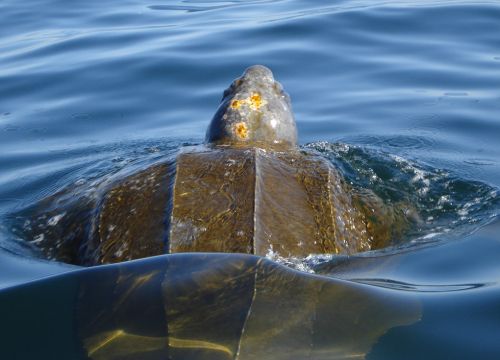
Leatherback sea turtle swimming. Image credit: NOAA.
The leatherback is the largest turtle--and one of the largest living reptiles--in the world. Leatherbacks are commonly known as pelagic (open ocean) animals, but they also forage in coastal waters, including the Gulf. Image credit: NOAA.
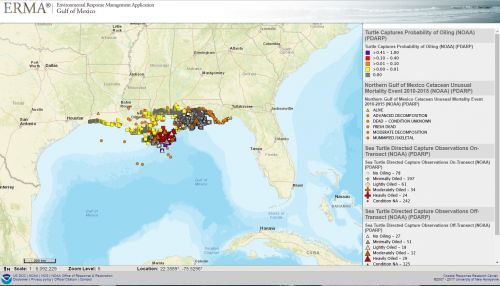
ERMA map of sea turtles in the Gulf. Image credit: NOAA.
This view of ERMA® Deepwater Gulf Response, our online mapping tool, displays sea turtle data from response efforts and the Natural Resource Damage Assessment. This site served a critical role in the response to the Deepwater Horizon oil spill and remains a valuable reference. Image credit: NOAA
Node Weight: 
8

NOAA Open House 2017

Short title: 
NOAA Open House 2017

Tours

Tours will be filled on a first come, first serve basis. Check back soon for tour times. Sign-ups will be available at the registration table. Guided tours include: WEATHER - Take a tour of NOAA’s National Weather Service Seattle office forecast center and learn how meteorologists work 24/7 to forecast the Seattle area weather from the waters of Puget Sound to the Cascade Mountains and everything in between. Tour is 30 minutes in length. OCEAN ENGINEERING – Step into NOAA’s engineering workspace where engineers are hard at work building and testing new technology to collect data from our oceans. See the evolution of tsunami sensing moorings and new innovative technologies used to study the ocean. Tour is 30 minutes in length. DIVING - Take a tour of NOAA’s Diving Center and take a (simulated) dive into the 30 foot deep training tower and hyperbaric recompression chamber. Get hands out experience with SCUBA diving equipment and learn how NOAA divers conduct research underwater. Tour is 45 minutes in length. MARINE MAMMALS - This tour includes rare access to the NOAA marine mammal research bone collection that includes orca skulls and a narwhal tusk! Tour is 30 minutes in length. SUSTAINABLE FISHERIES - Take a tour of NOAA Fisheries Net Loft where you will see how NOAA manages fisheries that produce sustainable seafood. Tour is 30 minutes in length. Please visit the Facebook event invitation for more information. Questions? Contact the NOAA Open House coordinators

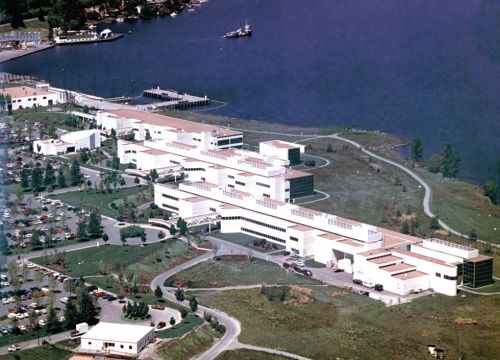
Aerial view of NOAA Seattle on Lake Washington.
NOAA’s Western Regional Center is in Seattle on Lake Washington, adjacent to Seattle’s Warren G. Magnuson Park. Image credit: NOAA
Node Weight: 
11

Pumpout Program Protects Puget Sound from Raw Sewage

Short title: 
Pumpout Program Protects Puget Sound from Raw Sewage

Instead, the sewage was collected for safe onshore treatment, a result of training and outreach funded by U.S. Fish & Wildlife for the Pumpout Washington program, a branch of the Clean Vessel Act that provides outreach and education to boaters.

This summer, the Pumpout team hopes to expand services to waterways that are more remote. Based on needs identified in boater surveys, services will soon reach the San Juan Islands, particularly near Sucia Island.

Washington Sea Grant redesigned a spill-free pumpout adaptor kit to make it easier for boaters to use the pumpout facilities without making a mess. Throughout 2016, 1,000 free adaptor kits were distributed at 50 marinas and raised awareness of best practices among Washington boaters at boat shows, festivals, yacht clubs and through a partnership with the Coast Guard Auxiliary.

“In Washington State, awareness of the Clean Vessel Act program and pumpout services is way up. The reaction from boaters has been so successful that we are breaking all records,” said Al Wolslegel, Clean Vessel Program manager.

For more information about the program, including a Google map showing pumpout station locations in Washington State, visit pumpoutwashington.org.

The Washington Clean Vessel Act program is part of the Clean Vessel Act of 1992 and in Washington it is managed by Washington State Parks and supported by the U.S. Fish and Wildlife Service’s Sportfish Restoration Fund from special taxes on recreational boats, fishing gear and boat fuel. The kits and training are made available to yacht clubs or other organizations that would like adaptor kits for members. Contact Aaron Barnett at 206-616-8929 or aaronb5@uw.edu for more information. Lake Washington boaters may schedule pumpouts through terryandsonsmobilepumpout.com, 206-437-6764.

MaryAnn Wagner is Assistant Director for Communications with Washington Sea Grant. Washington Sea Grant, based at the University of Washington, provides statewide marine research, outreach and education services. The National Sea Grant College Program is part of the National Oceanic and Atmospheric Administration (NOAA) U.S. Department of Commerce. Visit wsg.washington.edu for more information.

Seattle skyline on Lake Washington. Image credit: NOAA.
In 2016, Washington Sea Grant’s pumout program diverted a record 10 million gallons of raw sewage from Puget Sound, Lake Washington, and other state waterway. Image credit: NOAA
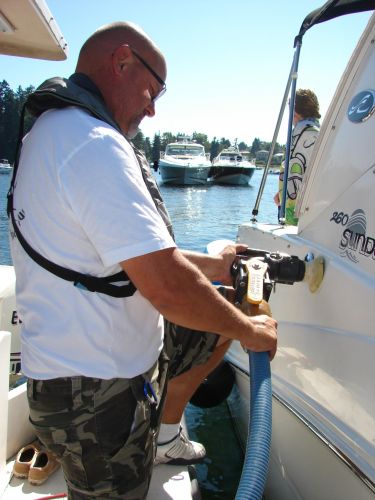
Man pumping out waste from boat. Image credit Washington Sea Grant.
Terry Durfee providing a free pumpout service to a boater on Lake Washington. Image credit: Washington Sea Grant
Node Weight: 
11

What we do to Help Endangered Species

Short title: 
What we do to Help Endangered Species

May 19, 2017 - For over 40 years, the 1973 Endangered Species Act has helped protect native plants and animals and the habitats where they live. Many government agencies play a role in that important work. That's one reason the United States celebrates Endangered Species Day every year in May.

The Office of Response and Restoration contributes to the efforts to protect these species in our Emergency Response Division and assessment and restoration work.

When a spill occurs in coastal waters one priority for our emergency responders is identifying any threatened or endangered species living in the area near the spill.

At every spill or chemical release, our scientists need to take into account:

  • Is it breeding season for any protected species in the area?
  • Is any of the spill area nesting grounds for protected species?
  • How protected species might come into contact with the spilled contaminant?
  • What are possible negative effects from the cleanup process on the protected species?

We assist the U.S. Coast Guard with a required Endangered Species Act consultation for spills to ensure those species are considered in any response action taken. We’ve also developed tools that can be used by all emergency responders and environmental resource managers to help protected endangered plants, animals, and their habitats.

Environmental Sensitivity Index maps identify coastal habitats and locations that may be especially vulnerable to an oil spills. The main components of these maps are sensitive wildlife, shoreline habitats, and the economic resources people use there, such as a fishery or recreational beach.

Threatened and Endangered Species Geodatabases allows oil spill planners and responders to easily access data on federal or state listed threatened and endangered species for specific regions. These data are a subset of the larger, more complex environmental sensitivity index data and are a convenient way to access some of the more critical biological information for an area.

Environmental Response Management Application, called ERMA ®, is our online mapping tool that integrates static and real-time environmental data and allows users to investigate data in their area. There are hundreds of publicly available base layers including many endangered and threatened species. Environmental Sensitivity Index maps are available in this tool.

Marine debris affects endangered and threatened species including species of sea turtles, whales, seals, and corals. These fragile populations face a variety of stressors in the ocean including people, derelict fishing gear, trash, and other debris. To learn more about the dangers of marine debris on marine life check out this blog post. or visit the NOAA Marine Debris Program website. For more information on threatened and endangered species, and local events for Endangered Species Day, visit U.S. Fish and Wildlife Service.

For information on endangered and threatened marine species visit NOAA Fisheries.

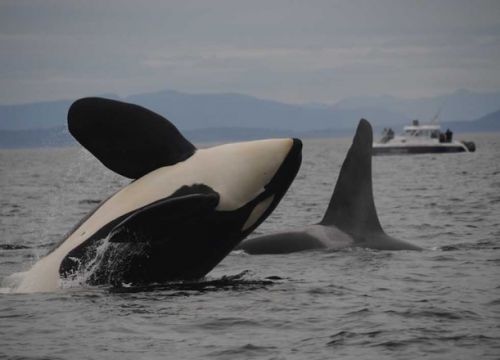
Two killer whales (orcas) breach in front a boat. Image credit: NOAA.
NOAA developed an oil spill response plan for killer whales that includes three main techniques to deploy quickly to keep these endangered animals away from a spill. Image credit: NOAA
Node Weight: 
10

Pages

Subscribe to response.restoration.noaa.gov RSS