Back to top

NOAA Supports Spill Response After Fishing Vessel Sinks Off San Juan Island, Washington

Short title: 
NOAA Supports Spill Response After Fishing Vessel Sinks Off San Juan Island, Washington

AUG. 17, 2022 — NOAA is continuing to support response efforts following the sinking of a commercial fishing vessel and the resulting diesel fuel spill 300 yards west of San Juan Island, Washington on Saturday, Aug. 13. The F/V Aleutian Isle was reported to have approximately 2,500 gallons of diesel fuel and 100 gallons of hydraulic fluid and lubricant oil aboard.

After the vessel sank, responders observed a sheen spanning about three miles that reportedly entered Canadian waters. NOAA’s Office of Response and Restoration is providing trajectory assistance for the spilled oil, as well as facilitating Endangered Species Act consultation with NOAA’s National Marine Fisheries Service for Southern Resident killer whales that are at risk in the area.

NOAA and its partners continue to monitor the area for the protected orca species, using aircraft overflights and underwater listening devices to monitor the animals’ locations. As of 2 p.m. Pacific Time on Aug. 17, no orcas were observed or acoustically detected near the spill area. 

OR&R is also supporting ongoing efforts to recover the purse seine net from the sunken vessel, and ensuring the safety of water intakes in the region. 

In on-scene observations this morning, responders noticed a significant reduction in the visible sheen that was confirmed by drone and helicopter overflights, as well as by surface and shore assessments, according to the latest U.S. Coast Guard press release. By mid-afternoon the sheen appeared to have completely dissipated. 

“I am proud of the interagency partnership and collaboration at all levels to respond to this pollution threat and minimize environmental impacts,” the federal on scene coordinator, Cmdr. Jon Ladyga, said in the release. “While optimistic about the on-water and shoreline assessments, we recognize that critical work remains”

As of Tuesday afternoon, more than 3,800-feet of absorbent boom had been placed throughout the affected area, in areas as far south as Kanaka Bay to areas as far north as the tip of Henry Island. Booming remains in place as a precautionary measure to protect sensitive environmental habitats.

The local salmon fishery opened yesterday amid the response efforts. While a 1,000-yard safety zone remains in effect, there are no additional restrictions as a result of the incident.  

“We would encourage fisherman to avoid catching fish in areas where sheens are observed,” Dave Byers, state on scene coordinator with the Washington Department of Ecology said in the release. “Thankfully with the dissipation of all visible sheening today, there should be no impacts to salmon fishing.” 

The Unified Command consists of the U.S. Coast Guard, Washington State Department of Ecology, San Juan County Office of Emergency Management, and the Swinomish Tribe. 

Support agencies include NOAA, Washington Department of Fish and Wildlife, Islands' Oil Spill Association, and the U.S. Fish and Wildlife Service. The Joint Response Team with Candanadians partners was also activated for coordination. The Unified Command is sharing information and coordinating with Canadian authorities.

To report any oiled wildlife, please call 1-800-22-BIRDS.

For more updates, visit the Washington Department of Ecology’s incident-specific webpage.

An aerial image of an oil sheen on a body of water.
Response vessels with vaccuum trucks on board off San Juan Island. Image credit: U.S. Coast Guard.
A net being pulled out of the water.
A lost net is raised out of the water by the crew of the Henry Blake. Image credit: U.S. Coast Guard.
Node Weight: 
1

Environmental Protection Agency Investigates Ocean Dumping Site in California

Short title: 
Environmental Protection Agency Investigates Ocean Dumping Site in California

From the 1930s until the early 1970s, multiple government agencies  approved ocean disposal of domestic, industrial, and military waste at 14 deep-water locations off the coast of Southern California. While EPA and our federal, state and local agency partners have been aware of these disposal practices over the years, the significant depth (up to 1000 meters or 3200 feet) and distance from shore of these disposal sites have historically posed significant challenges to assessing the sites for potential threats to human health or the environment.

With renewed public interest in these challenges, EPA, NOAA, and several other federal, state, and local agencies began working together to see if advances in technology enable a new look at this issue. Learn more about these ongoing efforts on the Environmental Protection Agency website

A map.
Figure 1: Shows the approximate placement of the 14 deep-water disposal locations. Source: 1973 Southern CA Coastal Water Research Project (SCCWRP) Report (PDF).
Node Weight: 
1

OR&R Supporting Oil Spill in Coastal Peru

Short title: 
OR&R Supporting Oil Spill in Coastal Peru

The spill has already impacted: numerous beaches; biodiverse swaths of the Pacific coastline and marine habitats, including five natural reserve areas; commercial and artisanal fisheries; and the tourism industry. The government of Peru has formally declared an environmental emergency and has reached out to the United Nations as well as governments and organizations around the world for assistance and advice. 

NOAA is coordinating with the U.S. Agency for International Development, the U.S. National Response Team, and the government of Peru to manage the complexities of supporting an international incident and is providing the following assistance. 

At the request of the government of Peru, NOAA’s National Environmental Satellite, Data, and Information Service is providing to Peru’s space agency, CONIDA, high-resolution satellite reconnaissance and its imagery reports and analysis, showing oiling extent and magnitude delineations that can be critical to emergency response operations. 

NOAA’s Office of Response and Restoration—a center of expertise in preparing for, evaluating, and responding to oil and chemical spills in coastal environments—represents NOAA on the U.S. National Response Team. The team is a network of 15 federal agencies that provides guidance, assistance, and resources for managing pollution incidents. Through this team, these agencies are engaged in dialogue with the Peruvian government. 

As requested by the government of Peru, OR&R is providing oil trajectory modeling forecasts and analysis to better understand the oil’s movements and to assess the threat it may pose to other resources. This work is helping Peruvian authorities focus clean-up activities and interventions, as well as preventative actions in appropriate places, given the broad geographic extent of the disaster. 

OR&R is also working side-by-side with the U.S. Coast Guard to advise on oil spill containment methodology and clean-up guidance, and is helping develop assessments of the environmental impacts  and economic damages. Among the resources that OR&R has shared was guidance in Shoreline Cleanup Assessment Technique, a methodology that spill responders use to conduct shoreline assessment after an oil spill, as well as other Spanish-language spill response resources.

This article will be updated.

For more information, contact Doug.Helton@noaa.gov or Aaron.Parker@noaa.gov

Cleanup workers on an oiled beach.
Cleaning crews work to remove oil from a beach near Lima, Peru, on Jan. 20, 2022. Image credit: EPA, via Shutterstock.
Node Weight: 
1

Map of the Month: Environmental Sensitivity in the Great Lakes

Short title: 
Map of the Month: Environmental Sensitivity in the Great Lakes

OR&R’s Environmental Sensitivity Index (ESI) program released two new atlases of ESI data and maps for two critical links in the Great Lakes region: St. Marys River and the St. Lawrence River. These rivers are high-risk corridors for an oil or chemical spill due to transport by rail, pipeline, and commercial shipping, and they contain diverse and sensitive habitats. The previous ESI atlases for the St. Marys and St. Lawrence rivers were published in 1986 and 1985, and did not provide responders with the up-to-date data critical for spill response.

ESI data are available as GIS data, PDF maps, and online interactively in the Environmental Response Management Application (ERMA®). The map below is a portion of the 52 new maps created showing the biologically-important areas and another corresponding 52 new maps showing the human use features relevant to oil and chemical spills. This update is fully incorporated into the digital analysis & query tools in ERMA. 

View the maps in ERMA here.

A map.
Detail of Map 16 and Map 18 of the St. Marys ESI Maps.
Node Weight: 
1

2021 Accomplishments: The Year in Review

Short title: 
2021 Accomplishments: The Year in Review

NOAA’s Office of Response and Restoration works to minimize environmental damages and prepare coastal communities to better deal with the impacts of marine debris, oil spills, and hazardous materials. 

In fiscal year 2021: we provided scientific support for 177 pollution-related incidents; we provided incident coordination to four hurricane and tropical storms during the 2021 hurricane season through the Disaster Preparedness Program; we removed 1,924 metric tons of marine debris; we recovered over $130 million from polluters for restoration; and we made significant, publicly available improvements to our data management and mapping capabilities. These accomplishments show our dedication to science-based solutions for protecting and restoring natural resources from coastal hazards.

“I’m incredibly proud of the entire OR&R team for these extraordinary results. These numbers are an indicator of the scope of the outstanding services that OR&R delivered this past fiscal year. Pandemic challenges were no match for the team’s creativity and drive to protect and restore ocean and coastal resources from the impacts of pollution—oil, chemical, marine debris—and other coastal hazards.”  —Scott Lundgren, OR&R Director

Explore our 2021 Annual Accomplishments Report to learn more about the work we did last year, and stay tuned over the next two weeks as we take a more in-depth look at some of the accomplishments featured.

Over $130 Million to Restore 10 Polluted Waterways Across the Country

When pollution harms American waterways, it’s not enough to simply clean up the contamination. Restoring the environment means implementing projects that help habitats, wildlife, and coastal communities recover quickly and completely. In fiscal year 2021, NOAA helped to recover over $130 million to restore 10 polluted waterways after oil spills and industrial pollution. Read more about the settlements and how the money will be used here. 

A Dozen Ways NOAA Advanced Marine Pollution Science in 2021

To answer the question “How does pollution impact the ocean and what can we do about it?” NOAA experts often need to conduct research that advances our knowledge of marine pollution science. This blog highlights 12 scientific articles about research advancing pollution response and assessment published in Fiscal Year 2021. Read the full blog here.

The First Cross-NOAA Disaster Recovery Support Workshop

In FY21, The Office of Response and Restoration’s Disaster Preparedness Program and the University of New Hampshire’s Coastal Response Research Center (CRRC) recently hosted the first cross-NOAA workshop on Disaster Recovery Support. Read more about the workshop here.

A Mission to Mālama Through Marine Debris Removal

On Wednesday, Sept. 22, the NOAA Pacific Islands Fisheries Science Center’s Marine Debris Project team, joined by the non-profit Papahānaumokuākea Marine Debris Project, marked the completion of their marine debris removal mission in the Papahānaumokuākea Marine National Monument (monument). The team arrived at Pearl Harbor aboard the charter vessel IMUA along with the nearly 124,000 pounds of marine debris removed during the 30-day mission. Read more about the removal here.

A screenshot of a map.
An Esri ocean map in ERMA.
Node Weight: 
1

Map of the Month: NOAA Oil Spill and Waste Sites

Short title: 
Map of the Month: NOAA Oil Spill and Waste Sites

Over our 30+ year history, NOAA and our partners have helped recover over $10.5 billion to restore coastal ecosystems and communities after oil spills and hazardous waste pollution. This map shows the 81 oil spill sites and 163 hazardous waste sites across the country where we have reached settlements to fund restoration. 

Restoration funds have been used to restore wetlands, beaches, reefs, corals, remove dams to restore fish passage on rivers, and to promote outdoor recreation by building parks, boat ramps, and fishing piers. These restoration projects also provide economic benefits to coastal communities, including underserved and indigenous communities often disproportionately affected by pollution. 

To learn more about NOAA’s work in your area, visit our interactive “Explore Projects” map on the Damage Assessment, Remediation, and Restoration Program website or learn about DARRP's accomplishments

A map of the U.S. showing oil and waste sites.
Node Weight: 
1

Update: NOAA's Support for Huntington Beach Oil Spill

Short title: 
Update: NOAA's Support for Huntington Beach Spill

The Unified Command for this incident is now composed of representatives of the U.S. Coast Guard (USCG), California Department of Fish and Wildlife's Office of Spill Prevention and Response, County of Orange, County of San Diego, and Amplify Energy (the Responsible Party).

The incident has transitioned to a primarily virtual Incident Command Post and the Unified Command continues to meet multiple times daily. 

Amplify Energy has secured the pipeline from leaking and is proceeding with assessment of the damaged areas of the pipeline to support repair planning, in close coordination with the Pipeline Hazardous Materials Safety Administration (PHMSA).

The spill amount is estimated as at least 24,696 gallons. This spill estimate was reached by consensus across seven agencies involved in the incident (USCG, PHMSA, California Department of Fish and Wildlife, NOAA, California State Lands, State Fire Marshal, and Bureau of Safety and Environmental Enforcement).

Since OR&R’s last update, the oil from this incident has continued to move southward and strand on San Diego beaches. The response team is investigating reports of tarballs reaching the Mexican shoreline and is coordinating with officials from the Mexican Navy.

The response team dealt with a forecasted weather event, including  rain, gusty winds, and high surf that passed through the area on Monday, Oct. 25. Operations were suspended on Monday afternoon due to unsafe conditions from the weather event, but resumed the next day. The storm brought a significant amount more oil and oiled wrack ashore.

Environmental Impacts

The response continues to assess shorelines for the presence of tarballs and prescribes cleanup, as necessary. Throughout the area of response, shorelines remain in various stages of assessment, cleanup, inspection, and sign-off. In addition to responding to reports of tarballs, shorelines are being resurveyed after storms to identify whether tarballs have mobilized onto shorelines. At this time, no shorelines have been signed off by the Unified Command. 

The public may encounter tarballs on San Diego and Orange County beaches. Because oil contains hazardous chemicals, do not attempt to touch/pick up any tarballs or oil. A tarball fact sheet is available for more information. If you observe oil on the shoreline, please email tarballreports@wildlife.ca.gov or use the “Report Tarballs” button on the Joint Information Center website.

Shoreline Cleanup Assessment

OR&R response scientists continue to support the SCAT (Shoreline Cleanup Assessment Technique) effort and shoreline sign-off process for Orange County beaches. OR&R is serving as Federal representative on two SCAT teams. 

Several of the county’s beaches are now being evaluated for sign-off. The following is a brief description of the sign-off process for shoreline segments:

The Sign-off Team is generally composed of representatives from the appropriate agency(ies) and the Responsible Party, usually the SCAT team and the local land manager(s).

When the SCAT Team agrees that a shoreline segment requires no further treatment (NFT), the team reports its recommendation for sign-off.  At that point, the segment enters a specific monitoring process which includes an initial inspection, then a 72-hour hold period, after which a Sign-off Team will return for a second inspection to determine if the segment continued to meet previously established cleanup endpoints. 

If endpoints are met, the team will recommend the segment for final approval by the Unified Command and move it out of response.

As part of the SCAT team—and using OR&R’s recently published Job Aid for use of uncrewed aircraft systems (UAS) for spill response—OR&R scientists used a UAS to capture high resolution photos and create orthomosaic images of the coastal wetlands and embayments in San Diego County. The tool was particularly effective because it allowed the responders to assess sensitive marsh habitats and difficult-to-reach shorelines through remote sensing, rather than risking damage to the habitats through physical presence.

Verification of Buried Oil

When oil first was observed on Huntington Beach, the beach was in an “accretion” phase (sand was being deposited), so some oil was buried in the first tidal cycles. It remained there until storms started to erode the shoreline and expose the buried oil on a small area of beach. Cleanup crews are cleaning the exposed oil.

Tarball Analysis

Samples of collected tarballs were transferred to U.S. Coast Guard custody. OR&R will be among several agencies/laboratories analyzing the chemical composition of the tarballs to determine if they are associated with this incident.

Natural Resource Damage Assessment

The initial injury assessment has begun for this incident’s Natural Resource Damage Assessment (NRDA)—a process to determine how natural and human-use resources were injured by pollution and what restoration may be needed.

The NRDA team is collecting samples of sediment, water, biota (e.g. invertebrates and fish), and documenting oil presence/absence to begin to assess what the injuries may be to natural resources of the beaches, water column, nearshore, marshes, rocky shores and subtidal habitats.

Important to this incident will be the economic/human-use impacts (e.g., closed beaches, marinas, fisheries) and how those impacts affect the public. Activities underway include daily surveys to document beach use post-spill.

Public Health Assessment Unit

The Public Health Assessment Unit (PHAU) updated its report on San Diego County to reflect the results of sampling. Based on the air, water, and sediment samples collected and analyzed during the oil spill, the PHAU determined that San Diego County air, water, and sediment do not pose a public health concern for short-term exposures from use of its water and beaches.

The PHAU’s determination does not cover fishing and harvesting activities. (See Fisheries Closures and Seafood Safety, below.)

Fisheries Closures and Seafood Safety

A state-imposed fisheries closure remains in effect, which prohibits the catch and consumption of any and all fish and shellfish within the area of the closure. Fisheries closure information and a closure map are available on the spill’s Joint Information Center website

NOAA is not involved in fisheries closure or seafood safety issues for this incident.

Wildlife

The Oiled Wildlife Care Network is continuing to respond to reports of oiled wildlife. Both oiled and unoiled wildlife have been recovered, with some being rehabilitated and released. A bird release is  planned for Friday, Oct. 29. 

A comprehensive list of species and daily updates on impacted wildlife recovered during response activities is available at the website of the Oiled Wildlife Care Network at the University of California-Davis. 

Anyone observing oiled wildlife should not attempt to capture it. Instead, please report observations of oiled wildlife to the oiled wildlife hotline at 1-877-UCD-OWCN (1-877-823-6926).

COVID-19 Safety

A comprehensive COVID-19 plan and protocols continue to be implemented. for both field operations and Incident Command Post personnel.

Other Reports about this Incident

Cleanup workers on a beach.
Cleanup team picking up tar patties, tarballs, and oiled wrack on Cardiff State Beach on Oct. 21, 2021. Image credit: NOAA.
Oil beach debris.
Typical beach debris—oil mixed with beach wrack—seen on Cardiff State Beach, Oct. 21, 2021.
Node Weight: 
1

Update on NOAA Support for California Oil Spill

Short title: 
Update on NOAA Support for California Oil Spill

OCT. 15, 2021 — Since Oct. 2, 2021, NOAA has been providing scientific support for an oil spill off of Huntington Beach, California. A Unified Command, composed of Amplify Energy, the U.S. Coast Guard, and the California Department of Fish and Wildlife’s Office of Spill Prevention and Response, is directing spill response efforts. Orange and San Diego county representatives have also joined the Unified Command.

The source of the spill is a pipeline associated with the offshore platform “Elly” owned by Beta Offshore, a subsidiary of Amplify Energy. Platform Elly is a processing and gathering facility for four other production facilities off the coast. 

The investigation is focusing on potential ship anchor damage. The spill volume is still reported as a maximum of 3,134 barrels (131,628 gallons) and a minimum spill of 588 barrels (24,696 gallons), but the Coast Guard has publicly stated that “the final count for the spill will likely be closer to the lower figure, which correlates with the amount of oiling seen on the California shore.” A multi-agency investigation continues separate from the spill response.

NOAA Activities

OR&R is providing on-scene and remote scientific support. This includes helping with shoreline assessment, development of shoreline treatment recommendations and clean-up endpoints, development of cleanup metrics, maintenance and monitoring plans, and development of best management practices for the protection of natural resources and historic properties. 

OR&R is also providing situational awareness to the Unified Command via the Environmental Response Management Application (ERMA®). ERMA is an online mapping tool that brings a variety of data together into a single interactive mapping application.

See how ERMA is being used to display the cumulative oil spill footprint and evaluate risk to sensitive habitats in this interactive ERMA map

The ERMA “SCAT Dashboard” has been implemented to show the number of shoreline segments surveyed and their degree of oiling status. 

Using the recently published Job Aid for using uncrewed aircraft systems (UAS) during oil spill response, the OR&R team is preparing flight plans for shoreline surveys using UAS to support SCAT (shoreline cleanup assessment technique) work. UASs are an emerging and effective tool in oil spill response.

NOAA Office of Response and Restoration experts are working to help assess the impacts of pollution from the Huntington Beach spill. Our scientists are currently working to evaluate impacts to shorelines, fish and other life in the water column, human use and outdoor recreation, and other coastal resources.  As natural resource trustees, NOAA works with federal, state, and tribal authorities, to assess injuries to coastal natural resources and work toward restoration. 

NOAA Fisheries is supporting the response effort by working with local partners on the recovery and rehabilitation of any oil-impacted marine mammals and sea turtles. NOAA Fisheries also supports the U.S. Coast Guard and all responders by assessing the impacts of response activities on threatened and endangered species.

NOAA National Environmental Satellite, Data, and Information Service continues to provide satellite support. Even negative reports are useful in evaluating the need for offshore overflights, skimming, and trajectories. Due to the lack of aerial oil observations (e.g., from aircraft and satellite), further trajectory products will be limited. 

NOAA’s National Weather Service continues to provide weather briefings and decision support to the Unified Command. Weather conditions will change how the oil moves and where it might strand on beaches.

A camera crew filming a man on a beach.
OR&R's Jordan Stout speaking with the media about the Huntington Beach oil spill. Image credit: California Department of Fish and Wildlife/OSPR.
A group of people in an incident command center.
OR&R's Catherine Berg and Faith Knighton speak with Admiral McCallister as he visited the Incident Command Post. Image credit: U.S. Coast Guard.
Node Weight: 
1

Map of the Month: Huntington Beach Oil Spill and Environmental Sensitivity

Short title: 
Map of the Month: Huntington Beach Oil Spill

On Oct. 2, 2021, NOAA was contacted by the U.S. Coast Guard regarding an oil spill off the coast of Long Beach, California. Quickly data started coming in as the size of the spill was evaluated. ERMA was utilized immediately as the common operational picture for the response and natural resource damage assessment. 

In the map above, ERMA is displaying the marine pollution surveillance reports (MPSR) from the satellite branch of NOAA's National Environmental Satellite, Data, and Information Service, which came in hours after first reports of oil being spilled. These green polygons depict where potential oil slicks have been observed across the days after the immediate spill.

In the map is the approximate spill location, shown with the red kite, and the environmental sensitivity index (ESI) data for the impacted area. ESIs depict sensitive shoreline, potential wildlife that can be present, as well as various habitats that are important to protect, such as Marsh or benthic habitats.

In the days to follow, the response grew as did the amount of data being collected. Teams were out collecting field data from samples, overflights, shoreline assessments, and teams tracking impacted animals.  

All this information was aggregated into ERMA as the common operational picture and helps responders assess the efforts across the entire effort and plan where to allocate resources for the future.

View the map in Southwest ERMA here.

Credit: 

This "Map of the Month" is brought to you by Jay Coady, George Graettinger, and Megan Ewald from OR&R’s Assessment and Restoration Division. This map features data from NOAA-NESDIS marine pollution surveillance reports.

A screenshot of a map.
Node Weight: 
1

NOAA Continues Support for California Oil Spill

Short title: 
NOAA Continues Support for California Oil Spill

Information is being provided to the public through a Joint Information Center website, established by the Unified Command composed of the U.S. Coast Guard, California Department of Fish and Wildlife’s Office of Spill Prevention and Response, and Amplify Offshore (the Responsible Party).

Additional NOAA staff have deployed to Long Beach for both response and injury assessment, with five additional staff deploying for response support on Oct. 6 and four deployed for injury assessment for the natural resource damage assessment.

Background 

At 8:40 a.m. local time on Oct. 2, 2021, the U.S. Coast Guard contacted NOAA regarding an unknown sheen in the waters off Huntington Beach, California. Roughly 45 minutes later, NOAA captured satellite imagery that became the basis for a marine pollution surveillance report, issued the same day by the Satellite Analysis Branch of NOAA’s Environmental Satellite, Data, and Information Service. The report showed oil slicks extending for more than 30 miles along the coast. A Unified Command was set up to direct spill response efforts. 

Spill Volume

At this time, the volume of the spill is still being investigated.

Spill Source

The source of the spill is a pipeline associated with the offshore platform “Elly” owned by Beta Offshore, a subsidiary of Amplify Energy. Platform Elly is a processing and gathering facility for four other production facilities off the coast. The volume and cause of the spill are still being investigated. 

Potential Cause

The cause of the spill remains under investigation. Preliminary surveys show potential anchor damage. Diver reports and remotely operated vehicle (ROV) footage by the Unified Command showed a 4,000-foot section of the 17.7 mile-long pipeline was displaced with a maximum lateral movement of approximately 105 feet and a 13-inch split, running parallel to the pipe. The footage showed no indications of oil still being released at the potential source of the leak.

There is a large number of ships anchored off the coast associated with the record backlog at the Port of Los Angeles/Long Beach. 

Other Updates

A brief update follows; however, for current information, the Unified Command continues to update its Joint Information Center website

  • Overflights continue to monitor the ocean and shore for oil impact.
  • Open-water skimming operations are continuing.
  • Shoreline cleanup and monitoring efforts are continuing.
  • Oiled wildlife have been recovered. The latest information can be found at the website of the Oiled Wildlife Care Network at the University of California-Davis. 
  • SCAT (shoreline cleanup assessment technique) teams are deployed, with SCAT results being entered into NOAA's online mapping tool, ERMA® (Environmental Response Management Application).
  • Fisheries in the region remain closed, with updates available from California Department of Fish and Wildlife, including a link to maps of closed regions.
  • Several of the recreational ports in the area have been closed or restricted to prevent pleasure craft from becoming contaminated.
  • Local area beaches remain closed, with cleanup teams operating at Huntington Beach and Newport Beach.

NOAA Activities

The NOAA National Ocean Service Office of Response and Restoration (OR&R) is providing on-scene and remote scientific support, including spill trajectory products [more information about oil spill trajectory modeling]. OR&R is also providing assistance with SCAT, data management, and other scientific support. The National Ocean Service is also engaged with trustees for natural resource damage assessment. NOAA satellites marine pollution surveillance reports (MPSR) are providing synoptic views of surface oil. [More information about MPSRs]

NOAA Fisheries is supporting the response effort by working with local partners on the recovery and rehabilitation of any oil-impacted marine mammals and sea turtles. NOAA’s National Weather Service forecasts are supporting the response, including scientific support products. NOAA wind forecast data and currents, from a combination of high frequency radar observations and models, are driving National Ocean Service modeling. The NOAA ship Fairweather is currently working on a project at the Channel Islands National Marine Sanctuary and is potentially available to support the response.

An aerial image of oil in water.
Crude oil is shown in the Pacific Ocean offshore of Orange County, Oct. 3, 2021. Image credit: U.S. Coast Guard.
A marine pollution surveillance report.
Node Weight: 
1

NOAA Supporting Oil Spill off Newport Beach, California

Short title: 
NOAA Supporting Oil Spill off Newport Beach, California

U.S. Coast Guard field teams investigating the information observed black oil roughly 3.25 nautical miles offshore and requested NOAA support in mapping the trajectory of the oil.

NOAA is engaged in multiple ways:

The NOAA National Ocean Service Office of Response and Restoration is providing scientific support, including modeling, as well as on-scene presence, shifting from virtual to in-person beginning October 4, 2021. 

NOAA’s National Ocean Service is also engaged with trustees on injury assessment for Natural Resource Damage Assessment

NOAA Fisheries is supporting the response effort by working with local partners on the recovery and rehabilitation of any oil-impacted marine mammals and sea turtles. NOAA Fisheries also supports the U.S. Coast Guard and all responders by assessing the impacts of response activities on threatened and endangered species.

NOAA Satellites Marine Pollution Surveillance Reports are providing synoptic views of surface oil. 

NOAA’s National Weather Service forecasts are supporting the response, including scientific support products. (NOAA wind forecast data and currents, from a combination of high frequency radar observations and models, are driving NOAA National Ocean Service modeling.)

A Unified Command, composed the Coast Guard, and the California Department of Fish and Wildlife’s Office of Spill Prevention and Response (CDFW-OSPR) has been established. 

More information is available in the Coast Guard's Update 1 and the Public Affairs Detachment San Diego news page.

(Correction made to Unified Command composition: Oct. 6, 2021.)

Woman looking out the window of a plane.
Capt. Rebecca Ore, commanding officer of Sector Los Angeles/Long Beach, assesses water and shoreline impacts along the Orange County coast, Oct. 3, 2021. Image credit: USCG.
Site Themes: 
Node Weight: 
2

Marine Pollution Prevention: Keeping Our Coasts and Waterways Clean

Short title: 
Marine Pollution Prevention: Keeping Our Coasts and Waterways Clean

The most important element in prevention is preparedness. OR&R combats pollution before it happens by preparing for a variety of scenarios, such as an oil spill in Arctic waters or damage to an industrial facility caused by a hurricane. While changes in policy and procedure can help to prevent the incidents entirely, there is always a potential for mechanical or human failure. Through training, exercises, and planning, responders can limit the pollution impacts of the incidents that do happen.

Below, explore marine pollution prevention through a series of blogs about prevention pollution on historic shipwrecks and during disasters, and how you can prevent marine debris and runoff pollution in your lawncare. 

Backyard Pollution Prevention: 5 Ways to Help Keep Waterways Healthy

When it comes to keeping waterways clean, we all have a part to play. Some of the most simple steps can take place in your own backyard. In our latest blog, here are five ways you can help keep waterways healthy ... Read more.

Preventing Marine Pollution Before the Storm

Hurricanes pose threats from storm surge, inland flooding, wind damage, and even tornadoes, but a lesser known impact is the natural and man-made marine debris they cause. In this blog, learn how you can help prevent marine pollution before a storm hits. ... Read more.

The Power of Prevention to Keep the Sea Free of Marine Debris

Our ocean is filled with items that don’t belong there. From our everyday food wrappers, plastic bottles, and cigarettes to large and damaging derelict fishing nets and abandoned and derelict vessels, marine debris is a global problem that touches every corner of our ocean and Great Lakes. Although cleaning up marine debris is a helpful way to address the problem, the best way to keep marine debris out of our environment is by preventing it. ... Read more.

Preventing Marine Pollution through a Historic Shipwreck Database

Prevention efforts have reduced recent ship sinkings, but what about the thousands of historical shipwrecks in U.S. waters?  Many of these sit out of sight, damaged, collapsed onto the seabed—some threatening to leak their oil cargo or fuel. Is there a way to prevent spills from ships that have already sunk? Improvements in underwater technologies now allow salvage companies to safely conduct oil removal operations from sunken ships, but where to start? ... Read more.

Learn More:

Oil in pollution boom.
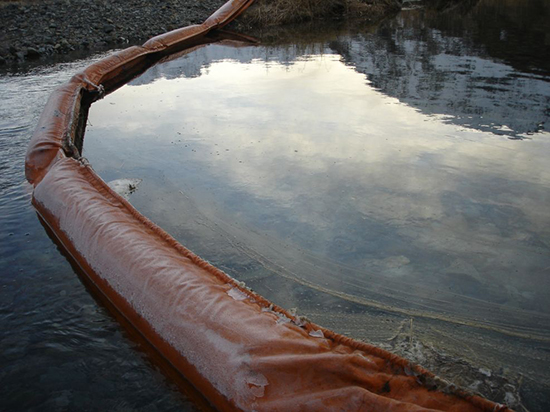
Pollution boom used in the Selendang Ayu oil spill. Booming is a common technique used by spill responders to prevent oil from spreading and impacting sensitive areas and habitats. (December 2004 - Unalaska Island, Alaska credit: NOAA)
Node Weight: 
1

Registration Open for the Great Shakeout

Short title: 
Registration Open for the Great Shakeout

This short event is designed to bring awareness to earthquake preparedness in support of the upcoming National Level Exercise 2022 that focuses on the Cascadia Subduction Zone, located on the West Coast.

During this preparedness activity, participants will hear a pre-recorded emergency alert asking them to get into their safe place and cover and hold for 1 minute. Also during this time, the program is asking participants to snap a picture of themselves in their safe spot and send it to us. We’ll then feature this activity and the photos in an upcoming OR&R Weekly as well as a future awareness and preparedness blog focusing on earthquakes.

Click here to register for either session of the Great Shakeout exercise on Oct. 21. Once registered, you will receive a separate Google Calendar invite for your requested time.

For more information, contact Leah.Odeneal@noaa.gov or Katherine.Krushinski@noaa.gov.

A graphic reading "Get Read to Shake Out."
Site Themes: 
Node Weight: 
1

NOAA Providing Scientific Support for Hurricane Ida

Short title: 
NOAA Providing Scientific Support for Ida

Sept. 3, 2021 — NOAA is providing direct scientific and technical support to federal and state agencies responding to pollution threats from Hurricane Ida. Hurricane Ida made landfall as a Category 4 hurricane on Sunday, Aug. 30, leaving behind a path of destruction and leaving over a million people without power along the Louisiana coastline. 

Many groups within the National Ocean Service of NOAA, including all of the divisions within the Office of Response and Restoration, are supporting the response to the devastation brought on coastal Louisiana by the Category 4 winds and torrential rain.

Prior to landfall, OR&R’s scientific support coordinators worked closely with response agencies in anticipation of impacts to oil and gas and transportation infrastructure in the projected path of the storm. Disaster response plans are activated and NOAA teams stand on the ready to provide immediate support identifying and sharing information on where impacts occur. 

Immediately after the storm made landfall, responders from NOAA’S National Response Team and the Office of Coast Survey deployed to the impacted region to help survey navigational waterways critical to marine transportation and the supply of vital resources to the heavily impacted region, such as emergency fuel, food, and other vital supplies. Survey crews work through very challenging conditions to deploy vessels in the ports and major navigation channels to identify sunken vessels and other obstructions that must be cleared to allow vital resources into and out of the heavily impacted region that serves as a critically important lifeline to the nation’s economy. 

From Aug. 30 to Sept. 2, the National Geodetic Survey collected aerial damage assessment images in the aftermath of Hurricane Ida. Imagery was collected in specific areas identified by NOAA in coordination with FEMA, the U.S. Coast Guard, and other state and federal partners. The imagery was made immediately available to all response agencies in the region and posted on the NGS website as well as the Emergency Response Management Application (ERMA) to aid these agencies in conducting rapid damage assessments and targeting areas where deploying response resources are needed most. Collected images are available to view online via the NGS aerial imagery viewer. (View tips and a video on how to use the imagery viewer.)

Additionally, a methodical analysis of all available imagery is initiated by OR&R as soon as it is made available to assist local, federal, and state response agencies in determining the precise location of each potential pollution source and quickly evaluating the overall extent of potential pollution sources throughout the entire impacted region. Other NOAA resources such as the Office of Satellite Products and Operations (OSPO) in the National Environmental Satellite, Data, and Information Service begin sourcing satellite imagery in the storm’s path and employ analysts to evaluate the imagery for potential pollution releases and quickly disseminate reports to response agencies. This greatly enhances awareness of potential threats to the environment in areas that are otherwise mostly inaccessible to other more traditional assessment resources deployed from air, water, and land. Additionally, it does not put more demand on these resources such as aircraft and boat crews who are conducting critical lifesaving search and rescue missions immediately post storm. 

Using aerial imagery, responders and contractors have identified a total of 906 pollution targets thus far, with more expected over the next week. These targets will later be confirmed on the ground by the U.S. Coast Guard and prioritized for response operations. 

Additionally, OR&R’s Marine Debris Program is providing support to the Hurricane Ida Debris Task Force, a joint effort led by the Louisiana Governor's Office of Homeland Security and Emergency Preparedness (GOHSEP), FEMA, and U.S. Army Corps. A vessel target list will provide the task force with necessary information for coordinating across debris removal and pollution response activities.

OR&R’s Disaster Preparedness Program is also providing incident coordination across the National Ocean Service. 

OR&R will continue to support response and recovery efforts in the region by providing scientific and technical support in pollution assessments and any resulting pollution removal actions. 

A screenshot of a map.
Site Themes: 
Node Weight: 
1

Map of the Month: Rapid Response to Pollution Threats Following Hurricane Ida

Short title: 
Map of the Month: Pollution Response to Ida

This map of the Port Fouchon area is displaying the aerial overflight imagery collected by the National Geodetic Survey (NGS) as well as possible oil observed in satellite imagery obtained by the National Environmental Satellite, Data, and Information Service. The red track is the best track line for Hurricane Ida provided by the National Hurricane Center (NHC).

Last month, on the 16th anniversary of the landfall of Hurricane Katrina, Hurricane Ida made landfall near Port Fourchon, Louisiana as a Category 4 hurricane. In the aftermath of Ida’s arrival, OR&R and partner agencies have been using ERMA (Environmental Response Management Application) as a common operating picture in the response and recovery operation.

ERMA has been used to provide scientific support and data to U.S. Coast Guard response efforts, including the display of aerial imagery collected by NGS and potential locations of oil spills from NOAA’s National Environmental Satellite, Data, and Information Service (NESDIS), marine debris targets, and navigational hazards.

To learn more, please visit the live map on Gulf of Mexico ERMA.

This "Map of the Month" is brought to you by George Marino from the OR&R Disaster Preparedness Program and Assessment and Restoration Division. 
 

A screenshot of a map.
Node Weight: 
1

Map of the Month: Marine Sanctuary Restoration Efforts

Short title: 
Map of the Month: Marine Sanctuary Restoration Efforts

This month is Get Into Your NOAA Marine Sanctuary Month and OR&R is highlighting our ongoing work with NOAA's Office of Marine Sanctuaries. There are 13 sanctuaries around the country and the Damage Assessment, Remediation, and Restoration Program works to restore habitats after chemical releases. As of 2021 there are eight DARRP funded restoration projects within sanctuary boundaries across the U.S. and seven of those are located in California. 

This map highlights restoration projects that focused on restoring marine sanctuary resources in Northern California. The projects demonstrate restoration implemented as a result of the Command Oil Spill. One project helped to create bird nesting habitats for the Greater Farallones National Marine Sanctuary and another increased outdoor recreational use and public access to the Monterey Bay National Marine Sanctuary.  

ERMA provides a user with the ability to identify the status of the restoration project and then click a link to get more information on project description, status and funding from NOAA Fisheries Restoration Atlas.     

View this map in ERMA Southwest here.

This "Map of the Month" is brought to you by Matt Dorsey and Megan Ewald from NOAA’s Office of Response and Restoration.

A screenshot of a mapping tool.
Node Weight: 
1

Spotlight on Urban Pollution: How NOAA Works to Keep Urban Waterways Clean and Recover After Pollution

Short title: 
NOAA's Work on Urban Industrial Pollution

Urban coastal communities present unique challenges when addressing pollution. The impacts can range from ecological to social. Pollution from past and current commercial and industrial activities has impaired our rivers and coasts. 

Hazardous waste, including oil spills, can have a devastating impact on coastal communities—affecting recreational and commercial activities such as fishing. NOAA is responsible for assessing and restoring river and coastal resources injured by hazardous waste releases. NOAA focuses on hazardous waste releases with the potential to harm marine and coastal resources, including chemicals like PCBs, and dioxins, PAHs, and toxic metals such as lead and mercury. These substances are released into coastal habitats and waterways from many commercial and industrial activities, such as shipbuilding, oil storage and transfer, and chemical manufacturing, among others.

This week, we’re taking a look at the different types of urban industrial pollution, how NOAA responds to pollution events and aids in the recovery of natural resources lost due to pollution, and what you can do to help keep pollution out of your waterway. In the blogs below, read about outdoor recreation on Washington, D.C.’s Anacostia River, urban community marine-debris cleanups, and how NOAA coordinates with the Urban Waters Federal Partnership on the Delaware, Anacostia, and Passaic river watersheds.

A Look at Oil Spills in Urban Centers

What’s different about spills in urban environments? When we hear or read about an oil spill, we often envision thick oil sullying a wilderness or open ocean environment—but most spills occur in more urban areas, where oil terminals, refineries, ports and marinas, or rail facilities are situated. In our latest blog, check out some oil spills that occurred in industrial and urban waterways and the types of impacts that they created, and the efforts of NOAA and partners to protect and restore injured resources ... Keep Reading.

Marine Debris Close to Home: Cleaning Up Our Urban Shores and Waterways

The coastal urban environment is an important place for people to enjoy a little bit of nature, and equally valuable for the animals and plants that make it their home. However, with people comes trash, and coastal areas close to large population centers can face a heavy burden of marine debris. The NOAA Marine Debris Program works with partners across the nation to prevent and remove marine debris in urban areas. ... Keep Reading.

The Value of Urban Waterways

You might be surprised to learn what swims through America’s cities. Even waterways with a history of pollution are full of life and are vital parts of local communities. In our latest blog, explore five urban waterways across the U.S to see the unique natural resources found there and learn where NOAA and co-trustee partners are working to restore urban habitats and communities ... Keep Reading.

The Anacostia River: Challenges and Opportunities for Outdoor Recreation in the Heart of Washington, DC

The Anacostia River in Washington D.C. has a long history of industrial pollution, but in recent years local advocates, government agencies, and water utilities have made great strides in restoring this urban river. Learn more in this guest blog from co-author Erin Garnass-Holmes, ambassador to the Anacostia Watershed Urban Waters Partnership ... Keep Reading.

The Nation's Founding Fish Returns to America's Most Historic Small Watershed

In this guest blog from our partners at the Brandywine Conservancy, learn about the Conservancy's reinvigoration of a 300-year-old quest to bring back our nation's founding fish to America's most historic small watershed ... Keep Reading.

Three Ways You Can Reduce Your Household's Pollution Footprint

In our latest blog, NOAA’s Illinois-Indiana Sea Grant Pollution Prevention Extension Specialist Sarah Zack shares tips for how to reduce your household pollution footprint. ... Keep Reading.

Restoring Polluted Urban Areas Helps the Environment and Communities Rebound

NOAA and partners have supported communities through restoration at two urban Superfund sites in Massachusetts and Washington. We’re increasing access to parks, and getting locals involved in habitat restoration through training and job opportunities. ... Keep Reading.

An urban waterway.
The Lower Duwamish River in Seattle. Image credit: NOAA.
Node Weight: 
1

Map of the Month: Tropical Storm Elsa

Short title: 
Map of the Month: Tropical Storm Elsa

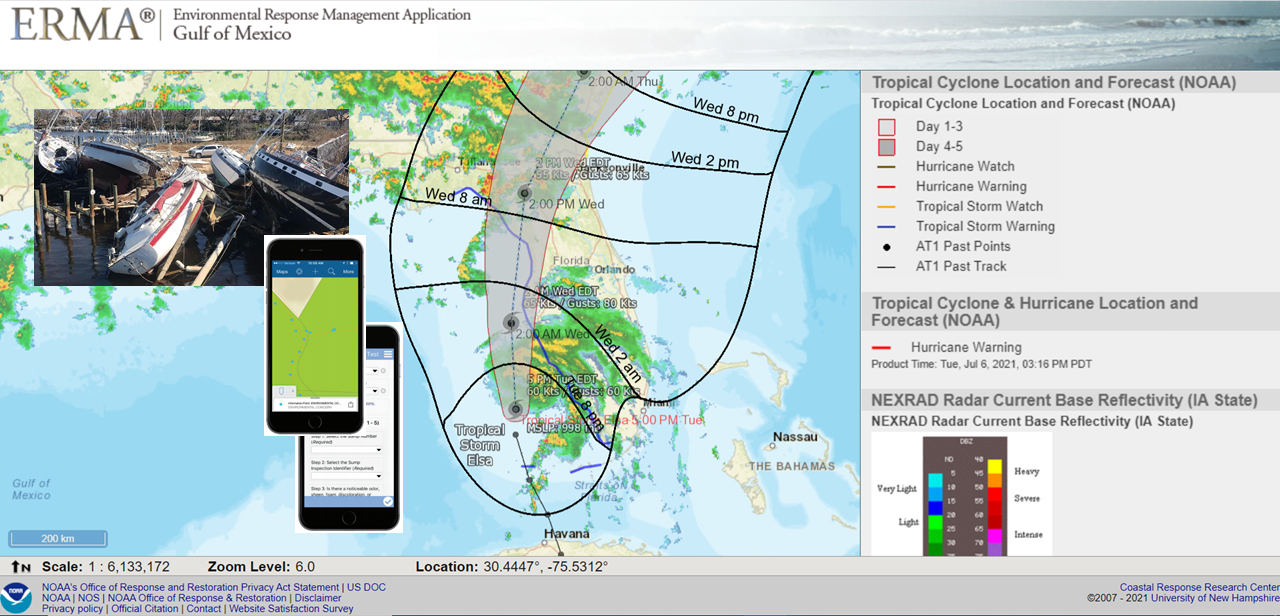
This map shows Tropical Storm Elsa as it approaches South Florida. This image is from 9 a.m. on July 6, 2021 and depicts the cumulative three-day precipitation forecast. NOAA’s Office of Response and Restoration works with the NOS Disaster Preparedness Program to track storm progress and help understand potential impacts to natural resources, navigation, and communities. 

OR&R coordinates with the U.S. Coast Guard and the U.S. Environmental Protection Agency to catalog displaced vessels and other potential hazards to navigation in ERMA using SmartPhones and tablets.  

View the Tropical Storm Elsa precipitation map here.

Tropical Storm Elsa: Forecast and Arrival

A screenshot of a mapping tool.

This map shows Tropical Storm Elsa as it approaches South Florida. This image is from July 6 and depicts the forecast path and time of arrival. The Office of Response and Restoration Disaster Preparedness Program tracks storm progress and helps document and remediate impacts to marine infrastructure.  

OR&R coordinates with the U.S. Coast Guard and the Environmental Protection Agency to catalog displaced vessels and other potential hazards to navigation in ERMA using SmartPhones and tablets.  

View the Tropical Storm Elsa forecast and arrival map here.

This "Map of the Month" is brought to you by George Graettinger and Megan Ewald from the OR&R Assessment and Restoration Division. Shout out to George Marino in the OR&R Disaster Preparedness Program. 

A map of a tropical storm.
Node Weight: 
1

Map of the Month: Sea Turtle Nesting Habitat Density

Short title: 
Map of the Month: Sea Turtle Nesting Habitat

June 16, 2021 — Today we’re Shell-ebrating National Sea Turtle Day! Did you know that sea turtles in the Gulf of Mexico are born on beaches and spend their early years floating among matts of sargassum seaweed? Since oil spills can impact both of these habitats, it’s important for NOAA scientists to understand sea turtle life cycles to understand the impacts of pollution and restore the environment afterwards. 

This map shows sea turtle nesting habitat density (how many sea turtles are laying eggs in that area) in yellow, orange, and red. The blue shading shows areas where sensitive sea turtles could be found in the event of an oil spill. Sargassum habitat, the floating seaweed where young turtles drift with ocean currents, is shown in green shading.

All of this information is available in ERMA for NOAA experts to access quickly to protect sea turtles in the event of an oil spill emergency. Check out our sea turtle graphic to learn about their life cycle, and our interactive ERMA Map to learn more!

This Map of the Month is brought to you by Adam Rotert and Megan Ewald from the Assessment and Restoration Division.

A screenshot of a map.
Node Weight: 
1

Pages

Subscribe to response.restoration.noaa.gov RSS