Back to top

Map of the Month: Coral Reef Monitoring and Damage Assessment in the Pacific Islands Region

Short title: 
Map of the Month: Coral Reef Monitoring in the Pacific Islands Region

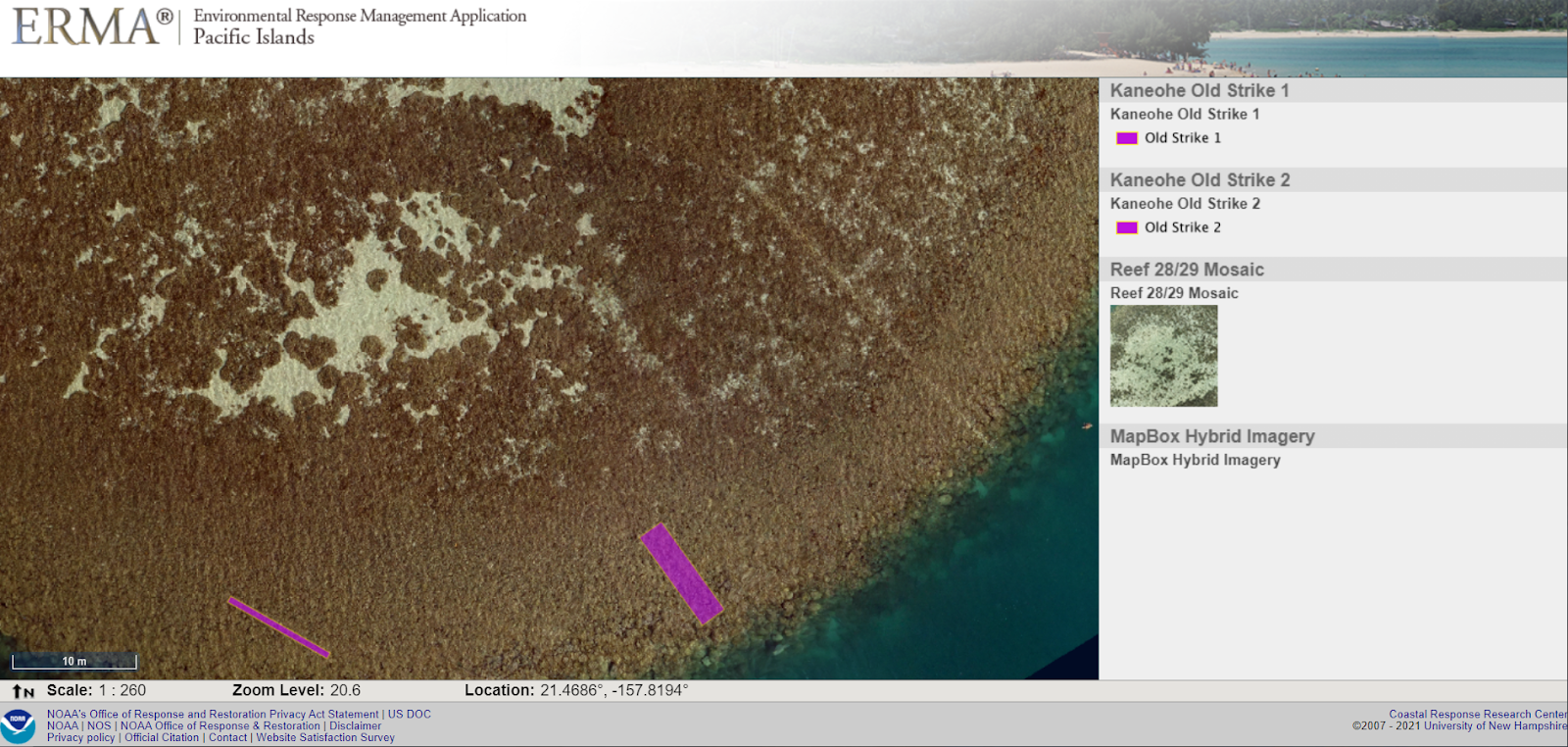
Map 2: NOAA has begun to use drones to capture and outline these groundings to devise protection strategies. In the image above, old prop scars are delineated in purple. Can you see the large prop scar on the eastern portion of the image?  

A screenshot of a map.


A screenshot of a map.
Node Weight: 
1

Map of the Month: Sea Level Rise

Short title: 
Map of the Month: Sea Level Rise

This animated map of Fulton Street in New York City shows several things: 1. Projected sea level rise of six feet, 2. Potential toxic hazards, like generators, that could pose problems during flood events, and 3. Where projected sea level rise and these hazards overlap. 

Sea level rise is one of the biggest risks for coastal communities today and far into the future. Flooding is occurring more frequently as has the severity of the floods. Sea level rise not only causes more flooding but it also impacts the habitat of coastal communities. The Office for Coastal Management maintains a Sea Level Rise Viewer, that illustrates potential flooding from future sea level rise—from current mean and higher high water to a six-foot rise. 

The Office of Response and Restoration has integrated this data into its common operational viewer, ERMA. Resource managers can use the sea level rise information to aid in the viability of any long term restoration projects or damage assessments. In the map pictured, Environmental Protection Agency Resource Conservation and Recovery Act (RCRA) data are paired with a six-foot sea level rise scenario in New York City. The RCRA data track generators, transporters, treaters, storers, and disposers of hazardous waste and when paired with the sea level rise, managers can identify sites that are at a greater flood risk. Visualization of sea level rise data, along with data from hazardous waste sites or spills, enables resource managers to make informed decisions for remediation and restoration projects.  

View the map here.

This Map of the Month is brought to you by the Office of Response and Restoration’s Assessment Restoration Division’s Jay Coady. Special thanks to the NOAA Office for Coastal Management. Their mapping data for sea level rise was used in this Map of the Month.

An animated image with multiple screenshots of sea level rise.
Node Weight: 
1

NOAA Responds to Fishing Vessel Fire in Tacoma, Washington

Short title: 
NOAA Responds to Vessel Fire in Washington

The seafood processing vessel is owned by Trident Seafoods and used to process herring and salmon seasonally in Alaska. It has a potential fuel capacity of 107,000 gallons but approximately 50,000 gallons of diesel were believed to be onboard. The vessel also has hazardous materials on board, including approximately 9,800 pounds of ammonia and 200 pounds of chlorine. The fire damage has yet to be fully assessed, but according to local media reports, the company expects the vessel to be a total loss.

As of Friday, Feb. 19, the fire continued to burn and there was still smoke in the air. The plan for Friday is to safely fight the fire and continue to stabilize the vessel. Once those two objectives are achieved, the hazardous substances will be removed. Removing the fuel is also an objective, but a decision about when that may happen has not yet been made.

A response contractor has assumed the lead role for salvage and firefighting. On Friday, Tacoma Fire was still on scene directing those operations and positioned to provide backup. 

Air monitoring continues. With earlier monitoring results, there was no detection of ammonia or chlorine and particulate levels remain consistent with winter background levels.

NOAA continues to provide the Coast Guard with scientific support, including chemical hazards, weather, tides, and resources at risk.

Smoking coming from a vessel.
Early on Feb. 18, 2021, the U.S. Coast Guard notified the NOAA scientific support coordinator for the region of a major vessel fire in the Hylebos Waterway in Tacoma, Washington. A fire had broken out shortly before midnight aboard the 233-foot Aleutian Falcon at Pier 25 in the Port of Tacoma. Image credit: NOAA.
Node Weight: 
1

Map of the Month: Abandoned and Derelict Vessel Inventory Map

Short title: 
Map of the Month: Abandoned and Derelict Vessels

When owner’s don’t claim responsibility for boats washed away and damaged during storms, these abandoned and derelict vessels can cause issues for marine habitats. The impact of these vessels thrown into wetlands, beaches, and shorelines can cause physical damage to the environment. These vessels can also become hazards for boat traffic and outdoor recreationists on the shore. Furthermore, the oil, batteries, and marine debris left on board can leak into the environment and negatively impact fish and wildlife. 

Assessing, removing, and safely disposing of abandoned and derelict vessels requires a big investment, and the laws addressing this issue vary greatly across the United States. Coast Guard Sectors in California have partnered with NOAA to house and report this information. Vessels are continuously removed and added, and there is currently an ongoing effort for a nationwide database seeking collaboration between federal and state agencies.

View the abandoned and derelict vessel inventory in California via ERMA here.

This Map of the Month is brought to you by Adam Rotert from OR&R's Assessment and Restoration Division Spatial Data Branch.

A screenshot of a map of California.
This map shows the locations of Abandoned and Derelict Vessels near Los Angeles. (Data Credit: Coast Guard Sector Los Angeles/Long Beach).
Node Weight: 
1

Two New Reports on Freshwater Mussels in Upper Hudson River, New York

Short title: 
Two New Reports on Freshwater Mussels in Upper Hudson River, New York

Nov. 13, 2020 — The Hudson River Natural Resource Trustees released two data reports presenting findings on freshwater mussels in the Upper Hudson River in support of the Hudson River Natural Resource Damage Assessment. One report features the findings of a population assessment, while the other reports results for age determination.

Remedial dredging, backfilling and capping in the upper Hudson River from 2009-2015, harmed freshwater mussels.The Trustees quantitatively surveyed multiple pools with the goal of investigating the effects of the dredging remedy on freshwater mussels. The survey report provides compelling evidence that the density and ecosystem services of freshwater mussels are substantially lower in remediated areas of the Upper Hudson relative to before-remediation and non-remediation areas. 

The results of these studies will be used to determine and quantify injury to freshwater mussels as a consequence of the dredging remedy and to identify necessary restoration actions.

These Reports and Their Associated Fact Sheets are Available Online.

An underwater image of mussels.
Freshwater mussels in the Hudson River. Image credit: United States Fish and Wildlife Service.
Node Weight: 
1

Scientists Testing Oil Movement at Ohmsett

Short title: 
Scientists Testing Oil Movement at Ohmsett

The project “Coordinating Advances in Estimating and Measuring Oil Slick Thickness” brings together an international team of experts to advance the collective ability to determine oil slick thickness and overall oil slick characterization, which is important for oil spill response and assessments (oil clean up, fate, and oil transport). This week, the scientists were conducting smaller scale controlled experiments at the Ohmsett facility that will inform test protocols for the larger exercise. The small on-site team worked remotely with the larger interdisciplinary team of scientists to advance our understanding of surface oil fate and behavior in support of future testing. Project partners for the test planning include representatives from government, academia, and industry.  The project is funded by the Canadian Multipartner Research Initiative and is supported by the Coastal Response Research Center (CRRC).

Three women in a lab.
OR&R senior scientist with EPA Research Scientist Dr. Robyn Conmy discussing results of bench scale oil experiments at the Ohmsett facility. Image credit: NOAA.
Node Weight: 
1

NOAA Responds to Oil Spill from Unknown Source Along Delaware Shorelines

Short title: 
NOAA Responds to Oil Spill Along Delaware Shorelines

OCT 27, 2020 — After an unknown volume of heavy oil from an unknown source washed ashore on Broadkill Beach, Delaware on Oct. 19, NOAA’s Office of Response and Restoration went on scene at the request of the Coast Guard to assist in hindcasting and forecasting the spill. 

Since that first day, tarballs have washed up on both bay-side and ocean-side beaches extending from Fowler Beach, Slaughter Beach, Prime Hook Refuge, Lewes, Cape Henlopen State Park, and continuing south to Rehoboth Beach, and Dewey Beach. On the morning of Oct. 26, the State of Maryland reported small amounts of tarballs coming ashore in Ocean City, Maryland. The cleanup continues more than one week later. Meanwhile, the Coast Guard continues to investigate the source of the spill and has spent over $1 million to date responding to the spill. Some Delaware beaches have been closed or have restricted access to facilitate cleanup. 

More than 100 personnel have been engaged in the cleanup operation daily over most of the last week. The Coast Guard estimates that about 55 tons of oil, tarballs, oily sand and oiled debris — enough to fill four construction dumpsters — has been recovered so far. A Unified Command, consisting of the U.S. Coast Guard’s Sector Delaware Bay and the Delaware Department of Natural Resources and Environmental Control (DNREC), is managing the cleanup. An Incident Command Post has been established at the Slaughter Beach Volunteer Fire Department in Slaughter Beach. NOAA and the U.S. Fish and Wildlife Service are also assisting with the cleanup operations. 

At the request of USCG Sector Delaware Bay, NOAA generated a trajectory model to assist with forecasting where the winds and currents may transport the tarballs, coordinated Endangered Species Act informal consultations with U.S. Fish and Wildlife Service and NOAA’s National Marine Fisheries Service, and have developed clean-up recommendations, best management practices, and clean-up end points. 

The Unified Command has also received more than 60 reports of oiled birds, however, Tri-State Bird Rescue and Research, based in Newark, Delaware has not recovered any wildlife for rehabilitation. 

While the oil spill cleanup continues, the Coast Guard and DNREC strongly advise the public not to handle any oily product found or attempt to assist affected wildlife along the shore, but to report these findings to DNREC's environmental hotline at 800-662-8802 so the situations can be addressed by hazmat-trained professionals.

NOAA Scientific Support Coordinator Frank Csulak (center in blue mask), in the Incident Command Post for the oil spill near Broadkill Beach, Delaware. Image credit: U.S. Coast Guard.
Node Weight: 
3

Map of the Month: ERMA Tiny Tutorial

Short title: 
Map of the Month: ERMA Tiny Tutorial

The Environmental Response Management Application (ERMA®) is NOAA’s online mapping tool that integrates both static and real-time data, enabling users to quickly and securely access, analyze, and display spatial data. The "Map of the Month" series highlights unique maps from throughout ERMA's use and history.

While The Environmental Response Management Application (ERMA®) is an online mapping tool frequently used by scientists and emergency responders, much of ERMA’s data is public and accessible to people from all walks of life. 

OR&R experts recently teamed up with NOAA environmental educators to create a Tiny Tutorial, which is a step-by-step guide explaining how to use ERMA.

This fun and interactive tool walks users through how to log in, zoom into the Gulf of America (formerly Gulf of Mexico), click through Deepwater Horizon datasets, and open a photo of a dolphin swimming through oil. 

Check out NOAA’s Tiny Tutorial to learn more about ERMA.

A graphic reading "NOAA Education Tiny Tutorial, ERMA; Mapping for environmental response."
Node Weight: 
2

In the Aftermath of Hurricane Sally

Short title: 
In the Aftermath of Hurricane Sally

As with Hurricane Laura, National Environmental Satellite, Data, and Information Service (NESDIS) provided satellite surveillance of the offshore oil and gas production areas at risk from Hurricane Sally. The storm’s eastward trajectory largely spared these areas, but the impacts to the coastal communities were significant. The hardest hit areas were from Gulf Shores, Alabama, east to the Florida Panhandle. Close to 1,000 pollution targets, mostly sunken and stranded commercial and recreational vessels, have been identified to date. 

The storm's impacts also included a half-mile stretch of oiling along the Gulf Islands National Seashore on Perdido Key, Florida. 

OR&R teams are working with the state and federal resource agencies and the U.S. Coast Guard to survey the affected seashore and to help track and assess the vessel targets. The OR&R team is also helping develop Best Management Practices for vessel removal and salvage to avoid and minimize response disturbance to sensitive habitats and historic properties during the cleanup operations. 

An oiled beach with ruler in foreground to show scale.
Shoreline survey of oil deposits on Perdido Key, a barrier island that spans the Alabama-Florida state line, after Hurricane Sally. Image credit: NOAA.
Site Themes: 
Node Weight: 
1

OR&R Supporting Hurricane Sally Operations

Short title: 
OR&R Supporting Hurricane Sally Operations

In the wake of Hurricane Sally, more than 1000 displaced and sunken vessels have been identified, 100 of these vessels are reported as leaking fuel, and oil pollution suspected to be ruminates from the Deepwater Horizon Oil Spill in 2010 has remobilized and washed ashore on the Gulf Islands National Seashore just across the Alabama border in Florida.  As the coastal marine response transitioned from immediate threats to life and safety to coastal debris and pollution, OR&R continues to provide mission support.  The Gulf of Mexico Disaster Response Center (DRC) located in Mobile, Alabama, is transitioning to the U.S. Coast Guard Hurricane Sally Command Post for Marine Environmental Response supported by an OR&R Scientific Support Team.  It is expected that this next response phase will take two to four weeks. 

The NOAA Gulf of Mexico Disaster Response Center was built to survive storms such as Hurricane Sally, while providing a base of operations for emergency response support.  Initially, U.S. Coast Guard Sector Mobile, which is responsible for coastal Mississippi, Alabama, and the Florida Panhandle, relocated command and planning operations to the DRC in advance of the storm.   

People at tables in a classroom facing a large screen.
OR&R Scientific Support Coordinator and U.S. Coast Guard personnel at the Incident Command Post located at the NOAA Disaster Response Center. Image Credit: NOAA.
Node Weight: 
2

OR&R’s Emergency Response Division: Incident Responses in FY 2020

Short title: 
OR&R FY2020 Incident Responses


82% were oil spills, 4% were chemical spills, and 14% were other incidents. These "other" incidents involved hurricanes, requests for search and rescue (SAR), marine debris events, dead whales, and other incidents where scientific support and forensic oceanographic modeling is requested. 2020 was one of the busiest years in the past decade despite the additional challenges of the current health emergency. These numbers do not include several larger incidents such as the sinking of the RO/RO Golden Ray within the Port of Brunswick, Georgia, that occurred on September 8, 2019. The response to that incident continued through fiscal year 2020 and wreck removal efforts are ongoing.

Two people distributing boom into the water from a small boat.
Golden Ray (St. Simons Sound Incident) responders practice boom deployment in St. Simons Sound, Georgia, Feb. 19, 2020. Boom is a floating barrier that is used to contain oil spills and protect shoreline from pollution. Image credit: U.S. Coast Guard.
Node Weight: 
2

OR&R’s Emergency Response Division Responses in Fiscal Year 2020

Short title: 
OR&R’s Emergency Response Division Responses in Fiscal Year 2020

82% were oil spills, 4% were chemical spills, and 14% were other incidents. These "other" incidents involved hurricanes, requests for search and rescue (SAR), marine debris events, dead whales, and other incidents where scientific support and forensic oceanographic modeling is requested. 2020 was one of the busiest years in the past decade despite the additional challenges of the current health emergency. These numbers do not include several larger incidents such as the sinking of the RO/RO Golden Ray near St. Simons Island, Georgia, that occurred on September 8, 2019. The response to that incident continued well into fiscal year 2020.  

Two people distributing boom into water from a small boat.
Golden Ray (St. Simons Sound Incident) responders practice boom deployment in St. Simons Sound, Georgia, Feb. 19, 2020. Boom is a floating barrier that is used to contain oil spills and protect shoreline from pollution. Image credit: U.S. Coast Guard.
Node Weight: 
1

Hurricane Sally: OR&R Provides Incident Coordination for the National Ocean Service

Short title: 
OR&R Provides Hurricane Sally Coordination for National Ocean Service

SEPT. 18, 2020—NOAA’s National Ocean Service brings a wealth of coastal science, management, and operational expertise to help communities respond to and recover from hurricanes. OR&R’s Disaster Preparedness Program supported National Ocean Service preparedness and response operations for Hurricane Sally for the duration of the event. As the incident coordinators, program staff are responsible for coordinating across National Ocean Service program offices when multiple offices are impacted by an event. The Disaster Preparedness Program gathered information on mission readiness, logistical needs, and impacts to personnel and infrastructure before, during, and after the storm. 

The program coordinated information on the tracking and safety of all National Ocean Service personnel in Hurricane Sally’s area of impact, as well as the closure, impacts, and reopening of numerous sanctuaries, estuarine research reserves, facilities, and laboratories. The program also coordinated the operational mission support provided by multiple National Ocean Service program offices, ensured all safety protocols were being implemented, and provided use of NOAA’s Gulf of Mexico Disaster Response Center for mission critical activities. 

Effective coordination ensures the National Ocean Service is in the best possible response posture to conduct our missions so commerce, communities, and natural resources can recover as quickly as possible.

A satellite image of a hurricane.
NOAA National Environmental Satellite, Data, and Information Service satellite image of Hurricane Sally approaching the coasts of Alabama and Florida. Image credit: NOAA.
Site Themes: 
Node Weight: 
1

Now Open: FY 2021 Grant Opportunity for Marine Debris Research Projects

Short title: 
Now Open: FY21 Marine Debris Research Grant

The NOAA Marine Debris Program is proud to announce our FY 2021 Marine Debris Research notice of funding opportunity. 

NOAA will fund research projects that investigate and identify the critical input pathways for marine debris introduction into the coastal zone (shoreline or nearshore), including evaluation of appropriate simultaneous pathways of riverine transport downstream, surface runoff, stormwater discharge, and wind-driven transport, as well as degradation and fragmentation of debris during transport. Projects should be original, hypothesis-driven projects that have not previously been addressed to scientific standards. 

The Letter of Intent (LOI) submission period for research projects will extend from Sept. 15 to Nov. 5, 2020. Applicants who submit successful LOIs will be invited to submit a full proposal following the LOI review period.

For more information on this FY 2021 grant opportunity, please visit Grants.gov and the NOAA Marine Debris Program’s website.

Plastic bottles and other debris in an urban waterbody.
Marine debris found floating along the Anacostia Riverwalk Trail in Washington, D.C. Image credit: NOAA.
Site Themes: 
Node Weight: 
2

Map of the Month: Hurricane Laura’s Aftermath

Short title: 
Map of the Month: Hurricane Laura

OR&R uses ERMA (Environmental Response Management Application) to prepare and track hurricanes before landfall and to help communities clean up post impact. ERMA recently served as a common operational picture and data resource for responders as  Hurricane Laura came crashing into the shores of Southwest Louisiana and Southeast Texas on Aug. 27, as a Category 4 storm. 

OR&R's Emergency Response Division (ERD) provided support for the U.S. Coast Guard response, providing trajectory analysis to show where any spilled oil or chemicals may have gone and helping to identify specific debris targets from NOAA's National Geodetic Survey (NGS) imagery generated post-landfall. While there was substantial destruction of property that created many small spills, fortunately, the storm did not cause any major pollution events that threatened the environment. 

However, Hurricane Laura created approximately 8 million cubic yards of debris and ORR’s Marine Debris Program is working with FEMA and the State of Louisanna to evaluate debris issues and provide necessary information to impacted communities. ERMA is being used to visualize debris target locations and ERMA’s data dashboards help track clean up progress. ERMA can display background information, photos of the target locations, and counts of the targets in each of the stages of remediation.

September’s "Map of the Month" showcases how ERMA is being used right now by experts to respond to the aftermath of Hurricane Laura. Due to the sensitive and evolving nature of this work, the debris target hurricane response data is not publically available. 

Please visit Gulf of America ERMA to view Hurricane Laura’s Wind Swath and hundreds of other public datasets.

A map showing an area in the Gulf of America (formerly Gulf of Mexico), with a photo of a helipad on a shoreline.
Map displaying the pollution targets from Hurricane Laura on Sept. 4, 2020 using ERMA's informational dashboards.
Node Weight: 
1

Hurricane Laura: OR&R’s Disaster Preparedness Program Serves as Incident Coordinator for the National Ocean Service

Short title: 
Disaster Preparedness Program Hurricane Laura Incident Coordination 

The National Ocean Service provides data, tools, and services that support coastal economies and their contribution to the national economy. NOS is dedicated to advancing the following priorities: safe and efficient transportation and commerce; preparedness and risk reduction; as well as stewardship, recreation, and tourism. OR&R’s Disaster Preparedness Program (DPP) supported National Ocean Service preparedness and response operations for Hurricane Laura for 11 days. As the incident coordinators for NOAA’s National Ocean Service, DPP staff are responsible for coordinating across National Ocean Service program offices when multiple offices are impacted by an event. The DPP gathered information on National Ocean Service mission readiness, logistical needs, and impacts to personnel and infrastructure before, during and after Hurricane Laura. 

During and after the storm, DPP coordinated information on the tracking and safety of all National Ocean Service personnel in Hurricane Laura’s area of impact, as well as the closure, impacts, and reopening of numerous sanctuaries, estuarine research reserves, facilities, and laboratories. The DPP also coordinated the operational mission support provided by multiple National Ocean Service program offices, ensured all safety protocols were being implemented, and provided use of NOAA’s Gulf of Mexico Disaster Response Center for mission critical activities. 

Effective coordination ensures the National Ocean Service is in the best possible response posture to conduct our missions so commerce, communities, and natural resources can recover as quickly as possible.

Weather map showing hurricane approaching land
Disaster Preparedness Coordination Hurricane Laura Incident Coordination
Site Themes: 
Node Weight: 
1

Marine Debris Program Supports Hurricane Laura Debris Response

Short title: 
Marine Debris Program Hurricane Laura Response

Sept.1, 2020 — On Aug. 27, 2020 Hurricane Laura made landfall in the early morning hours as a Category 4 hurricane with reported wind speeds of 137 mph at Lake Charles, Louisiana, 30 miles inland from landfall on the coast. 

Hurricane Laura created a preliminary estimate of 8 million cubic yards of debris but that amount is expected to increase as more data become available. The Federal Emergency Management Agency (FEMA) and Louisiana’s Governor's Office of Homeland Security and Emergency Management has called together a debris task force to evaluate debris issues and provide necessary information to impacted communities.  

NOAA’s Marine Debris Program is one of four federal agencies supporting the debris task force and Gulf of Mexico Regional Coordinator Caitlin Wessel is serving as the marine debris subject matter expert. The program is providing impacted communities with the Louisiana Marine Debris Emergency Response Guide to help them determine responsible parties for removing various types of debris and best management practices for debris removal from sensitive environments such as marshes. The Marine Debris Program is also working with NOAA’s National Geodetic Survey, which provided aerial imagery, and the Office of Response and Restoration Spatial Data Branch to analyze debris targets in marsh areas in southwest Louisiana to improve the debris estimates and determine the best response.

An aerial image highlighting debris.
Aerial imagery of household debris spread throughout the marsh located behind the Holly Beach community in coastal Louisiana. Image credit: National Geodetic Survey.
Site Themes: 
Node Weight: 
1

Minds Behind OR&R: Meet Oceanographer Dylan Righi

Short title: 
Minds Behind OR&R: Meet Dylan Righi

This feature is part of a monthly series profiling scientists and technicians who provide exemplary contributions to the mission of NOAA’s Office of Response and Restoration (OR&R). In our latest "Minds Behind OR&R," we feature oceanographer Dylan Righi.

It’s not every day that you meet someone who models the transport of dead floating whales. But that—among many other things—is part of the job for OR&R scientist Dylan Righi. 

When oil or chemicals are accidentally spilled into coastal waters or navigable rivers, NOAA is often consulted about where those pollutants may go and how they might cause harm. Providing some of that important information is Dylan Righi, an oceanographer who is part of OR&R’s scientific "home team" in Seattle. He provides trajectory and fate predictions, typically for incidents with spilled oil or potential oil releases, but sometimes for vessels, toppled containers, or log booms that are adrift; dead whales; missing aircraft; and occasionally, dead bodies. With a bachelor’s degree in physics, a master’s degree in physical oceanography, and nearly 18 years of experience in NOAA offices, Dylan provides strong support to the team. 

When Dylan explains to someone what he does for a living, he is sometimes asked, "But what do you do between spills?" He explains that although large spills capture our attention, there are actually many smaller spills (like the ones from recreational boats) that occur with much greater frequency, and which occupy some of his time. Equally important, though, Dylan’s time is committed to creating tools that improve the work he does—and which eventually become free resources available to responders and planners within the U.S. and internationally. 

Currently, Dylan is refining OR&R’s Trajectory Analysis Planner, or TAP, that allows spill planners to predict the probability that any oil spill will reach a specific segment of shoreline. A component of OR&R’s suite of oil spill response tools, TAP analyzes statistics from potential spill trajectories generated by GNOME, (our oil spill trajectory model) that predict how an oil spill will spread and move within a local area. In TAP, GNOME trajectories are run thousands of times to provide a statistically significant overview of possible trajectories from likely sources in the region. The TAP probability must take into account the bathymetry (water depth) and shoreline configuration of a particular body of water; currents and winds; and shoreline characteristics that determine beaching and refloating of oil. 

Versions of TAP are created for specific regions. Dylan’s team has produced the first online version of TAP (beta) for Southern California. Dylan is currently writing documentation for this TAP version to assist spill planners who want to use it in their work. 

There’s a lot to love about working with OR&R, but some of Dylan’s favorite parts are teaching, responding to a great variety of incidents, and traveling to some interesting places to do that.

Teaching OR&R’s Science of Oil Spills (SOS) class to new and experienced spill responders and planners is really rewarding because he gets to meet the people who are using the tools and products that he helps create. SOS classes are typically held four times a year, in Seattle and other locations around the country, so Dylan has traveled from the Florida Keys to Alaska to teach SOS training topics. In addition, he has taught for many years at NOAA’s annual Science Camp for middle school students, held in Seattle. 

In November 2017, Dylan arrived in Anchorage, Alaska to help teach an SOS class but—as can happen on flights—his duffel bag containing all his winter gear didn’t arrive with him. His first task there was to visit the class location on the shore of Cook Inlet to help prep with the other instructors. Outfitted in some borrowed gear from a colleague’s thrift donation bag, Dylan kept his preparations quick and efficient in the freezing temperatures! Thankfully, his bag arrived that night and he was properly equipped for the even colder temperatures for the actual class.

A man in a hard hat with a container ship in a canal lock behind him.
Dylan at the new Cocoli Locks in Panama. These locks are built larger and deeper to handle vessels carrying much larger cargo loads. Image courtesy of Dylan Righi.
A man at a desk with multiple computer screens.
Dylan at the new Cocoli Locks in Panama. Image courtesy of Dylan Righi.
A man taking a selfie from a kayak with another kayaker behind him.
Dylan enjoys the peaceful waters of the Skagit River delta, where he paddles with friends and family. Image courtesy of Dylan Righi.
Node Weight: 
2

Story Map: Examining the Oil Pollution Act’s Legacy Through 30 Oil Spills

Short title: 
The Oil Pollution Act’s Legacy in 30 Oil Spills

Thirty years ago today, in the wake of the Exxon Valdez disaster, the Oil Pollution Act of 1990 (OPA90) was passed unanimously by congress. This act streamlined and strengthened the U.S. government's ability to prevent, respond to, and hold polluters accountable for catastrophic oil spills.

This ArcGIS story map explores just one spill from each of the 30 years since OPA was passed. While these 30 spills represent a small fraction of overall events, we hope to shine a light on the real places and people who have been impacted by pollution and benefited from the Oil Pollution Act.

NOAA's Office of Response and Restoration provides scientific support, injury assessment, and restoration for oil spills. We provide scientific support for hundreds of spills each year, over 2,740 since the passage of the Oil Pollution Act, and with partners have recovered over $9.8 billion for restoration.

Over the past 30 years, NOAA continues to learn and evolve under the act's framework, developing state of the art tools and setting international standards for oil spill response, assessment, and restoration.

The legacy of the Oil Pollution Act is that it remains as important in 2020 as it was in 1990.

Explore our story map here.

Cleanup workers on a beach.
Task force members remove oil-contaminated sand from the beach on Matagorda Island, Texas, March 30, 2014. Cleanup operations are being directed by a unified command comprised of personnel from the Texas General Land Office, U.S. Coast Guard and Kirby Inland marine. Image credit: U.S. Coast Guard.
Node Weight: 
2

UPDATED: NOAA Continues to Provide Remote Technical Assistance in Mauritius Oil Spill Response

Short title: 
UPDATED: NOAA Continues Remote Assistance in Mauritius Spill Response

As most of the spilled oil is reported to be confined to the lagoon to the northwest of the grounding location and most has stranded ashore, the primary focus of responders on-scene has turned to shoreline cleanup. Shoreline cleanup challenges include areas of heavily oiled mangrove forests. Coral reefs, sea turtles, and subsistence fisheries are among other natural resources of particular concern. 

OR&R's Emergency Response Division (ERD) is coordinating technical assistance remotely to the Mauritius Ministry of Environment, as requested through the U.S. Department of State. On Aug. 17, the NOAA National Environmental Satellite, Data, and Information Service (NESDIS) provided a time series analysis of satellite imagery made available through the Disasters Charter activation. The series, which runs from Aug. 5 to Aug. 16, was provided to the Mauritius Ministry of the Environment and has been posted on the disaster charter portal.

Expert NOAA contacts on a variety of topics and links to NOAA spill response and natural resource guides available online have been sent to the Mauritius Ministry of the Environment. ERD ocean modelers are assisting organizations in Mauritius that have been using NOAA’s WebGNOME trajectory software to model the movement of the spilled oil on the water surface from the time of release. This product, along with the satellite analysis provide good indications to responders of where to look for oil on the shore or reefs. As cleanup continues and responders begin to assess injuries to habitats and eventually coral reef restoration, NOAA expertise will be ready to support.

International response to assist the government of Mauritius has been exceptional. A number of delegations from other countries are working on scene to provide support including France, Japan, India, the U.K. and the U.N., as well as technical representatives from private organizations, such as ITOPF. In addition to the U.S., experts from several other countries, such as Australia, are also standing by to provide remote technical assistance.  


NOAA to Assist with Oil Spill in Mauritius

Aug.13, 2020 — Effective immediately, NOAA will remotely support the global response to an environmental emergency in the Indian Ocean island nation of Mauritius, after the bulk carrier Wakashio ran aground on a coral reef on July 25. The grounding resulted in a spill of an estimated 210,000-300,000 gallons of oil.

Several U.S. agencies involved in spill response were convened last week as part of the National Response Team to answer a formal request from Mauritius under the procedures for international spill response support. Working through the State Department on Aug.12, the government of Mauritius accepted an offer of scientific and technical assistance from NOAA’s Office of Response and Restoration. OR&R’s Emergency Response Division is establishing lines of communication and prioritizing those requests with the Mauritius Ministry of Environment. The office will focus on clean-up and assisting with the environmental impacts.

The M/V Wakashio was without cargo when it ran aground off Mauritius’ Pointe d’Esny during a voyage from Singapore to Brazil, but was reportedly carrying about 1.1 million gallons of low-sulfur fuel oil, 63,000 gallons of diesel fuel, and 26,000 gallons of lube oils.The ship was initially reported stable; however, its condition deteriorated in bad weather, resulting in a breach of a bunker tank on Aug. 6, leading the Mauritian government to declare an environmental emergency. All 20 crew members were safely removed from the vessel. 

Areas threatened by the spill include protected coral reefs and lagoons, including the Blue Bay Marine Park and Ile aux Aigrettes island. The crystal clear waters and coral reefs surrounding Mauritius are world-renowned and the economy relies heavily on tourism.

The salvage company has confirmed that all remaining fuel has been removed from the ship. At this time, a crack in the ship’s hull has expanded, putting the ship at risk of breaking apart in rough sea conditions.

This story was updated (above). 

Shipping vessel in water.
The bulk carrier MV Wakashio before the spill. Image credit: Nagashiki Shipping.
Node Weight: 
2

Pages

Subscribe to response.restoration.noaa.gov RSS