Back to top

How Do You Solve a Problem Like Abandoned Ships?

Short title: 
How Do You Solve a Problem Like Abandoned Ships?

FEBRUARY 12, 2014 -- A rusted green hull, punched full of holes and tilted on its side, sits forlornly in the Hylebos Waterway of Tacoma, Washington.

The dilapidated boat's name, Helena Star, is partially obscured because the vessel is half sunk. The boat it is chained to, the equally rusted ship Golden West, is being drawn down into the waters with it. Bright yellow boom and a light sheen of oil surround the vessels.

Meanwhile, the owners are nowhere in sight.

This is just one example of the nationwide problem of derelict vessels. These neglected ships often pose significant threats to fish, wildlife, and nearby habitat, in addition to becoming eyesores and hazards to navigation.

Derelict vessels are a challenge to deal with properly because of ownership accountability issues, potential chemical and oil contamination, and the high cost of salvage and disposal. Only limited funds are available to deal with these types of vessels before they start sinking.

In Washington's Puget Sound alone, the NOAA Office of Response and Restoration's Emergency Response Division has had several recent responses to derelict vessels that either sank or broke free of their moorings.

Many of these recent responses have come with colorful backstories, including a pair of retired Royal Canadian Navy vessels, a fishing boat that at one time housed the largest marijuana seizure by the U.S. Coast Guard (F/V Helena Star), the first American-designed and –built diesel tugboat (Tug Chickamauga), and the boat that carried author John Steinbeck and biologist Ed Ricketts on their famous trip through the Sea of Cortez (Western Flyer).

Unfortunately, all these vessels have met the end of their floating lives either through the deliberate action or negligence of their owners. Had the owners taken responsibility for maintaining them, the environmental impacts from leaked fuel, hazardous waste, and crushing impacts to the seabed could have been avoided, as well as the costly multi-agency response and removal operations that resulted.

Yet there is hope that we can prevent these problems before they start. In Washington state there is momentum to combat the derelict vessel issue through measures to prevent boats from becoming derelict or environmental hazards, and by holding vessel owners accountable for what they own. Washington State House bill 2457 is currently in the Washington State Legislature. Among other measures, the proposed bill:

  • "Establishes a fee on commercial moorage to fund the state's derelict and abandoned vessel program."
  • "Creates new penalties for failure to register a vessel."

Additionally, Washington's San Juan County is developing a new Derelict Vessel Prevention program, using a grant from the Puget Sound Partnership. San Juan County, a county composed of small rural Pacific Northwest islands, has a high number of derelict vessels [PDF]. This program is going to be used not only in San Juan County but throughout counties bordering Puget Sound.

On January 15, 2014, Washington's Attorney General Bob Ferguson and Commissioner of Public Lands Peter Goldmark (who leads the Department of Natural Resources) announced the state was pursuing criminal charges against the owners of the Helena Star, which sank in Tacoma's Hylebos Waterway, and the Tugboat Chickamauga, which sank in Eagle Harbor. Both vessels released oil and other pollutants when they sank.

It is an ongoing battle to hold accountable the owners of derelict and abandoned vessels and prevent them from causing problems in our nation's waterways. Yet with cooperation, prevention, and increased accountability we can help manage the problem, and in the end reduce impacts to Washington's cherished Puget Sound.

Read more about how our office is working with Washington's Derelict Vessel Task Force to tackle this growing problem in Puget Sound.
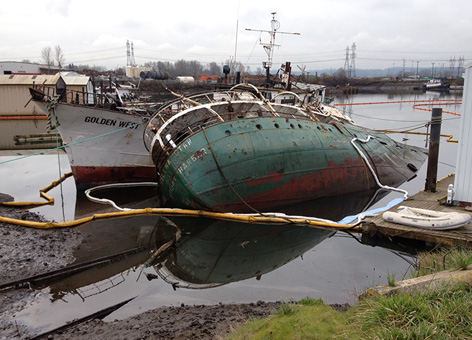
Two rusted ships partially sunk in water and surrounded by containment boom.
The old fishing vessel Helena Star has been allowed to become derelict, leaking oil and pulling down its neighboring vessel, the Golden West. (NOAA)
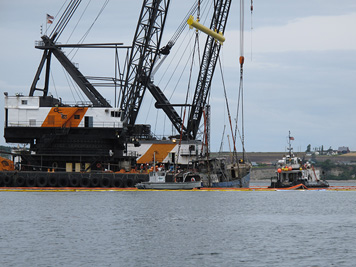
Heavy machinery is brought in to raise a sunken vessel from the sea floor.
In May 2012, the derelict fishing boat Deep Sea caught fire and sank near Washington’s Whidbey Island. The boat ended up leaking diesel fuel into waters near a Penn Cove Shellfish Company mussel farm, and the company took the precautionary measure of stopping the harvest. NOAA worked with them to sample mussels in the area for diesel contamination. Here, heavy machinery is brought in to raise the sunken vessel from the sea floor. (NOAA)
Node Weight: 
4

PCBs: Why Are Banned Chemicals Still Hurting the Environment Today?

Short title: 
PCBs: Why Are Banned Chemicals Still Hurting the Environment Today?

From the 1920s until they were banned in 1979, the U.S. produced an estimated 1.5 billion pounds of these industrial chemicals. They were used in a variety of manufacturing processes, particularly for electrical parts, across the country. Wastes containing PCBs were often improperly stored or disposed of or even directly discharged into soils, rivers, wetlands, and the ocean. Unfortunately, the legacy of PCBs for humans, birds, fish, wildlife, and habitat has been a lasting one. As NOAA's National Ocean Service notes:

Even with discontinued use, PCBs, or polychlorinated biphenyls, are still present in the environment today because they do not breakdown quickly. The amount of time that it takes chemicals such as PCBs to breakdown naturally depends on their size, structure, and chemical composition. It can take years to remove these chemicals from the environment and that is why they are still present decades after they have been banned.

PCBs are hazardous even at very low levels. When fish and wildlife are exposed to them, this group of highly toxic compounds can travel up the food chain, eventually accumulating in their tissues, becoming a threat to human health if eaten. What happens after animals are exposed to PCBs? According to a NOAA, U.S. Fish and Wildlife Service, and State of New York report [PDF], PCBs are known to cause:

  • Cancer
  • Birth defects
  • Reproductive dysfunction
  • Growth impairment
  • Behavioral changes
  • Hormonal imbalances
  • Damage to the developing brain
  • Increased susceptibility to disease

Because of these impacts, NOAA’s Damage Assessment, Remediation, and Restoration Program (DARRP) works on a number of damage assessment cases to restore the environmental injuries of PCBs. Some notable examples include:

Yet the list could go on—fish and birds off the southern California coast, fish and waterfowl in Wisconsin's Sheboygan River, a harbor in Massachusetts with the "highest concentrations of PCBs ever documented in a marine environment." These and other chemical pollutants remain a challenge but also a lesson for taking care of the resources we have now. While PCBs will continue to be a threat to human and environmental health, NOAA and our partners are working hard to restore the damage done and protect people and nature from future impacts.

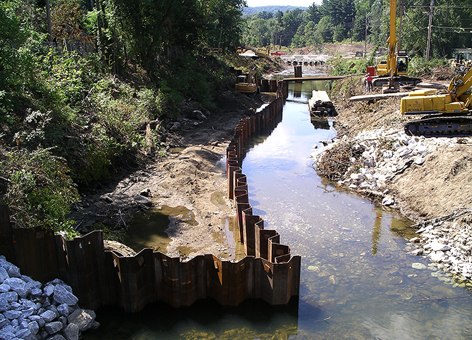
Heavy machinery removes soil and rocks in a polluted stream.
PCB contamination is high in the Housatonic River and New Bedford Harbor in Massachusetts. How high? The "highest concentrations of PCBs ever documented in a marine environment." (U.S. Fish and Wildlife Service)
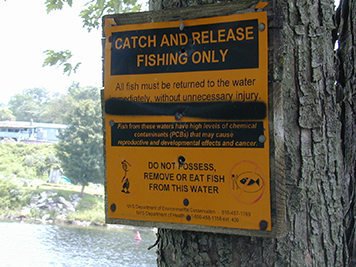
Sign by Hudson River warning against eating contaminated fish.
According to a NOAA, U.S. Fish and Wildlife Service, and State of New York report on the Hudson River, "New York State's 'eat none' advisory and the restriction on taking fish for this section of the Upper Hudson has been in place for 36 years." (NOAA)
Node Weight: 
3

As New Risks Emerge in Producing and Transporting Oil, University of Washington Helps NOAA Plan for Spills

Short title: 
As New Risks Emerge in Producing and Transporting Oil, University of Washington Helps NOAA Plan for Spills

Fracking

The main drivers of change for spill risks are the changes in the production of crude oil and natural gas. By far, the largest change in the market is the proliferation of hydraulic fracturing or "fracking," which involves forcing fluids under great pressure through production wells to "fracture" rock formations to allow more crude oil or natural gas to be released. This controversial drilling technique has seen rapid and abundant growth in North America.

Fracking and other new technologies have resulted in a change in the types of petroleum products being transported in the U.S. It has changed where the products are originating, the quantities involved, and the methods of transportation.

LNG

Liquefied Natural Gas (LNG) is natural gas that has been cooled to -260° Fahrenheit and liquefied for ease of transport. Its production has substantially increased in recent years. This is a result of the lower prices for natural gas that are caused by the immense supply, which is in turn due to increased production from fracking. Because there is so much LNG available at lower prices, two major changes in natural gas transportation have occurred.

First, due to the immense volume of available LNG (and the lack of export bans), the U.S. has started to export more LNG than in the past. The biggest recent change in LNG transport is the more widespread adoption of the LNG tanker. These tankers are just what the name implies: tanker ships storing large quantities of refrigerated LNG. These massive LNG tankers create a myriad of new challenges due to the nature of LNG (it is highly flammable) and the locations of shipping ports, which need to be large enough and properly equipped to load them.

Second, LNG is gaining popularity as a fuel for ships. Many of the new ships shipping companies are purchasing are built to run on LNG as well as traditional bunker fuel. Additionally, a number of existing ships are being retrofitted to run on LNG in certain conditions. As a result, fueling stations at the ports that service these large ships have to add a new fuel type that must be transported to the port and stored before fueling ships. This also further complicates port safety by adding more fueling processes that must be supported at in-port fueling stations.

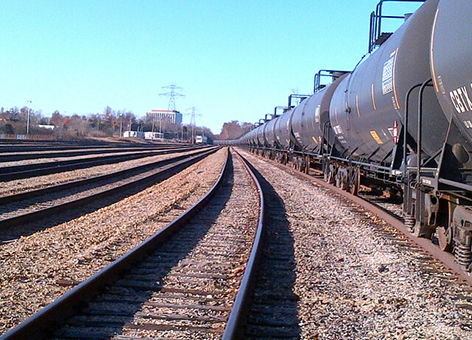
Oil tank cars with railroad tracks.
According to the Association of American Railroads, in 2008 U.S. railroads moved 9,500 train cars of crude oil, while in 2012, U.S. trains moved nearly 234,000 carloads of oil. (U.S. Pipeline and Hazardous Materials Safety Administration)
Trucks and heavy machinery used to drill for natural gas parked in dirt.
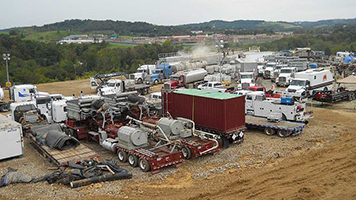
A hydraulic fracturing operation at a Marcellus Shale natural gas well in Pennsylvania. (U.S. Geological Survey)
Node Weight: 
3

45 Years after the Santa Barbara Oil Spill, Looking at a Historic Disaster Through Technology

Short title: 
45 Years after the Santa Barbara Oil Spill, Looking at a Historic Disaster Through Technology

JANUARY 28, 2014 -- Forty-five years ago, on January 28, 1969, bubbles of black oil and gas began rising up out of the blue waters near Santa Barbara, Calif.

On that morning, Union Oil's new drilling rig Platform "A" had experienced a well blowout, and while spill responders were rushing to the scene of what would become a monumental oil spill and catalyzing moment in the environmental movement, the tools and technology available for dealing with this spill were quite different than today.

The groundwork was still being laid for the digital, scientific mapping and data management tools we now employ without second thought.

In 1969, many of the advances in this developing field were coming out of U.S. intelligence and military efforts during the Cold War, including a top-secret satellite reconnaissance project known as CORONA.

A decade later NOAA's first oil spill modeling software, the On-Scene Spill Model (OSSM) [PDF], was being written on the fly during the IXTOC I well blowout in the Gulf of Mexico in 1979. Geographic Information Systems (GIS) software didn’t begin to take root in university settings until the mid-1980s.

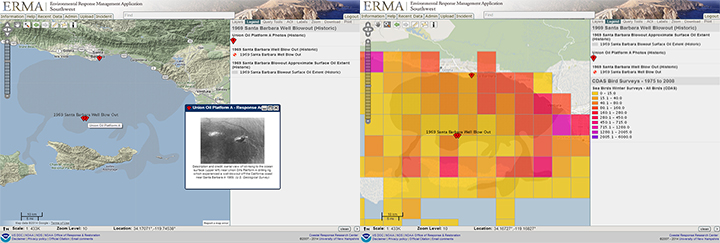
To show just how far this technology has come in the past 45 years, we've mapped the Santa Barbara oil spill in Southwest ERMA, NOAA's online environmental response mapping tool for coastal California. In this GIS tool, you can see:

  • The very approximate extent of the oiling.
  • The location and photos of the drilling platform and affected resources (e.g., Santa Barbara Harbor).
  • The areas where seabirds historically congregate. Seabirds, particularly gulls and grebes, were especially hard hit by this oil spill, with nearly 3,700 birds confirmed dead and many more likely unaccounted for.

Even though the well would be capped after 11 days, a series of undersea faults opened up as a result of the blowout, continuing to release oil and gas until December 1969. As much as 4.2 million gallons of crude oil eventually gushed from both the well and the resulting faults. Oil from Platform "A" was found as far north as Pismo Beach and as far south as Mexico.

Screen shots of two maps of the coast showing where a drilling platform and oil slick are located along with different colors indicating where sea birds live.
Left, a view of Santa Barbara Channel with the location and a historical photo of Platform “A” during the 1969 well blowout, as well as a very rough approximation of the extent of the oil spill, as viewed in NOAA’s online mapping tool, ERMA. Right, the extent of the oiling overlaid with different colors showing the abundance of seabirds during surveys from 1975-2008. (NOAA)

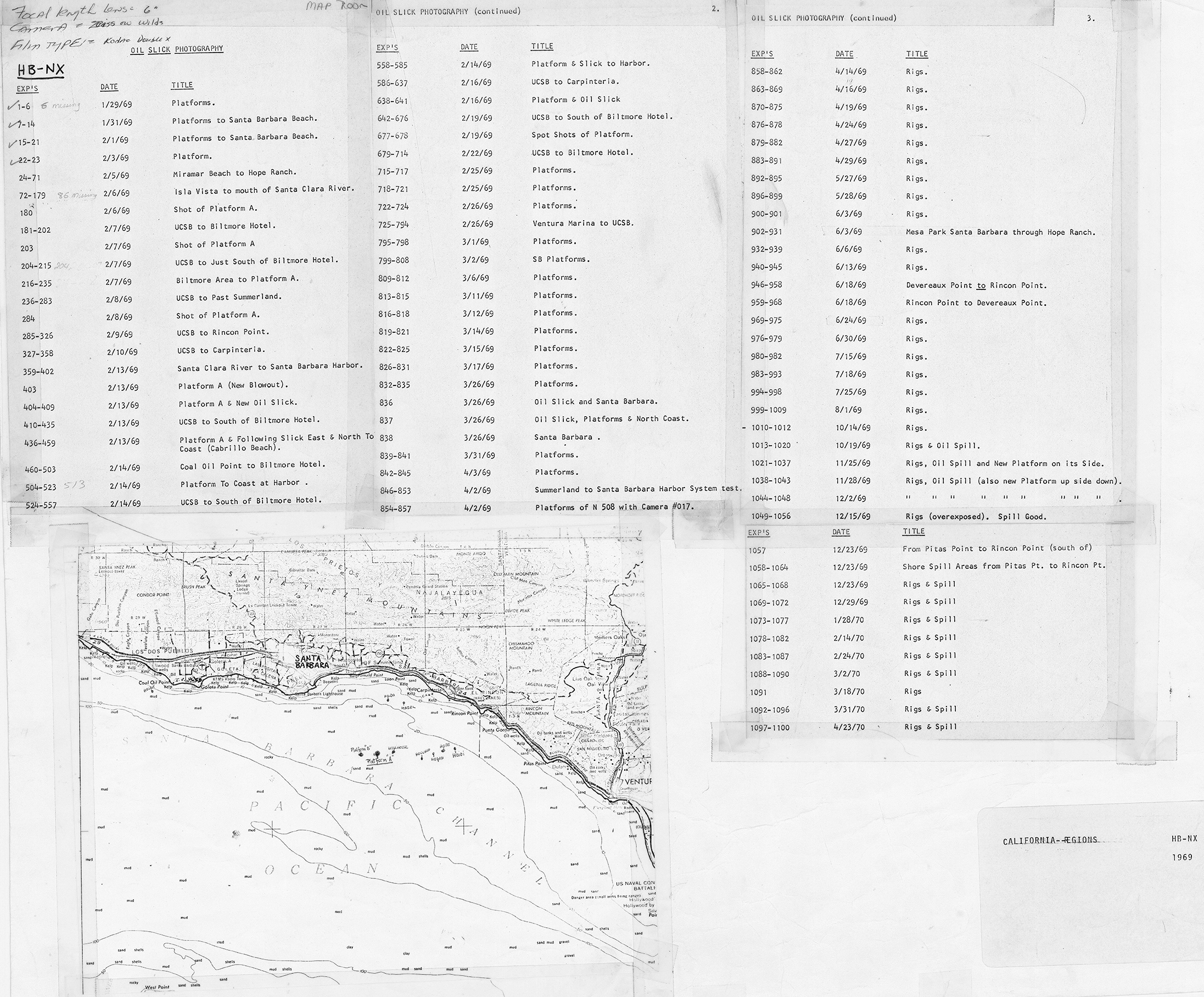

Nowadays, we can map the precise location of a wide variety of data using a tool like ERMA, including photos from aerial surveys of oil slicks along the flight path in which they were collected. The closest responders could come to this in 1969 was this list of aerial photos of oil and a printed chart with handwritten notes on the location of drilling platforms in Santa Barbara Channel.

A list of historical overflight photos of the California coast and accompanying map of the oil platforms in the area of the Platform
A list of historical overflight photos of the California coast and accompanying map of the oil platforms in the area of the Platform “A” well blowout in early 1969. (Courtesy of the University of California Santa Barbara Map and Image Library) Click to view larger.
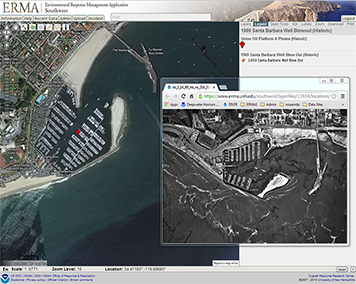
A screenshot showing Santa Barbara Harbor today using NOAA's online mapping tool, ERMA, along with a historical photo of the harbor during the 1969 Platform A well blowout.
A view of Santa Barbara Harbor today using NOAA's online mapping tool, ERMA, along with a historical photo of the harbor during the 1969 Platform "A" well blowout. (NOAA)

Yet, this oil spill was notable for its technology use in one surprising way. It was the first time a CIA spy plane had ever been used for non-defense related aerial photography. While classified information at the time, the CIA and the U.S. Geological Survey were actually partnering to use a Cold War spy plane to take aerial photos of the Santa Barbara spill (they used a U-2 plane because they could get the images more quickly than from the passing CORONA spy satellite). But that information wasn't declassified until the 1990s.

While one of the largest environmental disasters in U.S. waters, the legacy of the Santa Barbara oil spill is lasting and impressive and includes the creation of the National Environmental Policy Act, U.S. Environmental Protection Agency, and National Marine Sanctuaries system (which soon encompassed California’s nearby Channel Islands, which were affected by the Santa Barbara spill).

Another legacy is the pioneering work begun by long-time spill responder, Alan A. Allen, who started his career at the 1969 Santa Barbara oil spill. He became known as the scientist who disputed Union Oil's initial spill volume estimates by employing methods still used today by NOAA. Author Robert Easton documents Allen's efforts in the book, Black tide: the Santa Barbara oil spill and its consequences:

Others ... were questioning Union’s estimates. At General Research Corporation, a Santa Barbara firm, a young scientist who flew over the slick daily, Alan A. Allen, had become convinced that Union’s estimates of the escaping oil were about ten times too low. Allen’s estimates of oil-film thickness were based largely on the appearance of the slick from the air. Oil that had the characteristic dark color of crude oil was, he felt confident from studying records of other slicks, on the order of one thousandth of an inch or greater in thickness. Thinner oil would take on a dull gray or brown appearance, becoming iridescent around one hundred thousandth of an inch. Allen analyzed the slick in terms of thickness, area, and rate of growth. By comparing his data with previous slicks of known spillage, and considering the many factors that control the ultimate fate of oil on seawater, he estimated that leakage during the first days of the Santa Barbara spill could be conservatively estimated to be at least 5,000 barrels (210,000 gallons) per day.

And in a lesson that history repeats itself: Platform "A" leaked 1,130 gallons of crude oil into Santa Barbara Channel in 2008. Our office modeled the path of the oil slicks that resulted. Learn more about how NOAA responds to oil spills today.

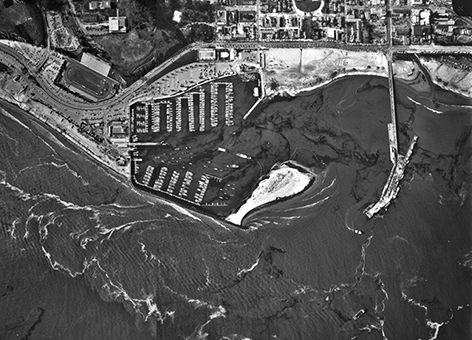
Aerial view of boats in a harbor with oil floating on the ocean.
An aerial view of Santa Barbara Harbor coated with the advancing oil slick from Union Oil’s Platform “A.” February 14, 1969. (University of California Santa Barbara Map and Image Library)
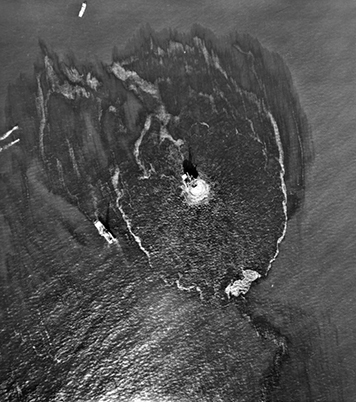
Aerial view of oil platform and response ships, surrounded by oil slicks.
Union Oil’s Platform “A” surrounded by oil on February 14, 1969. On February 7, the well was capped with 13,000 barrels of heavy drilling mud but fissures in the sea bottom continued to leak oil and gas for nearly a year after. (University of California Santa Barbara Map and Image Library)
Node Weight: 
3

A Tale of Two Shipwrecks: When History Threatens to Pollute

Short title: 
A Tale of Two Shipwrecks: When History Threatens to Pollute

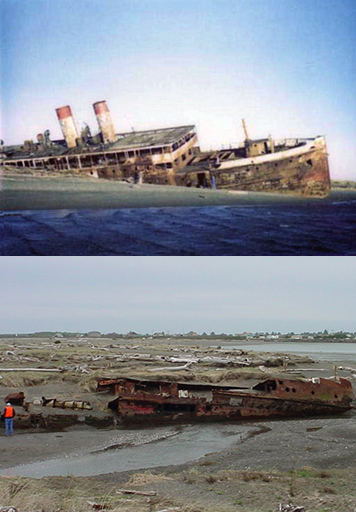
JANUARY 22, 2014 -- Last year we wrote about NOAA's work in identifying potentially polluting shipwrecks in U.S. waters. One of the wrecks that we've been watching with interest has been the wreck of the Brigadier General M.G. Zalinski, a World War II U.S. Army transport ship that ran aground and sank in 1946 near Prince Rupert, Canada. For the past decade the vessel has been the source of chronic oil spills in British Columbia's Inside Passage, and patches to the hull were only a temporary solution. Response operations were just completed in late December 2013, and the Canadian government reported that two-month-long operations safely extracted approximately 44,000 liters (about 12,000 gallons) of heavy Bunker C oil and 319,000 liters (84,000 gallons) of oily water from the wreck. More information on the project is on Canada's Department of Fisheries and Oceans website. Every shipwreck has its own story to tell. One of the interesting bits of trivia about the Zalinski is that the crew of the sinking ship back in 1946 was rescued by the Steam Ship Catala. The Zalinski, lying in Canadian waters, is not in our database of potentially polluting shipwrecks, but the S.S. Catala is, or should we say, was. The Catala met its end in 1965 when the ship grounded during a storm and was abandoned on a beach on the outer coast of Washington state. Over time the vessel was buried in sand, but 40 years later, winds and tides had changed the face of the beach, re-exposing the Catala's rusted-out, oil-laden hull.

A wrecked and rusted ship on a beach in 1976 and later in 2006.
Top, wreck of the S.S. Catala as viewed in 1976 (Levriere52/Creative Commons Attribution-Share Alike 3.0 Unported license) and, bottom, in 2006, looking west toward Ocean Shores, Wa. (Washington State Department of Ecology).

In 2007, the State of Washington led a multi-agency effort to remove not only the 34,500 gallons of oil still on board but also the ship's wreckage and the potential for a major oil spill near a number of state parks and national wildlife refuges on the coast. Learn more about how NOAA worked with the U.S. Coast Guard and Regional Response Teams to prioritize potential threats to coastal resources from the nation's legacy of sunken ships. Photos: Washington State Department of Ecology, Copyright and Levriere52, Creative Commons Attribution-Share Alike 3.0 Unported license.

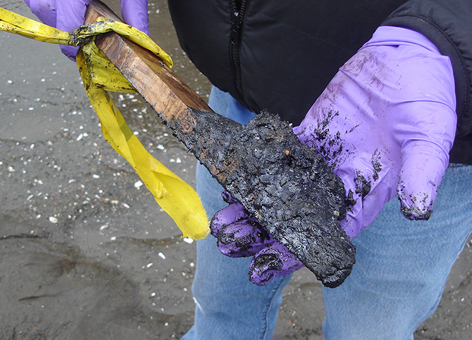
Person holding a piece of wood with oily sludge on it.
Oil-contaminated sludge found within the hull of the S.S. Catala. (Washington State Department of Ecology)
Several men work to pump oil onto a barge on the ocean.
During November 2013, the Canadian Coast Guard (Western Region) worked with Mammoet Salvage to remove the oil remaining on board the wreck of the Brigadier General M.G. Zalinski. The Zalinski sank off the North Coast of British Columbia, Canada, and its wreck remains upside down on top of an underwater cliff. (Daniel Porter, Mammoet Salvage)
Node Weight: 
4

When the North Cape Ran Aground off Rhode Island, an Unexpected Career Took Off

Short title: 
When the North Cape Ran Aground off Rhode Island, an Unexpected Career Took Off

JANUARY 17, 2014 — January 19, 1996 was a Friday. At the time, Kate Wheelock—now Chief of the Disaster Preparedness Program within NOAA's Office of Response and Restoration—was a senior at the University of Rhode Island, pursuing an ocean engineering degree.

She had no idea what she would do with it once she got it, but she loved the ocean, she had a tuition waiver since her dad taught there, and they had a well-known engineering program. She was living with roommates "down the line" in the fishing village of Point Judith in Narragansett, R.I.

When she and her friends returned home from a night out, it was the usual weather she was accustomed to during a coastal Rhode Island winter storm: foggy, rainy, and windy. But what Clark was not accustomed to was the nauseating smell of gasoline in the air and the helicopter traffic overhead.

Nudist Beach to Oiled Wreck

Clark woke on January 20 to the news that a ship had run aground, roughly four miles east on Moonstone Beach in South Kingstown. Being Rhode Island–born and Rhode Island–bred (as the fight song goes), she was all too familiar with Moonstone Beach, so called for the numerous ocean-polished silicate rocks that lined the beach.

This town beach where she grew up was idyllic for families because the shallow, warm salt ponds that sat right behind the thin strip of sandy beach were perfect for young kids. As a child she spent long summer days there combing the beach for shells and jellyfish.

However, other sections of Moonstone Beach were well known throughout the 1970s and 1980s as a popular nudist beach. When public access to Moonstone Beach was closed by the U.S. Fish and Wildlife Service in 1988 to save habitat for endangered least tern and piping plover, it shut down the East Coast's last fully staffed oceanic nudist beach.

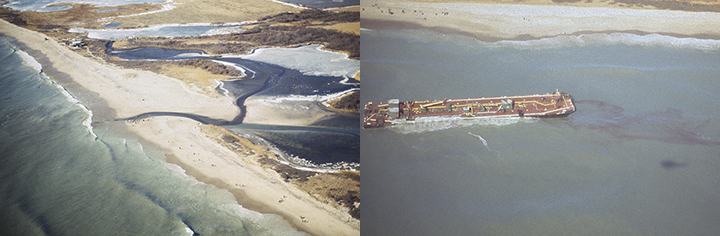
The tank-barge that grounded on Moonstone Beach during that harsh winter storm in 1996 was called the North Cape. Its hull ripped open and spilled 828,000 gallons of home heating oil into the pounding surf. That strong smell of oil in the air around the southern shores of South Kingstown and Narragansett was soon replaced by the stench of rotting crustaceans, shellfish, and starfish that died from the oil and washed up in droves along the beaches of Block Island Sound.
Left, spilled oil flowing from the ocean across a beach into saltwater ponds. Right, Oil leaking out of a barge run aground off of a beach.
Left, oil breaches the salt ponds on Moonstone Beach at Point Judith, R.I. in February 1996. Right, the leaking barge North Cape released oil into Block Island Sound in two separate releases. (NOAA)
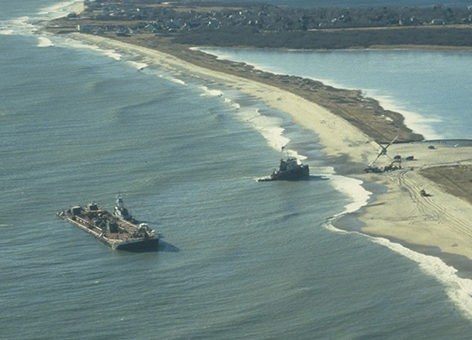
A ship and tug grounded on the shore.
The North Cape (left) and tug Scandia (right) grounded on Moonstone Beach in Rhode Island, January 25, 1996. (NOAA)
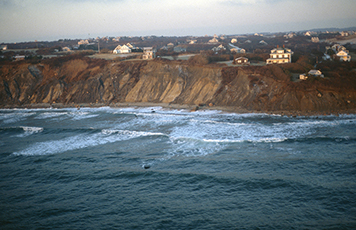
Houses on a cliff overlooking the ocean's pounding surf.
The pounding surf off of Narragansett, R.I. a few days after the North Cape grounding and spill in 1996. (NOAA)
Node Weight: 
2

Protecting the Great Lakes After a Coal Ship Hits Ground in Lake Erie

Short title: 
Protecting the Great Lakes After a Coal Ship Hits Ground in Lake Erie

When Staying Grounded Is a Bad Thing

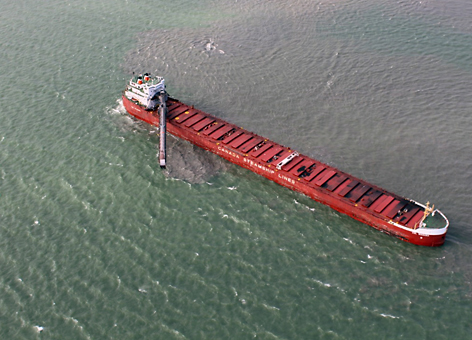
On November 17, just after 10:00 in the morning, the vessel master of the CSL Niagara reported to the U.S. Coast Guard that his ship had run aground while leaving Sandusky Bay through Moseley Channel to Lake Erie. Aboard the ship were 33,000 metric tons (36,376 U.S. tons) of coal, headed to Hamilton, Ontario, and about 193 metric tons of intermediate fuel oil (a blend of gasoil and heavy fuel oil) and marine diesel.

The concern in a situation like this would be that the grounded ship might leak oil. Its stern was stuck in the soft mud at the bottom of Lake Erie. At the time, the vessel master reported there were no injuries, flooding, or visible pollution.

This ship, the CSL Niagara, has a long history of transporting coal in Lake Erie. Launched in April of 1972 for Canada Steamship Lines, Ltd., the new ship was 730 feet long and even then was carrying coal to Hamilton, Ontario. During over 40 years of sailing in the Great Lakes, the Niagara has also carried cargos of grain, coke, stone, and iron ore.

Even though the vessel hadn't released any oil, the Coast Guard Marine Safety Unit, who had responders at the scene very shortly after the accident, put in a call to the Office of Response and Restoration's LCDR Lomnicky for scientific support. As a precaution, they requested that we model the trajectory of oil in a worst case scenario if 145 metric tons of intermediate fuel oil and 48 metric tons of diesel fuel were released all at once into the water. We also provided a prediction of when the lake's lower-than-usual water level would return to normal so a salvage team could refloat the stuck vessel. After gathering all of this information for the Coast Guard, LCDR Lomnicky continued to stand by for further requests.

In the hours that followed the ship's grounding, the winds grew stronger, hampering efforts to free the vessel. The wind was causing the water level in the lake to drop and NOAA's National Weather Service in Detroit predicted a 7.5 foot drop in levels for western Lake Erie. By 8:30 p.m., with 30 knot winds in two-to-three foot seas, the three tugboats contracted by the ship's owner to dislodge the CSL Niagara were making some progress. By midnight, however, with weather conditions worsening, salvage operations were suspended and scheduled to resume at first light.

But the next morning, November 18, the water level had dropped another two feet, and the three tugs still had had no luck freeing the stern of the Niagara from the lake bottom. The ship’s owner was now working on plans for lightering (removing the fuel) and containing any potentially spilled oil. Fortunately, there were still no reports of damage to the vessel or oil discharged into the water. The ship was just stuck.

By 4:00 that afternoon the water conditions had improved and another attempt to free the vessel was planned. Also, a combined tug-barge was en route should lightering become necessary.

Later that evening, shortly after 10:00, the ship was pulled free by two of the tugs and was back on its way early the next morning.

NOAA GIS map image of the grounding location of CSL Niagara.
The location where the CSL Niagara grounded in Lake Erie is indicated with a red diamond, along with a window of information and photo of the grounded ship. It is mapped in Great Lakes ERMA, NOAA's online mapping tool for coastal pollution cleanup, restoration, and response. (NOAA)

Keeping the Great Lakes Great

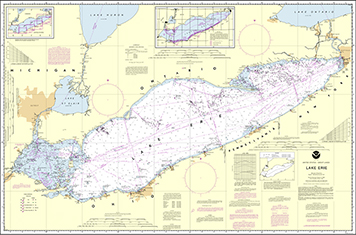
Lake Erie is the shallowest of the five Great Lakes, with an average depth of 62 feet. Yet its western basin, where this ship grounding occurred, has an average depth of only 24 feet. The lake is an important source of commerce for both the U.S and Canada, who depend on it for shipping, fishing, and hydroelectric power. These industries place environmental pressure on the lake’s ecosystems, which are also threatened by urban and agricultural runoff.

Happily, quick responders, sound information, and a break in the weather may have prevented this incident from becoming something much worse. A spill into Lake Erie could be devastating, especially considering its shallow waters, but this time, like many other times along the nation's coasts, an oil spill was avoided.

Didn't know that NOAA works in the Great Lakes? Nicknamed "the third coast," the Great Lakes are a major U.S. water body, with a shoreline that stretches longer than the East Coast and Gulf Coast combined. Learn more about the Great Lakes and NOAA's efforts there in this Great Lakes regional snapshot.

The coal ship CSL Niagara got stuck in Lake Erie's soft, muddy bottom.
The coal ship CSL Niagara got stuck in Lake Erie's soft, muddy bottom at the entrance to Sandusky Bay in November 2013. (U.S. Coast Guard)
NOAA chart of Lake Erie.
Lake Erie has an average depth of 62 feet, but its western basin, where the CSL Niagara grounded, averages only 24 feet deep. (NOAA Chart)
Node Weight: 
2

As North American Oil Production Explodes, So Do Oil Trains

Short title: 
As North American Oil Production Explodes, So Do Oil Trains

JANUARY 10, 2014 -- December 30, 2013 turned out to be an explosive day. On that date, a train hauling grain near Casselton, N.D., derailed into the path of an oncoming crude oil train, resulting in several oil tank cars exploding.

Fortunately, the burning tank cars caused no injuries, but local residents were evacuated as a precaution.

The North Dakota accident is one of a number of high-profile rail accidents in North America over the past year, which included the July 2013 accident in Quebec, Canada, that killed 47 people.

Earlier this week, on January 8, another train accident occurred, this one in New Brunswick near the Maine border. It resulted in several crude oil and liquefied petroleum gas tank cars catching fire.

The growth in U.S. and Canadian oil production has exceeded pipeline capacity and has resulted in a dramatic increase in oil shipments via rail. According to the Association of American Railroads [PDF], in 2008 U.S. railroads moved "just 9,500 carloads of crude oil. In 2012, they originated nearly 234,000 carloads."

These recent accidents have also raised concerns about the safety of some of these crude oils being transported.

Within days of the North Dakota oil train accident, the U.S. Pipeline and Hazardous Materials Safety Administration issued a warning to emergency responders that "crude oil being transported from the Bakken region may be more flammable than traditional heavy crude oil." The full safety alert can be found online [PDF].

This rise in transporting oil by rail is one way the growth in the domestic oil industry and changing oil transportation patterns can pose new environmental and safety risks. Unit trains carrying oil are becoming a common sight. (A "unit train" is an entire train carrying the same product to the same destination. A crude oil unit train of 100 tanker cars would carry about 60,000 barrels, or about 2.5 million gallons.) Additional rail terminals have been proposed in Washington state and elsewhere to accommodate growing oil production in the Dakotas and eastern Montana, particularly from the Bakken oil fields.

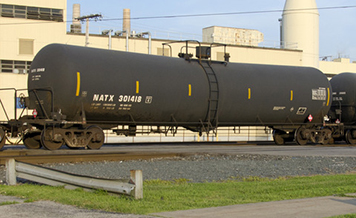
A DOT-111 car, which is currently the type of train car that carries Bakken crude oil.
A DOT-111 car, which is currently the type of train car that carries Bakken crude oil. (U.S. Pipeline and Hazardous Materials Safety Administration)

NOAA and other spill responders are working to understand these emerging risks in order to effectively and safely respond to oil spills. We are currently working with the University of Washington's Program on the Environment on a project to explore these risks from changes in oil and gas production and transportation. Stay tuned for future blog posts about the progress and findings of this project.

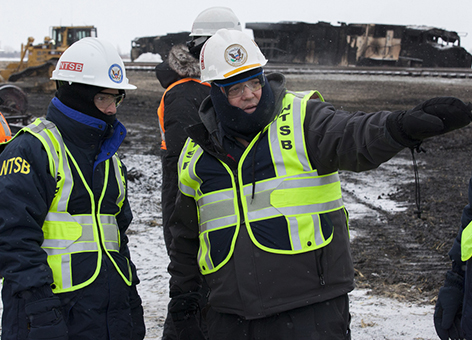
National Transportation Safety Board officials at N.D. train accident scene.
National Transportation Safety Board officials at the scene of the Casselton, N.D., train derailment and explosion on January 1, 2014 in below-zero temperatures. One of the burned-out trains is in the background. (National Transportation Safety Board)
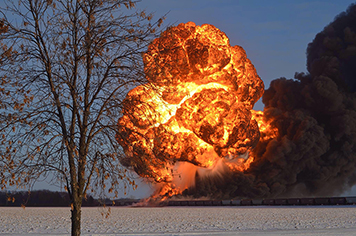
The fireball that followed the derailment and explosion of two trains in N.D.
The fireball that followed the derailment and explosion of two trains, one carrying Bakken crude oil, on December 30, 2013, outside Casselton, N.D. (U.S. Pipeline and Hazardous Materials Safety Administration)
Node Weight: 
3

A Delaware Salt Marsh Finds its way to Restoration by Channeling Success

Short title: 
A Delaware Salt Marsh Finds its way to Restoration by Channeling Success

What Does it Take to Fix a Marsh?

Previously, however, Slough's Gut was on the decline, with many of the plants growing in its salty waters either stunted or dying off. The overriding goal, as with many marsh restoration projects, was to reverse this trend and increase the vegetative cover. But does just revegetating a marsh really restore it? On the other hand, some folks, including a few at NOAA, asked whether Slough's Gut should even be considered for "restoration" since it was already functionally a marsh and ... wasn't the ecosystem working OK? The answer on both accounts was: We were about to find out. Although the cause of the marsh plant die-offs was not entirely clear, Hahn and the other trustees suspected it had to do with changes to the natural water drainage systems associated with:

  1. Historical mosquito ditching.
  2. Sea level rise.
  3. The gradual sinking of the land.
  4. All of the above.

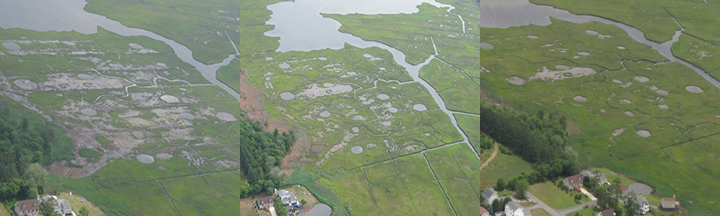
Time sequence of Slough's Gut Marsh from above showing bare patches of open water filling in with healthy marsh grass.

Left to right: Aerial, northeast views of Slough’s Gut Marsh in June 2009 with patches of open water where marsh grass is absent and straight channels, in June 2011 when marsh grass is beginning to fill in, and in June 2013 when healthy marsh grass has returned and some of the reconstructed channels of water follow more natural patterns.

These suspicions were based on monitoring conducted before Slough's Gut was ever slated for restoration. It appeared that water would not drain sufficiently off the marsh during the tidal cycle and this was suppressing the vegetation, in a phenomenon known as "waterlogging." Hahn became involved as they began scoping the restoration project design. At this point, he suggested that although revegetating the marsh was a reasonable goal, the primary emphasis should be on restoring a more natural network of tidal channels, replacing the old mosquito ditches. Around the 1940s, this salt marsh had been dug up and filled in, creating a series of parallel ditches connecting at a straightened main river channel (a now-questionable practice known as "mosquito ditching" because it aimed to reduce mosquito populations). The current configuration of channels that was leading to the loss of vegetation in Slough's Gut was likely also impacting the fish, crabs, and other aquatic life that would normally use the marsh. Looking to a similar project on Washington, DC's Anacostia River, the design team decided on a technique for restoring tidal channels that uses observations from relatively unimpacted marshes. This example helped them answer questions such as:

  • How big should the channels be?
  • What would a natural channel network look like? (e.g., how often would the channels split, how much would they wind)?

Next, Delmarva Power and Light hired the contractor Cardno ENTRIX to develop a restoration design that used the existing channels as much as possible but restored the channel network by creating new channels while plugging and filling others. The Delaware Department of Natural Resources and Environmental Control (DNREC), which has extensive experience working in wetlands, executed the design. Then, they watched and waited.

The End Game

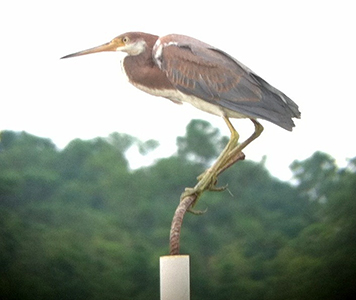
The number of birds observed at Slough's Gut Marsh has doubled since 2008. Here, a heron perches at the site.

Cardno ENTRIX monitored the renovated marsh for five years and collected data on its recovery. In the summer of 2013, the natural resource agencies involved (NOAA, the Delaware DNREC, and the U.S. Fish and Wildlife Service) together with Delmarva Power and Light, Cardno ENTRIX, and the Center for Inland Bays (the project hosts) visited Slough's Gut Marsh to view and discuss its progress. Based on the past five years of data, the marsh is on a path toward successful restoration. There has been a 50 percent increase in the density of fish, shrimp, and crabs living in Slough's Gut, compared with levels before they restored the natural tidal channels. With this extra food, the number of birds observed there has doubled since 2008. Additional environmental sampling showed localized drainage improvements, indicating that the new channel network is stable yet adaptable, as it should be in natural marshes. This feature is particularly beneficial when confronted with issues like sea level rise and hurricanes. Protecting and restoring tidal wetlands is an important effort in adapting to climate change in coastal areas.

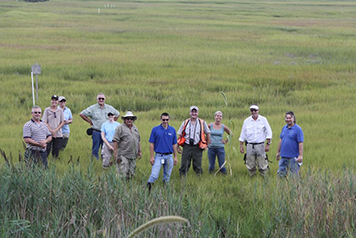
The natural resource trustees celebrate the restoration of Slough’s Gut Marsh in August 2013.
The natural resource trustees celebrate the restoration of Slough’s Gut Marsh in August 2013. Simeon Hahn is at the far right.

This project demonstrates that ecological impacts in tidal marshes from historical ditching and diking can be restored by reconstructing a more natural tidal channel network. Next time you're in the area, go see the success at Slough's Gut yourself and leave time to visit the Center for the Inland Bays to learn more about other great environmental efforts going on in Delaware's inland bays. The center is easily accessible and the view is tremendous.

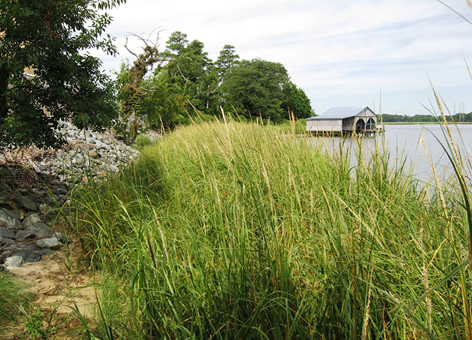
The restored shoreline near the Indian River Power Plant is revegetated.
The restored shoreline near the Indian River Power Plant is now repopulated with healthy marsh grasses.
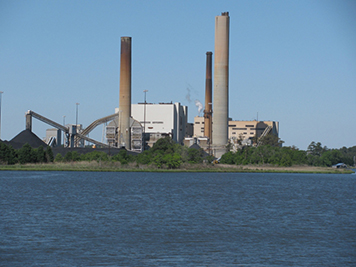
Indian River Power Plant on the edge of Indian River Bay in southern Delaware.
Indian River Power Plant on the edge of Indian River Bay in southern Delaware. (Delaware Department of Natural Resources and Environmental Control)
Node Weight: 
3

As NOAA Damage Assessment Rules Turn 18, Restoration Trumps Arguing Over the Price Tag of a Turtle

Short title: 
As NOAA Damage Assessment Rules Turn 18, Restoration Trumps Arguing Over the Price Tag of a Turtle

JANUARY 6, 2013 -- What is a fish or sea turtle or day of sailing worth? Some resources may be easily valued, such as a pound of lobsters, but other natural resources may not be assigned values as easily, such as injured habitats or non-game wildlife. And what about the value of a lobster in nature rather than in a soup pot? In 1989, under the paradigm in place at the time of the Exxon Valdez oil spill, damage assessments were based on the economic value of natural resources and their uses lost as a result of a spill. Eighteen years ago, on January 6, 1996, NOAA issued its final rules for conducting Natural Resource Damage Assessments (NRDA) for oil spills. The Oil Pollution Act of 1990, prompted by the Exxon Valdez spill, changed many aspects of the U.S. response to oil spills, including the approach to damage assessments. One of the lessons learned from the Exxon Valdez and other incidents was that restoration became delayed when the focus was on arguing over the monetary value of natural resource damages. This was because once government agencies reached a dollar-based settlement with the organization responsible for the spill, we still had to conduct studies to figure out what restoration was really necessary. Furthermore, since the process focused on calculating monetary damages rather than restoration costs, the trustees did not always receive sufficient funds to conduct restoration (the economic value of a fish or acre of wetland may not represent the costs to restore that resource).

NOAA's Doug Helton during the response to the 1993 Tampa Bay oil spill.
NOAA’s Doug Helton during the response to the August 10, 1993 Tampa Bay oil spill. A collision between a freighter and two fuel barges resulted in hundreds of thousands of gallons of oil spilled into the Bay. The damage assessment that evaluated injuries to birds, sea turtles, mangrove habitat, seagrasses, salt marshes, and recreational uses was an early example of a restoration-based claim, and NOAA used this experience in developing the damage assessment rules. A number of ecological and recreational restoration projects were conducted to address or compensate for these injuries.

To reform this issue, the Oil Pollution Act of 1990 required that NOAA promulgate new damage assessment regulations, and Doug Helton was assigned to work with a team of attorneys and scientists to help develop a rule that made sense legally and scientifically. In response to the lessons learned from the Exxon Valdez and other recent oil spills, this team developed a new approach, focusing on the ultimate goal of restoration rather than attempting to establish a price tag for each fish, bird, or marine mammal injured by a spill. In other words, the damage claim submitted to the responsible party is based on the cost to conduct restoration projects for the damages rather than the value of the injured resource. The Oil Pollution Act regulations also turned Natural Resource Damage Assessment into a more open process through three major changes:

  • Making assessment results and critical documents available to the public in an administrative record.
  • Requiring that the public have a chance to review and comment on restoration plans.
  • Inviting the organizations responsible for the spill to actively cooperate in the assessment and restoration planning.

The rulemaking process took several years, and the team had lots of comments from the public, nongovernmental organizations, and the marine insurance, shipping, and oil industries. Finally, after incorporating all of the comments and developing a series of guidance documents, NOAA published the final rule on January 6, 1996. There was little time to relax, however. The first test of those cooperative, restoration-based regulations came a couple weeks later when the Barge North Cape and Tug Scandia ran aground in Rhode Island on January 19. Stay tuned for the story of how that grounding off of a former nudist beach inspired an unexpected career for a young college student.

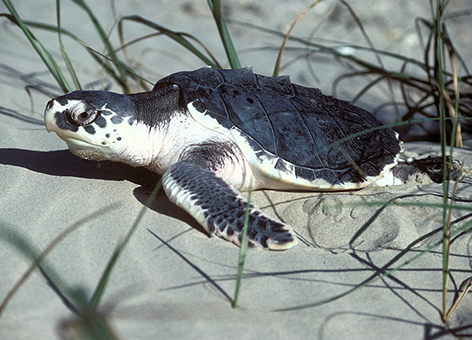
Kemp's Ridley sea turtle on a beach in Texas.
How do you put a price tag on natural resources like this endangered Kemp's Ridley sea turtle? (U.S. Environmental Protection Agency)
Node Weight: 
4

Our Top 10 New Year's Resolutions for 2014

Short title: 
Our Top 10 New Year's Resolutions for 2014

DECEMBER 31, 2013 -- With the end of 2013, many are reflecting on how the past year went. For NOAA's Office of Response and Restoration, we think we handled things pretty well, despite seeing some unusual challenges come our way (e.g., grounded drilling rig, molasses spill, 70 foot stranded dock). After all, being prepared—and preparing others—for the worst is a major focus in our work.

Despite our many accomplishments of the last year, however, we know that we should always be striving to improve how we respond to oil and chemical spills, assess and restore damaged ecosystems, and reduce the threat of marine debris.

So, without further ado, here are our top 10 resolutions for 2014:

  1. Lose "wait." That is, we're increasing our capacity to process damage assessment cases and get dollars for restoration out the door more quickly.
  2. Get more mobile. We're making several of our websites friendlier for mobile devices. In particular, stay tuned to response.restoration.noaa.gov and incidentnews.noaa.gov.
  3. Make more friends. We're now on Facebook and Twitter, so don't be shy about following us for the latest news and updates.
  4. Stay trendy. As trends change in what petroleum products America is importing and exporting, we're working with the University of Washington to explore how this will affect our readiness to respond to the oil spills of tomorrow.
  5. Quit littering. Or rather, get others to quit littering. We're always dreaming up better ways to change people's behavior so that everyone's trash, including plastics, stays out of our oceans.
  6. Get our ducks in a row. When Hurricane Sandy came racing toward the East Coast, it was bringing wind and waves that would literally reshape the shoreline. As a result, we're updating our northeast Environmental Sensitivity Maps to reflect changes caused by the storm and to add information that would enhance the value of these geographic summaries of vulnerable coastal resources when another disaster strikes.
  7. Help others. We're partnering with states impacted by Sandy to assess and remove marine debris from the storm, so that means getting funding out fast to those who need it.
  8. Update our look. This spring, we'll be releasing a major update to our mapping program MARPLOT, which allows emergency responders such as firefighters to create, customize, and download maps for offline use. Users will see very high-quality base (background) maps, including the familiar sight of Google maps.
  9. Listen more. We'll be looking forward to hearing your thoughts on restoration plans and projects around the country, starting with Deepwater Horizon public meetings across the Gulf of Mexico in January.
  10. Release a new GNOME. In 2014, we'll be releasing GNOME 2, our next generation oil spill modeling system. GNOME 2 will offer a Web-based system for forecasting the path of spilled oil in pre-designated locations in the U.S., include better 3-D modeling support, and integrate our oil weathering model, ADIOS.

Thanks for helping us make 2013 a great year. We look forward to even more in 2014!

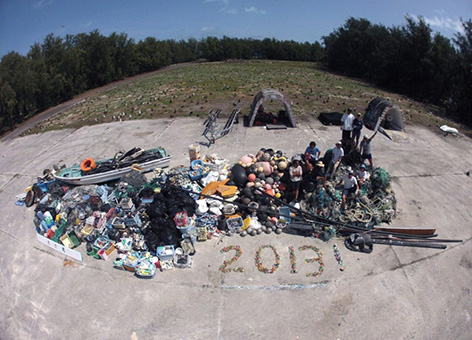
In 2013, a NOAA team collected 14 metric tons of marine debris from Midway Atoll
In 2013, a NOAA team collected 14 metric tons of fishing gear, plastic, and other debris from the shoreline and waters around Hawaii's Midway Atoll. We're looking forward to keeping our coasts clean in 2014 too! (NOAA)
Node Weight: 
2

Study Shows Gulf Dolphins in Poor Health following Deepwater Horizon Oil Spill

Short title: 
Gulf Dolphins Ill after Deepwater Horizon Spill

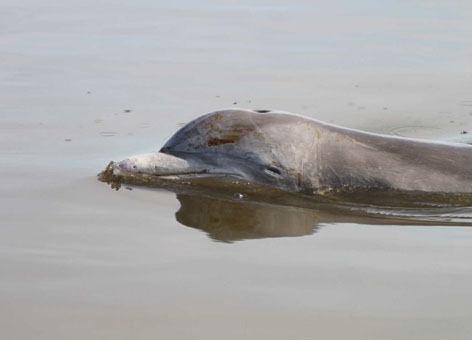
DEC.18, 2013 — Barataria Bay, located in the northern Gulf of Mexico, received heavy and prolonged oiling after the 2010 Deepwater Horizon oil spill. This area is also home to many bottlenose dolphins. In the wake of the spill, how healthy are dolphins living in this area? And how do they compare to dolphins living elsewhere?

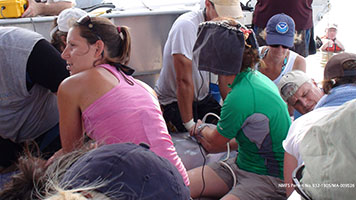
As part of the Natural Resource Damage Assessment for the Deepwater Horizon oil spill, a team of more than 50 government, academic, and non-governmental researchers assessed the health of bottlenose dolphins living in Louisiana's Barataria Bay, which received heavy oiling following the Deepwater Horizon spill, and in Florida's Sarasota Bay, which was not oiled following the spill. The team of scientists and veterinarians temporarily captured live dolphins, performed comprehensive health examinations on them at the site, and then released them. The health exam included measuring each dolphin's length and weight; doing a physical exam; sampling skin, blood, and blubber; and performing an ultrasound to evaluate their internal organs, particularly their lung condition and pregnancy status. The team has published the results of this study in the peer-reviewed journal Environmental Science & Technology. We spoke with two of the NOAA scientists involved, Dr. Lori Schwacke and Dr. Teri Rowles, to learn more about the research and what their findings mean for dolphins in the Gulf of Mexico.

Q: When did you conduct the dolphin health assessments and what did you observe?

The first health assessments were conducted in the summer of 2011 in Barataria Bay, La., and in Sarasota Bay, Fla. We found that the dolphins in Barataria Bay were in very poor health. Many of them were underweight and their blood tests showed a number of abnormal conditions such as anemia, elevated markers of inflammation, and increased liver enzymes. Also, one rather unusual condition that we noted in many of the Barataria Bay dolphins was that they had very low levels of some hormones (specifically, cortisol) that are produced by the adrenal gland and are important for a normal stress response. Under a stressful condition, such as being chased by a predator, the adrenal gland produces cortisol, which then triggers a number of physiological responses including an increased heart rate and increased blood sugar. This gives an animal the energy burst that it needs to respond appropriately. In the Barataria Bay dolphins, cortisol levels were unusually low. The concern is that their adrenal glands were incapable of producing appropriate levels of cortisol, and this could ultimately lead to a number of complications and in some situations even death. We also found significant lung disease. We looked for several different abnormalities based on studies that have been done on captive animals, and what we saw was most consistent with pneumonia. In some of the animals, the lung disease was so severe that we considered it life-threatening for that individual.

Q: How serious were the conditions observed in dolphins from Barataria Bay?

Some of the conditions observed in these dolphins were very serious. Some of the animals had multiple health issues going on, such as lung disease, very high liver enzymes, and indications of chronic inflammation. The veterinarians assigned a prognosis for each animal and nearly half of the Barataria Bay dolphins were given a guarded (uncertain outcome) or worse prognosis. In fact, 17 percent of them were given a poor or grave prognosis, indicating that they weren’t expected to live. In comparison, in Sarasota we had only one guarded prognosis and the rest were in good or fair condition. Sarasota dolphins were much healthier than Barataria Bay dolphins.

Q: Have you been able to follow up on the status of any of the dolphins examined during these assessments? We know one of them died. Y12 was a 16-year-old male that we examined in August 2011. He was underweight and many of his blood parameters were out of the expected range. The veterinary team assigned him a grave prognosis. His carcass was recovered by the Louisiana Department of Wildlife and Fisheries in January of 2012. So we know that he only survived a little over five months after the health assessment was conducted. But often carcasses aren't recovered, and there were other dolphins that we examined that we didn't expect to live for very long.

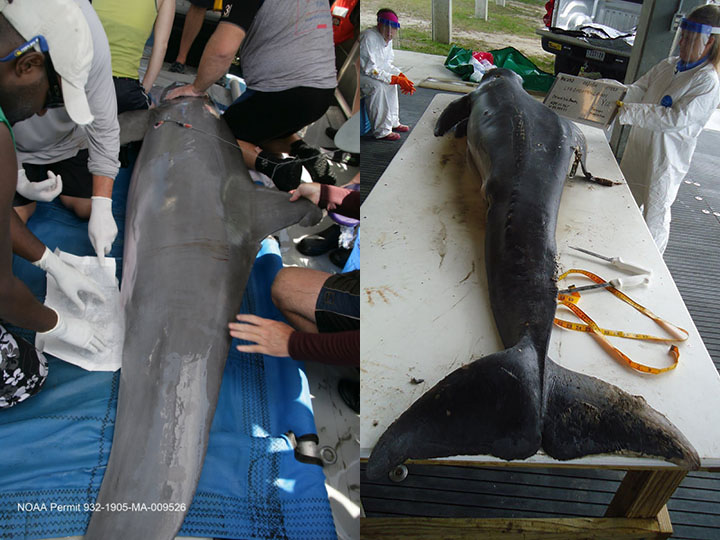
Left, dolphin Y12 during a health assessment in August 2011 and right, after his carcass was recovered in January 2012.
Left, August 2011: Veterinarians collect a urine sample from Y12, a 16-year-old adult male bottlenose dolphin caught near Grand Isle, LA. Y12's health evaluation determined that he was significantly underweight, anemic, and had indications of liver and lung disease. (NOAA) Right, January 2012: The carcass of Y12 was recovered on Grand Isle Beach. The visible ribs, prominent vertebral processes and depressions along the back are signs of extreme emaciation. (Louisiana Department of Wildlife and Fisheries)

We're also conducting photographic monitoring studies to monitor the survival and reproductive success or failure of the dolphins we sampled. Several of the females we sampled in Barataria Bay were pregnant so we’ve been monitoring them around and past their due date to see whether or not we see them with a calf. The gestation period for a dolphin is around 12 months, so these monitoring studies take a little bit longer. We hope to report those results soon.

Q: Are the disease conditions observed in Barataria Bay dolphins—lung disease, compromised stress hormone response—consistent with those expected from exposure to oil? The decreased cortisol response is something fairly unusual but has been reported from experimental studies of mink exposed to fuel oil. The respiratory issues are also consistent with experimental studies in animals and clinical reports of people exposed to petroleum hydrocarbons.

Q: How do you know these health impacts weren’t caused by other lingering pollutants in the Gulf?

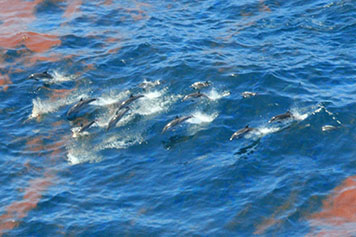
Following the Deepwater Horizon oil spill, numerous dolphins were documented encountering oil.
Following the Deepwater Horizon oil spill, numerous dolphins were documented encountering oil, such as those in this photo from July 2010. (NOAA)

We analyzed the dolphins' blubber to evaluate the levels of contaminants that have been previously reported in marine mammal tissues and then also linked with health effects. This covered a fairly broad suite of contaminants and included polychlorinated biphenyls (PCBs) as well as a suite of persistent pesticides that we know accumulate in dolphins over their lifetime, leaving a record of their exposure. We found that the levels of these pollutants in Barataria Bay dolphins were actually lower than the levels in Sarasota Bay dolphins. The levels from Barataria Bay dolphins were also low compared to previously reported levels in dolphins from a number of other coastal sites in the southeastern U.S. Therefore, we don’t think that the health effects we saw can be attributed to these other pollutants that we looked at.

Q: Are there more dolphin health assessments currently taking place or planned for the future?

Yes, in the summer of 2013 we repeated the studies in Sarasota Bay and Barataria Bay and expanded the studies to Mississippi Sound, where we assessed dolphins both in Mississippi and in Alabama waters. Those samples and data are still being analyzed.

Q: Was there anything about this study that you found surprising?

The magnitude of the health effects that we saw was surprising. We've done these health assessments in a number of locations across the southeast U.S. coast and we've never seen animals that were in this poor of condition.

Q: How does this study relate to or inform the investigation of the high number of marine mammal strandings observed along the Gulf Coast since February 2010 (the Unusual Mortality Event), which pre-dates the Deepwater Horizon oil spill?

The Unusual Mortality Event that’s underway is in the same general geographic area as the Deepwater Horizon oil spill response and overlaps with the Natural Resource Damage Assessment. These findings overlap with the high number of strandings, particularly in the Barataria Bay or central Louisiana area. When you have a significant event like an oil spill or an Unusual Mortality Event, being able to study both live and dead animals provides more information about what might be going on as animals get ill and then die. Having access to findings from both of these studies enables us to look for commonalities between what we’re finding in the sick animals and what we’re finding in the dead animals to better evaluate causes and contributing factors.

Q: Outside of NOAA, who else did you work with to perform the health assessment?

This work was part of the Deepwater Horizon Natural Resource Damage Assessment being conducted cooperatively among NOAA, other federal and state trustees, and BP. This wouldn't have been possible without the help of a number of our partners, including the National Marine Mammal Foundation, Chicago Zoological Society, and Louisiana Department of Wildlife and Fisheries. Also, Seaworld and the Georgia Aquarium provided personnel to support our studies. Their expertise and experience were key to getting these studies done. Watch a video of the researchers as they temporarily catch and give health exams to some of the dolphins in Barataria Bay, La., in August of 2011: Download the video with captions. Download the video without captions.

Dolphin with oil on skin.
A dolphin is observed with oil on its skin on August 5, 2010, in Barataria Bay, La. (Louisiana Department of Wildlife and Fisheries/Mandy Tumlin)
Aug 2011: A veterinarian performs an ultrasound on aBarataria Bay dolphin
Aug 2011: A veterinarian performs an ultrasound to assess a Barataria Bay dolphin's health. (NOAA)
Node Weight: 
3

Marine Debris 2014 Planners Are Now Available

Short title: 
Marine Debris 2014 Planners Are Now Available

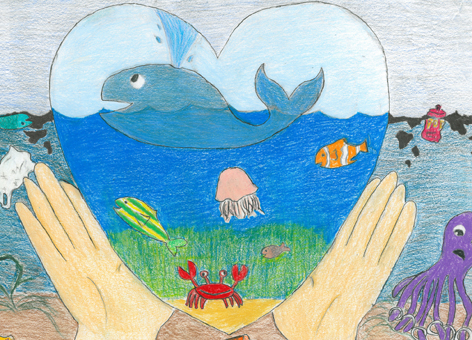
DECEMBER 16, 2013 -- The 2014 Marine Debris planner, featuring winning artwork from the 2013 "Keep the Sea Free of Debris!" art contest, is now available while supplies last. To request a printed planner, send an email to MarineDebris.web@noaa.gov with:

  • Subject line: "2014 Planner request"
  • Your name and preferred mailing address

Please note that supplies are limited and we may not be able to fulfill every request. You may also download a digital copy of the 2014 planner. Learn more at marinedebris.noaa.gov.

The cover of the 2014 Marine Debris Planner.
Node Weight: 
4

A Video Update on California Kelp Restoration from Thank You Ocean

Short title: 
A Video Update on California Kelp Restoration from Thank You Ocean

DECEMBER 10, 2013 -- "Imagine a barren underwater 'desert' turned back into a lush, healthy habitat in mere months!" A recent video podcast produced by the Thank You Ocean Report welcomed NOAA scientist David Witting to discuss a project to restore kelp forests off the coast of southern California. To bring back the decimated kelp forests, volunteer divers, commercial urchin divers, researchers, and local nonprofit groups are removing urchins to keep them from eating every newly settled kelp plant. This is one of the projects aimed at restoring fish habitat in southern California and was funded by the NOAA Montrose Settlements Restoration Program. So, take a few minutes, kick up your feet (or flippers), and enjoy this early success story about NOAA and our partners' efforts to restore the forests of the sea:

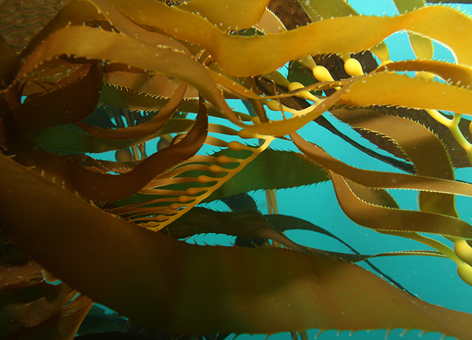
Giant kelp.
The goal of removing the excess urchins is to allow young kelp plants to establish themselves and grow into a diverse, healthy kelp forest. (NOAA Monterey Bay National Marine Sanctuary)
Node Weight: 
1

How Do Oil Spills Affect Coral Reefs?

Short title: 
How Do Oil Spills Affect Coral Reefs?

DECEMBER 6, 2013 -- A warming, more acidic ocean. Grounded ships and heavy fishing nets. Coral reefs face a lot of threats from humans. For these tiny animals that build their own limestone homes underwater, oil spills may add insult to injury.

But how does spilled oil reach coral reefs? And what are the effects?

How an oil spill affects corals depends on the species and maturity of the coral (e.g., early stages of life are very sensitive to oil) as well as the means and level of exposure to oil. Exposing corals to small amounts of oil for an extended period can be just as harmful as large amounts of oil for a brief time.

Coral reefs can come in contact with oil in three major ways:

  1. Oil floating on the water’s surface can be deposited directly on corals in an intertidal zone when the water level drops at low tide.
  2. Rough seas can mix lighter oil products into the water column (like shaking up a bottle of salad dressing), where they can drift down to coral reefs.
  3. As heavy oil weathers or gets mixed with sand or sediment, it can become dense enough to sink below the ocean surface and smother corals below.

Once oil comes into contact with corals, it can kill them or impede their reproduction, growth, behavior, and development. The entire reef ecosystem can suffer from an oil spill, affecting the many species of fish, crabs, and other marine invertebrates that live in and around coral reefs.

As oil spill responders, NOAA's Office of Response and Restoration has to take these and many other factors into account during an oil spill near coral reefs. For example, if the spill resulted from a ship running aground on a reef, we need to consider the environmental impacts of the options for removing the ship. Or, if an oil spill occurred offshore but near coral reefs, we would advise the U.S. Coast Guard and other pollution responders to avoid using chemical dispersants to break up the oil spill because corals can be harmed by dispersed oil.

We also provide reports and information for responders and natural resource managers dealing with oil spills and coral reefs:

You can learn more about coral reefs, such as the basic biology of corals, how damaged coral reefs can recover from an oil spill or be restored after a ship grounding, and what we've learned about oil spills in tropical reefs.

For lessons a little closer to home, be sure to find out five more things you should know about coral reefs and listen to this podcast about threats to coral health from NOAA's National Ocean Service.

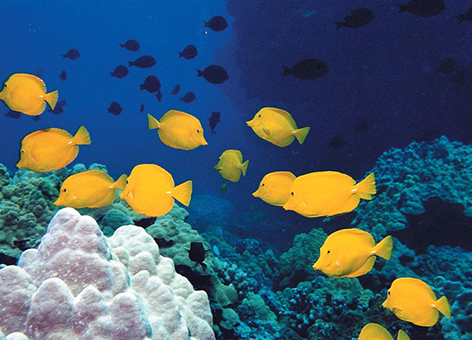
Coral habitat with fish in the Hawaiian Islands.
Coral habitat in the Hawaiian Islands. (NOAA)
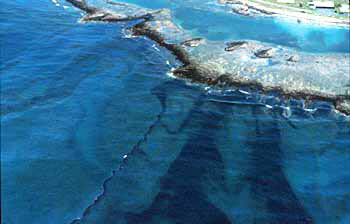
Oil slicks moving onto coral reefs at Galeta after the Bahia las Minas oil spill
Oil slicks moving onto coral reefs at Galeta at low tide after the Bahia las Minas refinery spill, Panama, in April 1986. (NOAA)
Node Weight: 
2

Emergency Restoration Is in a Basketful of Coral

Short title: 
Emergency Restoration Is in a Basketful of Coral
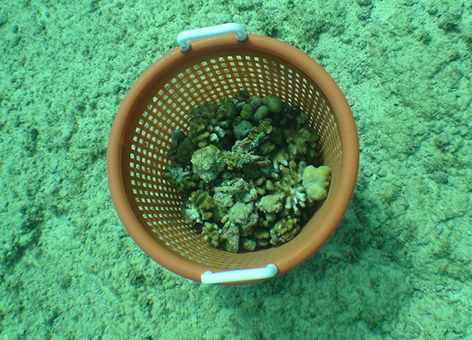
Basket of loose corals collected from the area damaged by the 2010 grounding.
Basket of loose corals collected from the area damaged by the Vogetrader's grounding, where divers are removing rubble. Image credit: NOAA.
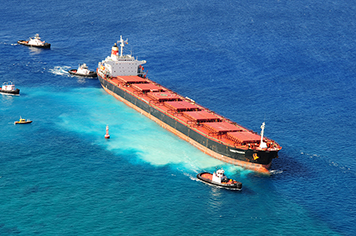
The 734-foot bulk carrier M/V Vogetrader after it ran aground in Hawaii in 2010.
The 734-foot bulk carrier M/V Vogetrader after it ran aground near Oahu, on February 5, 2010. The milky color in the water beneath the ship is the pulverized coral. (U.S. coast Guard)
Node Weight: 
3

Recipes for Disaster: Cleaning up After Food Spills

Short title: 
Recipes for Disaster: Cleaning up After Food Spills

NOVEMBER 26, 2013 -- At a holiday feast like Thanksgiving, something is sure to be spilled: gravy, cranberry sauce, salt, and even more tragically, sometimes oil.

For those of us in NOAA who deal with the effects of spills every day of the year, we'll be grateful if there aren't any major spills of these items, edible or otherwise, this Thanksgiving.

The Beans

During a large storm on December 8, 2004, the cargo ship M/V Selendang Ayu lost power and ran aground just off the coast of Alaska's remote Aleutian Island of Unalaska, approximately 25 miles southwest of Dutch Harbor.

It was in these chilly waters that the ship broke in two and literally spilled the beans—about 60,000 tons of soybeans—along with 337,000 gallons of oil. The beans and most of the oil were washed onto the island's rocky beaches, coating miles of shoreline.

In the aftermath of the spill, NOAA's Office of Response and Restoration helped conduct shoreline surveys before and after cleanup, made cleanup recommendations, and was involved in assessing damage to natural resources and planning restoration. While spill responders labored to remove oil from the beaches, they left the tons of soybeans to rot and disperse naturally.

An unfortunate side effect of this, however, was that the decomposition used up oxygen in the water, similar to what happened when molasses spilled in Hawaii's Honolulu Harbor in September 2013. This caused low oxygen levels and impacts to marine invertebrates such as shellfish in the intertidal zone. The seagulls took care of the invertebrates, but there are few natural predators of soybeans in the surf of the Aleutian Islands. At one point, there was a concern that the soybeans could begin sprouting in the moist conditions, but that was never observed, and they continued decomposing over the next year and a half. (View more photos from the wreck on IncidentNews.)

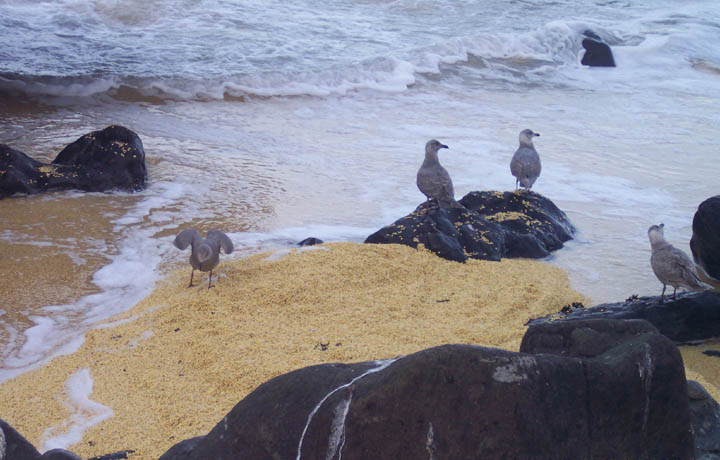
Seagulls peck for food among the soybeans released from the wreck of the Selendang Ayu, Dec. 28, 2004.
Seagulls peck for food among the soybeans released from the wreck of the Selendang Ayu, Dec. 28, 2004. (NOAA)
 
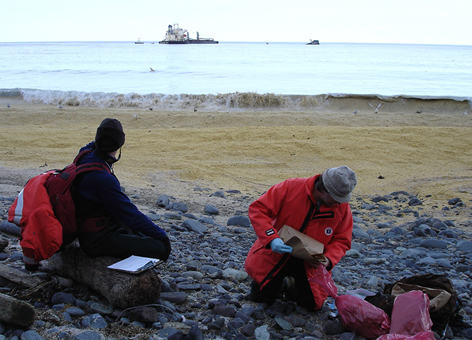
Collecting dead birds on a soybean-covered beach with the Selendang Ayu visible.
Members of the U.S. Fish and Wildlife Service collected bird carcass on January 6, 2005 on a beach littered with soybeans. The wreck of the Selendang Ayu is visible in the background. (Unified Command)
M/V Selendang Ayu broken in two, releasing its fuel and cargo of soybeans.
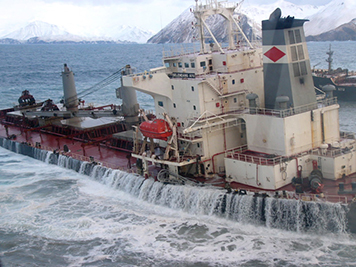
Off the coast of Unalaska Island, the floundering M/V Selendang Ayu broke in two, releasing its fuel and cargo of soybeans. The other half of the ship is visible in the background. (Unified Command)
Node Weight: 
2

In New Jersey, Celebrating a Revived Marsh and the Man who Made it Possible

Short title: 
In New Jersey, Celebrating a Revived Marsh and the Man who Made it Possible
Ernie Oros at the Woodbridge marsh dedication ceremony in 2007
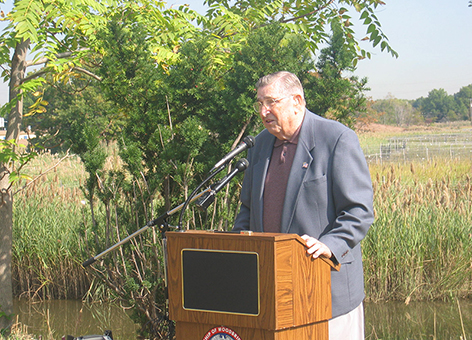
Former State Assemblyman and champion of open space, Ernie Oros at the Woodbridge marsh dedication ceremony on Oct 16, 2007. (New York New Jersey Baykeeper/Greg Remaud)
Tidal creek in Woodbridge Marsh in 2008 and observation deck layout in 2013.
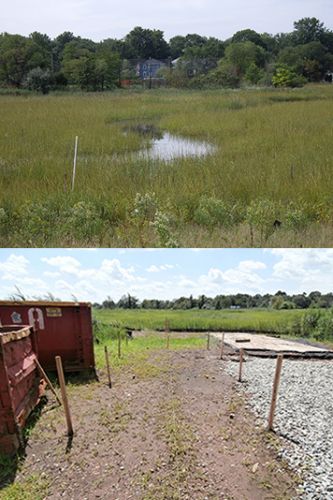
Top: A newly created tidal creek in Woodbridge Marsh in September 2008. Bottom: Layout of the much-anticipated second observation deck at Woodbridge Marsh, as seen in August 2013. (NOAA)
Node Weight: 
4

Let Maps Open up the World Around You on GIS Day

Short title: 
Let Maps Open up the World Around You on GIS Day

GIS is mapping software that can display multiple sets of location-based information onto a single map.

Viewing information this way can help you visualize lots of data and identify trends and relationships, such as the potential health impacts of living near power plants and major highways, or how many pizza places are within 10 miles of your house.

Like offices and agencies around the world, we in NOAA's Office of Response and Restoration use GIS in our everyday work. Take a look at a few of the ways we use GIS—and you can too—to reduce environmental threats from coastal pollution.

    Mapping Environmental Sensitivity

    One of our teams is developing Environmental Sensitivity Index (ESI) maps using GIS technology to integrate and share information about sensitive shoreline resources, such as birds, wildlife, fisheries, and public beaches. Historically used for oil and chemical spill response and planning, these maps have become effective tools in preparing for and responding to storms, hurricanes, and other coastal disasters.

    ESI data are published in a variety of GIS formats, including a file geodatabase and map document, that simplify their use within the GIS program ArcMap. Users can query data for their region to see what species are present in January, where threatened and endangered species live, what shoreline types are present, etc. You can download ESI data and ESI tools from our website and use them yourself.

    Atlantic ERMA view of grounded tanker after Post Tropical Cyclone Sandy.
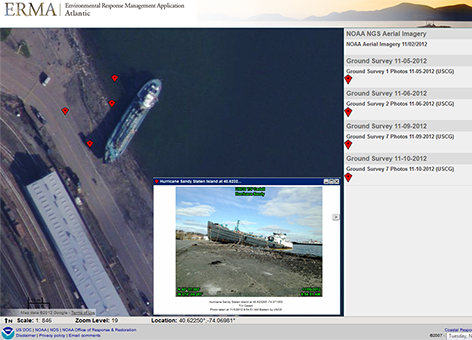
    In our online GIS tool Atlantic ERMA, you can see NOAA National Geodetic Survey aerial photography showing the derelict tanker John B. Caddell grounded on Staten Island, N.Y., following Post Tropical Cyclone Sandy. Red markers show field photos such as the image seen in the pop-up window in Atlantic ERMA. (NOAA)
    GIS Day logo.
    Node Weight: 
    4

    Pages

    Subscribe to response.restoration.noaa.gov RSS